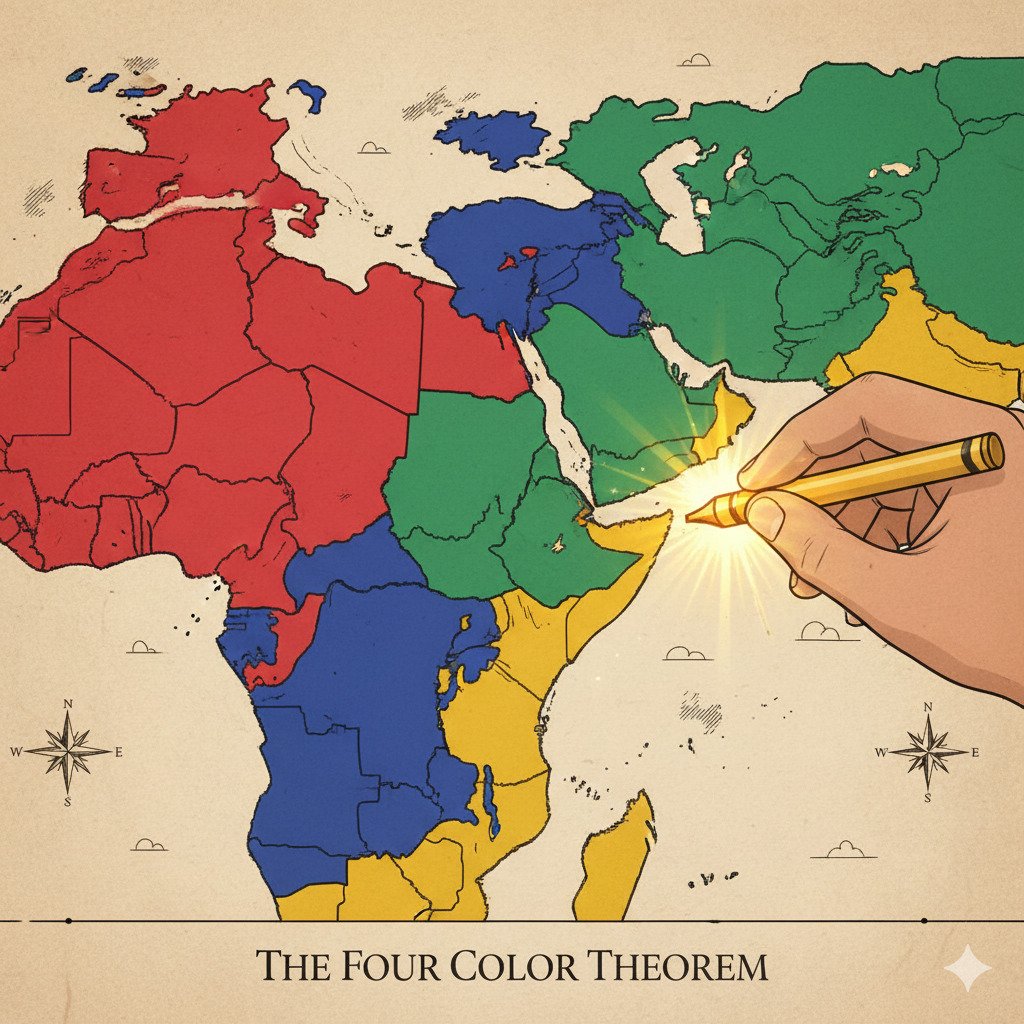
Imagine you’re handed a coloring book with a map of imaginary countries. Your challenge is simple: color the entire map, but with one crucial rule – no two countries that share a common border can have the same color. (Countries that only touch at a single point don’t count as neighbors).
How many different colored crayons do you think you’d need to guarantee you could finish any map, no matter how complex? Five? Six? Ten?
For over a century, this simple-sounding question captivated and stumped some of the world’s brightest minds. The answer, as it turns out, is just four. This is the essence of the Four Color Theorem, one of the most famous problems in mathematics. Welcome to Sequentia, where today we’re exploring the epic journey of this deceptively simple puzzle.
The Birth of a Brain Teaser
The story begins in 1852, when a student named Francis Guthrie was coloring a map of the counties of England. He noticed he only needed four different colors to complete the task and wondered if four colors would suffice for any map. The question seemed so elementary that it was initially dismissed by some as trivial.
They couldn’t have been more wrong. While proving you need at least four colors is easy (just try drawing a map where one country is surrounded by three other mutually-touching countries), proving you’d never need five turned out to be monumentally difficult. The challenge lies in proving it for an infinite number of possible maps.
A Century of False Starts and Frustration
For decades, the problem attracted countless attempts at proof. In 1879, a man named Alfred Kempe published a proof that was celebrated by the mathematical community for over a decade… until a flaw was discovered in 1890. The Four Color Problem was once again unsolved, leaving a trail of frustration and renewed determination.
The breakthrough came from a different angle. Mathematicians realized they didn’t need to check every single map. They could reduce the infinite possibilities down to a finite (but enormous) number of fundamental map configurations. If they could prove that all of these “basic” configurations could be colored with four colors, then the entire theorem would be proven. The problem? The number of these configurations was in the thousands. Checking them all by hand was humanly impossible.
The Computer Steps In: A Controversial Victory
Enter the computer age. In 1976, mathematicians Kenneth Appel and Wolfgang Haken at the University of Illinois finally cornered the problem. They successfully reduced the theorem to 1,936 “unavoidable configurations” and then used a computer to meticulously check each and every one. After more than 1,200 hours of computation, the computer confirmed it: four colors were indeed sufficient.
For the first time in history, a major mathematical theorem had been proven with the indispensable help of a machine. And this sparked a huge debate! How could mathematicians verify a proof that was too long and complex for any single human to check by hand? Was a proof that relied on trusting a computer’s calculations truly a proof at all?
This pioneering work forced the world of mathematics to grapple with new philosophical questions about the nature of proof itself.
The Four Color Theorem is a beautiful testament to human curiosity. It’s a reminder that the simplest questions can lead to the most profound and complex journeys, pushing the boundaries of what we know and how we know it.
So, next time you’re doodling or coloring, grab four different pens and try it out for yourself!
