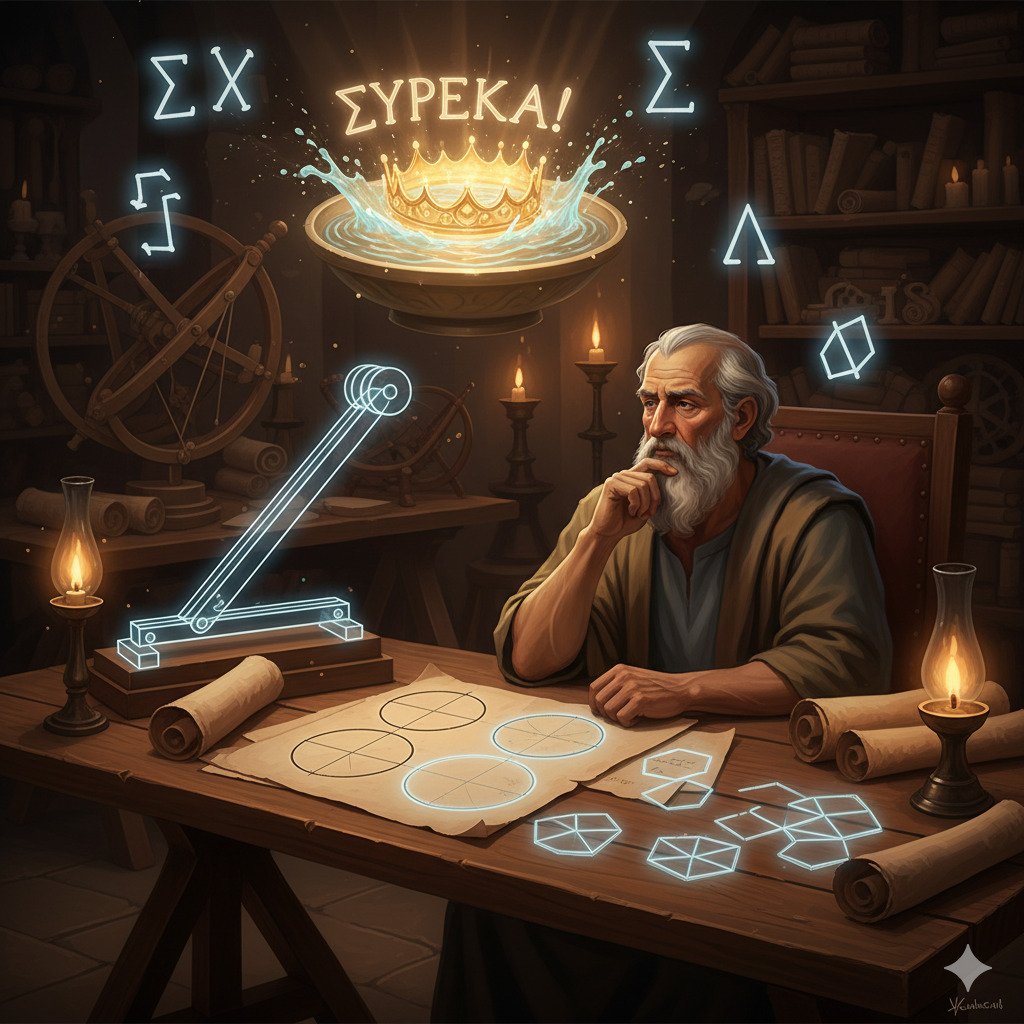
“Eureka!” The cry is legendary, echoing through history from a bathtub in ancient Syracuse. It’s the ultimate “Aha!” moment, famously exclaimed by Archimedes as he discovered a fundamental principle of physics. But Archimedes was more than just a brilliant scientist and inventor; he was, at his core, one of the world’s greatest puzzle solvers. He saw the physical world as a series of grand challenges waiting to be cracked with logic, observation, and cleverness.
Welcome back to Sequentia, where today we celebrate the puzzle-solving mind of the one and only Archimedes!
The Lever: Solving the Puzzle of Impossible Force
Archimedes is famously quoted as saying, “Give me a place to stand, and I shall move the Earth.” This wasn’t just poetic boasting; it was a statement of absolute confidence in a logical principle he had mastered: the law of the lever. He understood that by using a rigid bar and a pivot (a fulcrum), a small force could be multiplied to move an impossibly heavy object.
He didn’t just invent a tool; he solved the puzzle of force itself. He saw the hidden relationship between distance and power and expressed it in a simple, elegant rule. It’s the same kind of thinking we use today when we look for the underlying rule in a complex number sequence.
The Golden Crown: The Ultimate “Aha!” Moment
The “Eureka!” story is a classic detective puzzle. King Hiero II had a new golden crown but suspected the goldsmith had cheated him by mixing in cheaper silver. The challenge: how to determine the crown’s purity without melting it down?
Archimedes was stumped, the problem rolling around in his mind. As we explored in our last post on the psychology of puzzles, the solution often comes when we stop forcing it. Stepping into his bath, he noticed the water level rise and overflow. In that instant, he made the crucial connection: an object displaces a volume of water equal to its own volume!
He realized he could submerge the crown and measure the displaced water. Then, he could do the same with a pure gold block of the same weight. If the crown displaced more water, it meant it was less dense and therefore adulterated with a lighter metal like silver. The puzzle was solved with a flash of brilliant insight, born from observing the world.
The Stomachion: Archimedes the Puzzle Master
Beyond solving the puzzles of the physical world, Archimedes also created them! One of his most fascinating and lesser-known works is the Stomachion (also known as Ostomachion or Loculus Archimedius).
Think of it as an ancient, fiendishly difficult version of a tangram. It’s a dissection puzzle consisting of 14 flat pieces of various shapes, cut from a square. The primary challenge is to arrange these 14 specific pieces to form a perfect square. For centuries, that was thought to be its only purpose. However, modern analysis of a long-lost manuscript revealed the true depth of the puzzle: Archimedes was likely investigating how many different ways the 14 pieces could be arranged to form that square. The answer, discovered by modern mathematicians, is a staggering 17,152!
From the lever to the crown to the Stomachion, Archimedes’ mind saw no boundary between physics, mathematics, and recreational puzzles. It was all one grand exploration of logic, shape, and order.
Which of Archimedes’ “puzzles” fascinates you the most? The practical power of the lever, the brilliant insight of the golden crown, or the complex geometry of the Stomachion? Let us know in the comments!
