Series: The Sequentia Lectures: Unlocking the Math of AI
Part 6: Advanced Architectures & Concepts
Lecture 54: Introducing Transformers: The Architecture Powering ChatGPT
In our last few lectures, we’ve traced an evolution in AI: from simple RNNs that processed data step-by-step, to the introduction of the powerful Attention Mechanism that allowed models to dynamically focus on important parts of an input sequence.
In 2017, researchers at Google published a groundbreaking paper titled “Attention Is All You Need.” They proposed a new architecture that threw away the sequential, looping structure of RNNs entirely and was built exclusively around the concept of attention. This architecture is the Transformer, and it has completely revolutionized the field of Artificial Intelligence.
The Transformer is the foundational technology behind virtually all modern Large Language Models (LLMs), including the famous GPT series (which powers ChatGPT) and BERT.
The Problem with RNNs: One Word at a Time
RNNs, even advanced LSTMs, have an inherent bottleneck: they process information sequentially. To understand the fifth word of a sentence, the model must first process the first, second, third, and fourth words in order. This makes them slow to train on massive datasets and, despite improvements, they can still struggle to connect words that are very far apart in a long text.
The Transformer’s Breakthrough: Parallel Processing with Self-Attention
The Transformer architecture breaks this sequential chain. It processes all the words in a sentence at the same time (in parallel).
How does it understand context and word order if it’s not going step-by-step? It uses a powerful variant of the attention mechanism called Self-Attention.
Self-Attention: Every Word Looks at Every Other Word
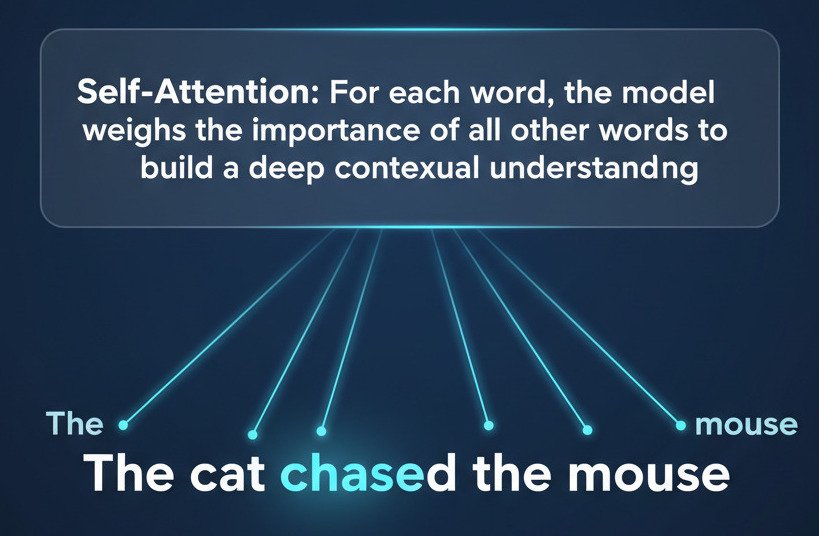
Self-Attention is a mechanism that allows the model, for each word in the input sentence, to look at every other word in that same sentence and calculate an “attention score” to determine how relevant each of them is to understanding the current word.
Imagine the sentence: “The cat sat on the mat and it was asleep.”
When the model is processing the word “it,” a self-attention mechanism would allow it to:
- Pay high attention to the word “cat,” correctly identifying that “it” refers to the cat.
- Pay less attention to words like “sat” or “mat,” which are less relevant to understanding the pronoun.
The model does this for every single word simultaneously. Each word generates a Query, Key, and Value vector (as we discussed in the last lecture). Each word’s Query is compared against every other word’s Key to generate a full matrix of attention scores, showing the relationships between all pairs of words in the sentence.
This allows the model to build a rich, contextual understanding of the entire sentence at once, capturing complex grammatical dependencies and long-range connections far more effectively than an RNN could.
Key Components of the Transformer Architecture
While the full architecture is complex, it’s built on a few key ideas:
- Positional Encodings: Since the model doesn’t process words in order, how does it know the word order? Before the input embeddings are fed into the model, a special “positional encoding” vector is added to each word’s embedding. This vector gives the model a mathematical signal about the position of each word in the sequence (e.g., this is the 1st word, this is the 2nd, etc.).
- Multi-Head Attention: Instead of just calculating self-attention once, the Transformer does it multiple times in parallel in different “heads.” Each “head” can learn to focus on different kinds of relationships (e.g., one head might learn to track subject-verb relationships, another might track pronoun references). The results are then combined.
- Encoder-Decoder Structure: The original Transformer was designed for machine translation and had two main parts: an Encoder that reads and understands the source sentence (e.g., in French) using self-attention, and a Decoder that generates the target sentence (e.g., in English), paying attention to both the source sentence and the words it has already generated.
The Impact: A Paradigm Shift
The Transformer’s parallel nature and its powerful self-attention mechanism were a massive breakthrough.
- Scalability: Because it could process all words at once, it could be trained on vastly larger datasets and hardware (like GPUs) than RNNs. This scalability is what enabled the creation of massive models like GPT-3 and beyond.
- Performance: Transformers shattered performance records on nearly every Natural Language Processing task, from translation to summarization to question-answering.
- Beyond NLP: The architecture has proven so effective that it is now being successfully applied to other domains, including computer vision (Vision Transformers) and biology.
The Transformer architecture represents a true paradigm shift in AI. By replacing the sequential loop with parallelized self-attention, it provided a more powerful, scalable, and effective way for models to understand the complex and contextual relationships that define our world.
