Series: The Sequentia Lectures: Unlocking the Math of AI
Part 6: Advanced Architectures & Concepts
Lecture 53: The Attention Mechanism: How AI Learns to “Focus” on What’s Important
In our lectures on RNNs and LSTMs, we learned how models can process sequential data by maintaining a “memory” or hidden state. This state is a compressed summary of all the information seen so far. But this creates a bottleneck. To predict the next word in a long paragraph, the model has to cram the entire meaning of the preceding text into a single, fixed-size vector. This is like asking a human translator to read an entire paragraph, close their eyes, and then translate it from memory. It’s incredibly difficult.
A human translator doesn’t do that. When translating a sentence, they might focus on the current word’s context, but their “attention” can jump back to the subject of the sentence from several words ago to ensure grammatical agreement.
What if we could give our AI models this same ability to dynamically “focus” on the most relevant parts of the input? This is the groundbreaking idea behind the Attention Mechanism.
The Core Idea: A Weighted Focus
The Attention mechanism is a technique that allows a neural network, at each step of its output, to look back at the entire input sequence and assign an “attention score” to each input element. It then creates a context vector, which is a weighted sum of all the input elements, where the weights are determined by these attention scores.
In simple terms: Attention allows the model to decide which inputs are most important and pay more attention to them.
An Intuitive Example: Machine Translation
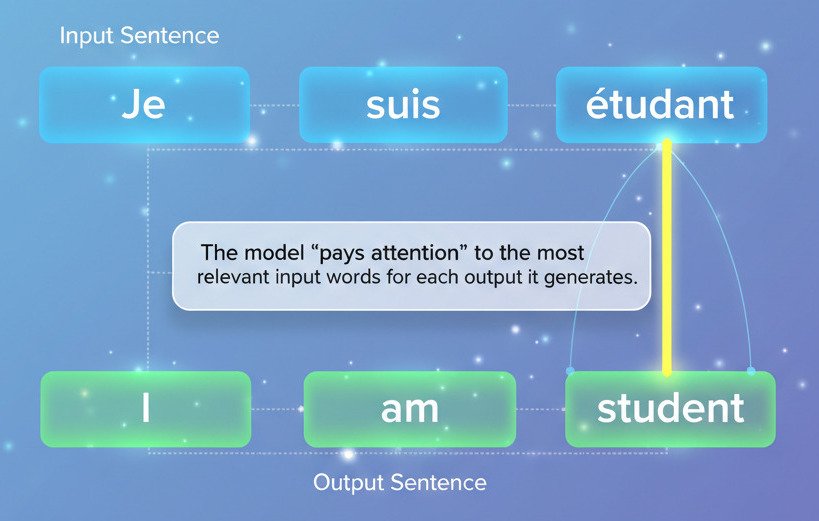
Let’s say we’re translating the French sentence “Je suis étudiant” to English.
When the model is generating the first English word, “I,” its attention should be highly focused on the first French word, “Je.”
[ “Je” (0.9), “suis” (0.05), “étudiant” (0.05) ] -> “I”
When it’s generating the third English word, “student,” its attention should shift and focus almost entirely on the third French word, “étudiant.”
[ “Je” (0.05), “suis” (0.05), “étudiant” (0.9) ] -> “student”
The attention mechanism learns to create these dynamic alignments between the input and output sequences.
How is Attention Calculated? Query, Key, and Value
The most common form of attention works using three components derived from our input vectors:
- Query (Q): This represents the current thing we’re trying to figure out. Think of it as the “question.” In our translation example, the Query is related to the state of the decoder trying to produce the next English word.
- Key (K): Each input element has a “Key” vector associated with it. This is like a “label” or a “keyword” for that input.
- Value (V): Each input element also has a “Value” vector. This is the actual content or representation of that input.
The process is like a database lookup:
- Calculate Scores: The model takes the current Query and compares it to every Key in the input sequence (often using a dot product!). This comparison produces a “relevance score” for each input element. A high score means that Key is very relevant to the current Query.
- Normalize Scores (Softmax): These raw scores are then passed through a softmax function (a generalization of the sigmoid), which turns them into a set of positive numbers that all add up to 1. These are our final attention weights.
- Calculate the Context Vector: The final context is a weighted sum of all the Value vectors, where each Value is multiplied by its corresponding attention weight.
This context vector, which is heavily influenced by the most “attended-to” inputs, is then used by the model to make its final prediction. The entire process—calculating Queries, Keys, Values, and the attention scores—is done with learnable matrices, so the model learns how to pay attention through backpropagation.
The Impact of Attention: Beyond Sequences
The Attention mechanism was a revolutionary breakthrough, first for machine translation, but its impact spread far beyond.
- Long-Range Dependencies: It completely solved the long-term memory problem of RNNs. The model can directly attend to a word from 100 steps ago if it’s relevant, creating a “shortcut” through time.
- Interpretability: We can visualize the attention weights to see what the model was “looking at” when it made a decision, making the model less of a black box.
- The Transformer Architecture: The idea was so powerful that researchers realized they might not need the recurrent “loop” of RNNs at all. A model could be built entirely out of attention mechanisms. This insight led to the creation of the Transformer architecture, which is the foundation of virtually all modern, state-of-the-art Large Language Models (LLMs) like GPT and BERT.
The Attention mechanism transformed AI by giving it a dynamic focus, allowing it to sift through vast amounts of information and hone in on what truly matters for the task at hand. It’s the mathematical equivalent of paying attention.
