Sequentia Explores: The Mathematics of Crypto
Part I: The Foundations of Digital Trust
Lecture 4: Alice, Bob, and Eve: Meet the Cast of Characters in Every Crypto Story
In our last lecture, we established a foundational rule of modern cryptography: Kerckhoffs’s Principle. It taught us that the strength of a cryptographic system lies not in the secrecy of its method, but in the secrecy of its key.
As we move from these high-level principles to actual cryptographic systems, the scenarios can become quite abstract. We’ll be talking about senders, receivers, attackers, and various types of threats. To keep these complex interactions clear, relatable, and easy to follow, cryptographers have developed a standard cast of characters. These aren’t real people; they are archetypes, placeholders in a story that help us frame the problem we are trying to solve.
Today, we meet the three most important characters in every crypto story: Alice, Bob, and Eve.
Alice and Bob: The Senders and Receivers
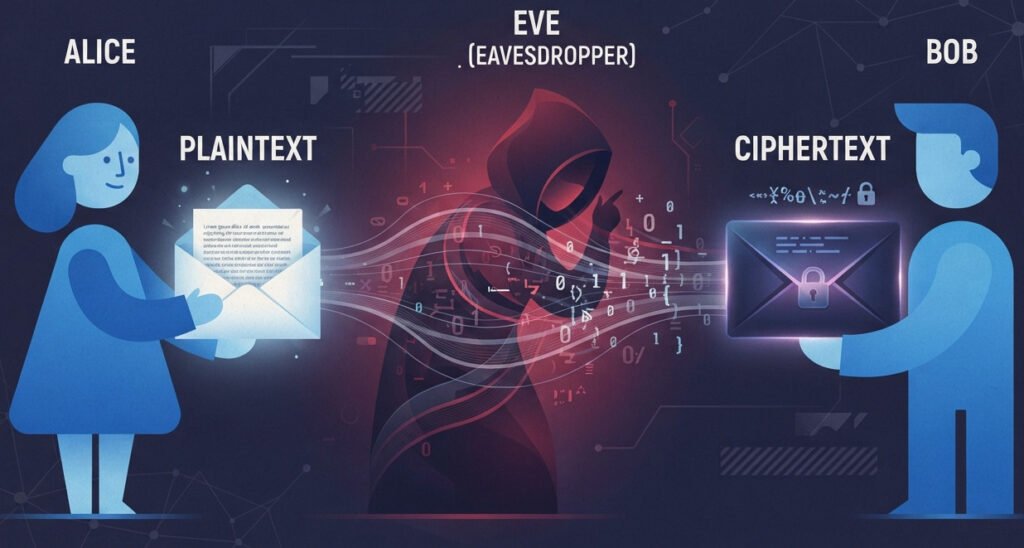
Meet Alice and Bob. By convention, in any cryptographic scenario, Alice is the one who wants to initiate communication. She is typically the sender. Bob is her intended recipient.
- Alice (A) wants to send a message to Bob (B).
Their goal is simple: to communicate securely. Whether Alice is sending Bob a private love letter, a secret battle plan, or her credit card information to his e-commerce store, the fundamental setup is the same. Alice has a message (plaintext), and she wants Bob—and only Bob—to be able to read it.
Whenever you read about a cryptographic protocol, you will almost always see it framed as “Alice sends a message to Bob.” This simple convention instantly clarifies who is doing what and removes ambiguity.
Eve: The Passive Eavesdropper
Now, meet our first antagonist: Eve. Her name comes from “eavesdropper.”
Eve’s goal is to listen in on the communication between Alice and Bob. She wants to read the secret message, but she doesn’t want to interfere with it. She is a passive attacker.
- Eve (Eavesdropper) wants to intercept and read the message Alice sends to Bob.
Eve represents the spy, the nosy network administrator, the government agency, or anyone who might be monitoring the communication channel. When Alice encrypts her plaintext into ciphertext, she is doing so specifically to protect it from Eve. If Eve intercepts the ciphertext but cannot decrypt it, Alice and Bob’s system is successful in providing confidentiality.
Eve has access to all the same public information as Alice and Bob. She knows the cryptographic system (the algorithm) they are using—remember Kerckhoffs’s Principle! Her challenge is to figure out the message without knowing their secret key. The strength of a cryptosystem is often measured by how long it would take Eve, with all her resources, to break the encryption.
Mallory: The Malicious and Active Attacker
While Eve is a passive listener, our next character is far more dangerous. Meet Mallory, whose name starts with “M” for “malicious.”
Mallory is an active attacker. She doesn’t just want to read the message; she wants to tamper with it.
- Mallory (Malicious) can intercept, block, modify, and replay messages between Alice and Bob.
Mallory can do everything Eve can, but she can also:
- Intercept and Change a Message: She could intercept Alice’s message, “Pay Bob $100,” and alter it to say, “Pay Mallory $10,000,” before sending it on to Bob. A good cryptographic system must provide integrity to protect against this.
- Impersonate Alice: Mallory could send a message to Bob pretending to be Alice. A strong system needs authentication to prevent this.
- Replay an Old Message: If Alice sends Bob an encrypted message saying “Transfer $50,” Mallory might capture that message and send the exact same encrypted data to Bob ten times, hoping to trigger ten transfers. This is a “replay attack.”
Whenever we discuss digital signatures, message integrity, or authentication, we are primarily trying to defend against Mallory.
Why Use These Characters?
Using a story with characters like Alice, Bob, Eve, and Mallory is more than just a quirky tradition. It’s a powerful tool for clarity and rigorous thinking:
- Simplifies Complex Scenarios: Instead of saying “Sender A transmits data to Receiver B while Attacker C attempts to read it,” we can simply say “Alice sends a message to Bob, and Eve is listening.” It’s instantly understandable.
- Defines Threat Models: Each character represents a different type of threat (the “threat model”). When designing a system, cryptographers ask, “How do we protect against Eve?” and “How do we protect against Mallory?” This ensures all angles of an attack are considered.
- Provides a Common Language: Any cryptographer anywhere in the world knows what you mean when you talk about Alice, Bob, and Eve. It’s a universal shorthand that facilitates clear and precise communication.
There are many other characters in the cryptographic cast (Trent the trusted arbitrator, Walter the warden, and so on), but Alice, Bob, Eve, and Mallory are the stars of the show.
From now on in this series, we will use these characters to frame our cryptographic puzzles. Our goal will be to find mathematical tools that allow Alice and Bob to communicate freely, confident that Eve can’t understand them and Mallory can’t manipulate them.
In our next lecture, we will put this cast to work as we analyze our first real cipher: The Caesar Cipher. Alice has a secret, and Eve is listening—how can we help her protect it?
