Sequentia Explores: The Mathematics of Crypto
Part I: The Foundations of Digital Trust
Lecture 3: Secrets vs. Systems: Kerckhoffs’s Principle
In our first two lectures, we established our focus on cryptography and defined the Digital Trust Problem—the inherent insecurity of digital information. We know we need a “digital sealed envelope” and an “unforgeable signature.” Our instinct might be to invent a clever, secret method for scrambling and unscrambling messages and then guard that method with our lives. If no one knows how our system works, surely our messages will be safe, right?
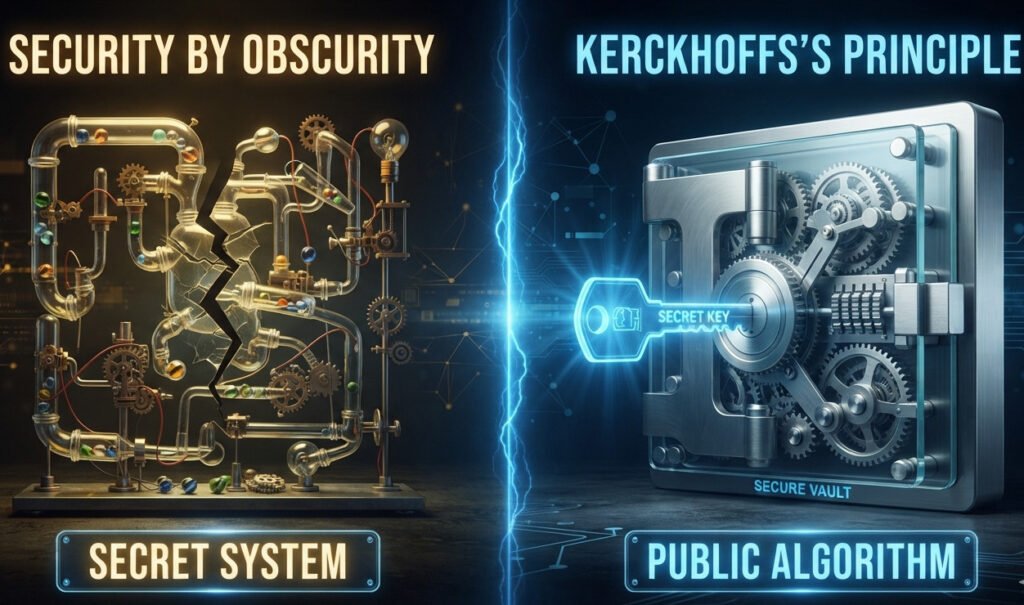
This line of thinking, known as security by obscurity, feels intuitive. It’s the logic of a child creating a secret language that only they and their best friend understand. However, in the world of serious cryptography, this approach is considered dangerously weak.
Today, we introduce one of the most important and counter-intuitive philosophies in the history of secret-keeping: Kerckhoffs’s Principle.
The Man and His Maxims
In the late 19th century, Auguste Kerckhoffs, a Dutch linguist and professor, wrote a series of essays on military cryptography. He wasn’t just interested in creating new ciphers; he was interested in the principles that make a cryptographic system practical, reliable, and secure in a real-world military context.
He laid out several maxims, but one has echoed through the ages and become the bedrock of modern cryptography. Paraphrased, it states:
A cryptosystem should be secure even if everything about the system, except the key, is public knowledge.
Let’s unpack that. Kerckhoffs argued that the security of your encrypted messages should not depend on the secrecy of your method (your algorithm, your machine, your software). It should depend only on the secrecy of a small, changeable piece of information: the key.
Why “Security by Obscurity” Fails
Imagine you and your friend design a “secret decoder ring.” The method is that every letter is shifted forward by a number of places equal to its position in the word (1st letter shifts by 1, 2nd by 2, etc.). You believe your messages are safe because no one else knows this unique, clever rule. This is security by obscurity.
Now, consider the problems:
- The System Can Be Captured: What if an enemy spy captures one of your decoder rings? Or they capture a messenger who, under pressure, reveals the method? The entire system is now permanently broken. Every past and future message is compromised. You’d have to invent a whole new system and distribute new rings to everyone.
- The System Can Be Reverse-Engineered: An adversary can analyze multiple messages you’ve sent. By looking for patterns, frequencies, and applying logical deduction (a process called cryptanalysis), they can often figure out the underlying method. Humans are very good at finding patterns; a clever algorithm is just a complex pattern.
- There is No Peer Review: If you keep your system secret, how do you know if it’s actually any good? You can’t ask other experts to test it for weaknesses without revealing your secret. You might have a glaring flaw you’re completely unaware of, and you’ll only find out when your secrets are exposed.
The Power of Kerckhoffs’s Principle: Open Systems, Secret Keys
Kerckhoffs’s Principle flips the “secret decoder ring” logic on its head.
Imagine instead that you use a well-known, publicly documented system. Let’s say, a simple substitution cipher where the key is a secret word. The method is public: everyone knows you’re using a substitution cipher based on a keyword. The entire security now rests on the secrecy of one thing: the keyword you chose.
This approach has profound advantages:
- Keys are Easier to Protect and Change: Protecting a single, short key (like a password) is much easier than protecting the design of an entire complex system. If a key is compromised, you don’t throw away the whole system; you simply agree on a new key and you are secure again. This is incredibly practical.
- Public Scrutiny Creates Strength: When a cryptographic algorithm is published, it is immediately attacked by thousands of the smartest mathematicians and cryptographers in the world. They poke it, prod it, and test it for any conceivable weakness. If an algorithm can survive years of this intense public scrutiny (like the modern AES – Advanced Encryption Standard), we can have a very high degree of confidence in its strength. This is the power of open-source security and academic peer review.
- Standardization and Interoperability: Public, well-tested systems can be adopted as standards. This allows different parties who have never met to communicate securely, as long as they are using the same public system and can securely exchange a secret key. This is the foundation of the entire internet.
Modern Analogy: The Lock and the Key
Think of a high-quality bank vault door. The manufacturer can publish the blueprints for the lock mechanism. They can show everyone the intricate gears, the hardened steel pins, and the complex engineering. The security of the vault does not depend on the secrecy of its design.
The security of the vault depends entirely on the uniqueness and secrecy of the physical key that opens it.
In modern cryptography, the public algorithm is the well-engineered lock. The secret key is the only thing that can open it.
This principle is one of the most significant mental shifts in our journey. We must move away from the idea that our methods must be secret and embrace the idea that our keys must be secret. This allows us to build robust, trustworthy, and publicly verifiable systems.
In our next lecture, we’ll finally get our hands dirty with our first cryptographic system, the Caesar Cipher. As we explore it, keep Kerckhoffs’s Principle in mind and ask yourself: what is the system, and what is the key?
