Series: The Sequentia Lectures: Unlocking the Math of AI
Part 7: The Frontier – New Paradigms & Unsolved Puzzles
Lecture 69: From Data Patterns to True Understanding: The Quest for AI “Common Sense”
We have spent this entire series exploring the incredible power of machine learning. We’ve seen how models can learn to recognize images, translate languages, and generate breathtakingly realistic art, all by learning complex statistical patterns (correlations) from vast amounts of data.
And yet, for all their power, today’s AI systems lack a fundamental human quality: common sense.
A deep learning model might know that the words “smoke” and “fire” often appear together, but it doesn’t understand that fire causes smoke. It can’t reason about what might happen if you add wind, or what would happen if the “fire” were just a picture on a screen. This gap between correlation and true understanding is one of the biggest and most exciting unsolved puzzles in the quest for artificial general intelligence.
The Two Roads to Deeper Understanding
How can we bridge this gap? Researchers are exploring several fascinating frontiers, two of which stand out as particularly promising: Causal Inference and Neuro-Symbolic AI.
1. Causal Inference: Teaching AI to Ask “Why?”
As we touched upon in Lecture 60, standard machine learning operates at the level of association. Causal Inference aims to push AI up the “ladder of causation” to reason about intervention (“What if I do this?”) and counterfactuals (“What if I had done something else?”).
- The Goal: To build models that don’t just learn that A and B are correlated, but can infer if A causes B.
- The Method: This requires more than just raw data. It involves creating causal models (often as graphs) that represent our hypotheses about the world’s structure. By combining these structural models with data and specialized mathematical frameworks (like Judea Pearl’s do-calculus), AI can begin to untangle cause from effect.
- The Payoff: A causal AI would be far more robust. It wouldn’t be fooled if it saw a cow on a beach because it would understand that “grass” doesn’t cause a cow. It could reason about the effects of its actions, a critical step towards building truly safe and reliable autonomous systems.
2. Neuro-Symbolic AI: Combining Intuition and Logic
The history of AI has seen two major schools of thought:
- Symbolic AI (or “Good Old-Fashioned AI”): This approach is based on formal logic and rules. It represents knowledge in a structured, symbolic way (e.g., All(x), Man(x) -> Mortal(x)). It is excellent at rigorous, step-by-step reasoning but brittle when faced with the messy, uncertain real world.
- Connectionist AI (Neural Networks): This is what we’ve been studying. It’s excellent at learning fuzzy patterns from data (intuition) but struggles with formal reasoning and is often a “black box.”
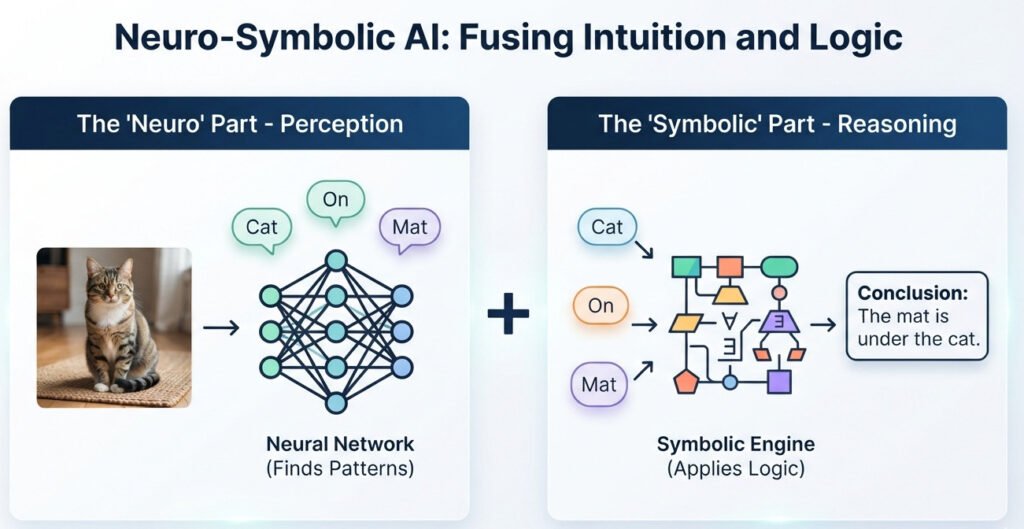
Neuro-Symbolic AI is an exciting research field that aims to get the best of both worlds. The goal is to combine the pattern-matching “intuition” of deep learning with the rigorous, transparent reasoning of symbolic AI.
- How it might work:
- A neural network (the “neuro” part) could be used to process raw perceptual data, like looking at an image and identifying objects (“cat,” “ball,” “table”).
- This output is then converted into a structured, symbolic representation.
- A symbolic reasoning engine (the “symbolic” part) can then use this representation to perform logical deductions: “The cat is on the table. The ball is under the table. Therefore, the cat is above the ball.”
- The Payoff: This fusion could lead to AI that can not only “see” the world but can reason about what it sees, explain its reasoning in a human-understandable way, and incorporate existing knowledge and common sense rules directly into its learning process.
The Ultimate Puzzle: A Model of the World
Both Causal Inference and Neuro-Symbolic AI are part of a grander quest: to build AI systems that don’t just learn statistical patterns from the world, but learn a true model of the world.
A model that understands cause and effect. A model that can distinguish between a real fire and a picture of a fire. A model that possesses the vast web of background knowledge that we call common sense.
This is arguably the final frontier of AI. It’s a puzzle that will require not just more data or bigger computers, but a fundamental paradigm shift in the mathematics and philosophy of what it means to learn and to understand.
