Series: The Sequentia Lectures: Unlocking the Math of AI
Part 7: The Frontier – New Paradigms & Unsolved Puzzles
Lecture 68: Beyond Silicon: The Search for AI’s Ultimate Hardware
For this entire series, we have taken one thing for granted: our AI models, no matter how abstract, will ultimately run on silicon-based digital computers. The GPUs and CPUs in our data centers and phones are the undisputed workhorses of the current AI revolution.
But as our models grow ever larger and their energy demands soar, researchers are looking to a more distant and exotic horizon. They are asking a fundamental question: Is there a better, more natural substrate for intelligence? Could the future of AI be grown in a lab or built from light?
Welcome to the frontier of non-silicon computing, where material science, physics, and AI mathematics converge.
The Limits of Silicon
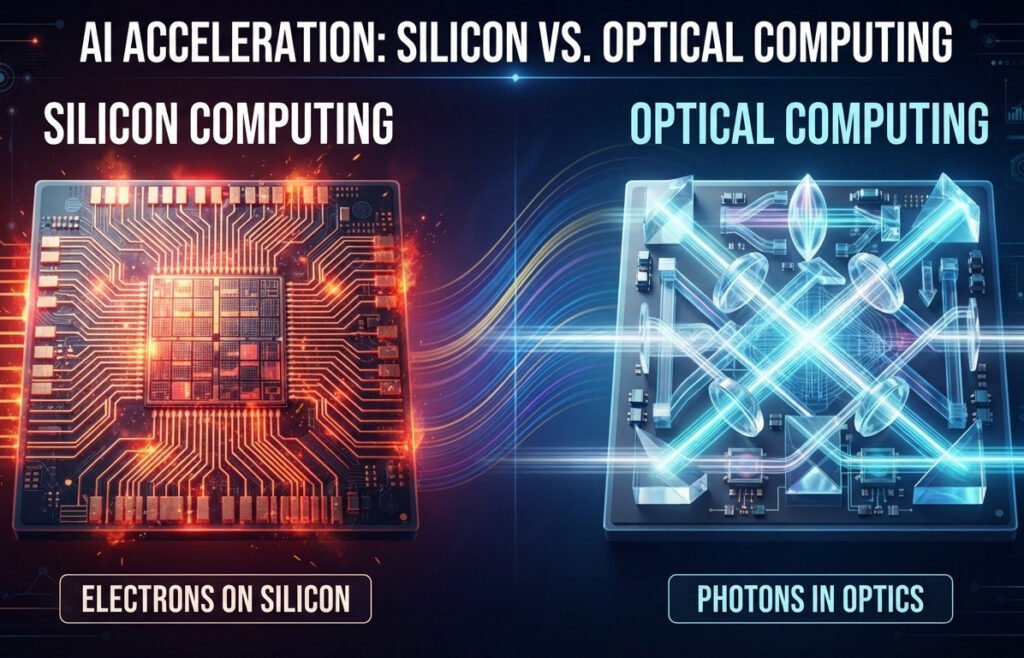
Digital silicon chips are incredible, but they face fundamental limitations. They consume vast amounts of power, generate immense heat, and are reaching the physical limits of how small we can make transistors (Moore’s Law is slowing down). The very architecture of shuttling data between memory and processing units (the von Neumann bottleneck) is inherently inefficient for the massively parallel, interconnected calculations of deep learning.
What if, instead of forcing AI math onto silicon, we could find a physical system whose natural behavior inherently performs the calculations we need?
1. Optical Computing: AI at the Speed of Light
One of the most promising near-term alternatives is optical computing. Instead of using electrons to represent information, this approach uses photons—particles of light.
- The Advantage: Photons travel at the speed of light, have almost zero mass, and don’t interfere with each other in the same way electrons do. This means optical processors can be incredibly fast and generate far less heat, making them vastly more energy-efficient.
- The AI Connection: The core operation in a neural network is matrix multiplication. It turns out that this complex mathematical operation can be performed almost instantaneously and in parallel as light passes through a carefully configured set of lenses and optical components. The physics of light diffraction and interference naturally computes the result.
- The Status: Companies are already building and demonstrating specialized optical chips designed to accelerate the core matrix math of AI, promising orders-of-magnitude improvements in speed and power efficiency.
2. Analog Computing: Embracing the “Messiness” of the Real World
Digital computers work by approximating the continuous world with discrete 1s and 0s. Analog computers do the opposite. They model a problem using a continuous physical property, like voltage or current.
- The Advantage: For certain problems, particularly solving complex systems of differential equations or optimization problems (like finding the bottom of a cost function valley!), an analog circuit can “settle” into its lowest energy state almost instantly. This lowest energy state physically represents the mathematical solution.
- The AI Connection: Instead of iteratively calculating a gradient and taking discrete steps (Gradient Descent), an analog computer could potentially find the “minimum” of a complex optimization landscape by letting the physics of the circuit find its own stable state naturally.
- The Challenge: Analog computers are susceptible to noise and are difficult to program for general-purpose tasks, but for specialized AI acceleration, they are a powerful and resurgent idea.
3. The Speculative Frontier: DNA, Crystal, and Chemical Computing
Looking even further ahead, scientists are exploring ways to harness the very structure of matter for computation.
- DNA Computing: A single gram of DNA can theoretically store more information than a trillion CDs. Researchers have shown that the natural binding properties of DNA strands can be used to solve certain complex combinatorial problems (like the “traveling salesman problem”) in a massively parallel way. Could we one day “grow” a computer?
- Reservoir Computing / “Crystal” Computing: This is a fascinating idea where, instead of a carefully designed circuit, you use a complex, random, but fixed physical system (a “reservoir”)—like a bucket of water, a random network of carbon nanotubes, or a piece of silicon with random impurities. You feed input signals into this system, let the complex internal physics interact, and then simply train a “readout” layer to interpret the resulting complex state. The random, chaotic physics of the reservoir itself does the heavy lifting of creating complex, non-linear feature transformations for free.
Conclusion: Finding the Right Body for the Mind
The quest for AI’s ultimate hardware is a profound one. It suggests that the future of intelligence may not just be about writing better software, but about finding the right physical embodiment for that software.
Will the next generation of AI run on chips that compute with light, settle into analog solutions, or emerge from the complex dynamics of a chemical soup? We don’t know. But this frontier is a powerful reminder that the universe itself is a computational engine. The mathematical principles we’ve discussed—vectors, matrices, optimization—are not just abstract tools; they are a language that describes the behavior of physical systems. By finding the right system, we might unlock a new era of impossibly fast, efficient, and “natural” intelligence.
