Series: The Sequentia Lectures: Unlocking the Math of AI
Part 6: Advanced Architectures & Concepts
Lecture 55: Generative Adversarial Networks (GANs): Two AIs in a “Forger vs. Detective” Game
How can a computer create a photorealistic image of a person who doesn’t exist? How can it generate new, original pieces of art or music? One of the most brilliant and innovative answers to this question came in 2014 with the invention of Generative Adversarial Networks, or GANs.
The core idea, conceived by Ian Goodfellow, is not to train a single, monolithic network, but to pit two neural networks against each other in a competitive, zero-sum game. This “adversarial” process forces both networks to become progressively more sophisticated, resulting in the creation of incredibly realistic outputs.
The Two Players: The Forger and the Detective
A GAN consists of two distinct models that are trained simultaneously:
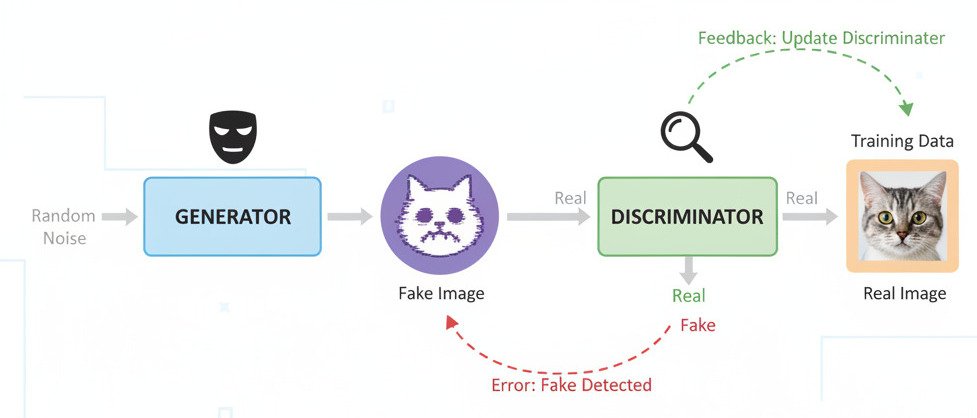
- The Generator (The Forger): This network’s job is to create fake data. It starts with a random input vector (like a seed of random noise) and attempts to transform it into something that looks like the real data. For example, it might try to generate a realistic image of a human face. Initially, its creations will be terrible—just noisy, nonsensical messes.
- The Discriminator (The Detective): This network’s job is to be a critic. It is a standard classification model that is shown a piece of data and must decide if it is “Real” (from the actual training dataset) or “Fake” (created by the Generator).
The Adversarial Training Loop
The magic of a GAN lies in how these two networks are trained together in a feedback loop:
- Phase 1: Train the Detective (Discriminator):
- The Discriminator is shown a batch of data containing a mix of real images from the training set and fake images created by the Generator.
- It makes its predictions (“Real” or “Fake”).
- We calculate its error (how many it got wrong) and use backpropagation to update its weights, making it a better detective. It learns to get better at spotting the Generator’s forgeries.
- Phase 2: Train the Forger (Generator):
- The Generator creates a new batch of fake images.
- These fake images are passed through the Discriminator.
- Here’s the clever part: The Generator’s goal is to produce images that the Discriminator incorrectly classifies as “Real.” The Generator’s “error” is high if the Discriminator easily spots its fakes.
- We then use backpropagation to update the Generator’s weights, but the error signal comes from the Discriminator’s decision. The Generator learns by figuring out what it did that “fooled” the Discriminator, and then doing more of that.
A Competitive Arms Race
This loop repeats millions of times, creating a competitive arms race:
- The Generator gets slightly better at creating fakes.
- The Discriminator, now facing better fakes, is forced to get better at detecting them.
- This, in turn, pushes the Generator to become an even more sophisticated forger.
This adversarial process continues until the Generator’s creations are so realistic that the Discriminator is no better than random chance (50/50) at telling the difference between real and fake. At this point of “equilibrium,” the Generator has become a master forger, capable of producing new, high-quality data that is indistinguishable from the real thing.
The Impact of GANs
GANs have had a profound impact on the field of generative AI, enabling a wide range of incredible applications:
- Image Generation: Creating realistic faces, animals, objects, and landscapes (the source of many “deepfake” technologies).
- Image-to-Image Translation: Turning sketches into photos, photos into paintings in the style of Van Gogh, or changing seasons in a landscape.
- Super Resolution: Taking a low-resolution image and “imagining” the high-resolution details.
- Data Augmentation: Generating new, synthetic training data to improve the performance of other machine learning models.
While newer generative models like Diffusion Models (which we’ll discuss later) have become state-of-the-art for many image tasks, the conceptual breakthrough of GANs—pitting two models against each other in a game of forgery and detection—remains one of the most elegant and powerful ideas in the history of AI.
