Sequentia Explores: The Mathematics of Crypto
Part II: The Mathematician’s Toolkit
Lecture 8: Finding Your Way: The Greatest Common Divisor & Euclid’s Algorithm
In our journey so far, we’ve explored the cyclical world of modular arithmetic and the foundational nature of prime numbers. Today, we add another ancient and profoundly elegant tool to our toolkit: a method for finding the Greatest Common Divisor (GCD).
While the concept might sound simple, the algorithm used to find it is a masterpiece of efficiency that has been a cornerstone of number theory for over two millennia. Understanding it is crucial, as it unlocks key operations in modular arithmetic that are vital for modern cryptography.
What is the Greatest Common Divisor (GCD)?
The Greatest Common Divisor of two integers is the largest positive integer that divides both numbers without leaving a remainder. It’s the biggest “common factor” they share.
Let’s take two simple numbers: 12 and 18.
- The divisors of 12 are: 1, 2, 3, 4, 6, 12.
- The divisors of 18 are: 1, 2, 3, 6, 9, 18.
The common divisors are 1, 2, 3, and 6. The greatest of these is 6.
Therefore, GCD(12, 18) = 6.
For small numbers, we can find the GCD by listing out all the divisors. But what about GCD(1071, 462)? Or even worse, what about finding the GCD of two 300-digit numbers? Listing all divisors is completely impractical. We need a more efficient method—a clever algorithm.
This is where the genius of the ancient Greek mathematician Euclid comes into play.
Euclid’s Algorithm: A Timeless Masterpiece
Euclid’s Algorithm, described in his work Elements around 300 BC, is one of the oldest algorithms still in common use today. It provides a stunningly fast way to find the GCD of two numbers, and it relies on one simple principle:
The greatest common divisor of two numbers does not change if the larger number is replaced by its difference with the smaller number.
An even more efficient version of this principle uses remainders instead of differences:
The greatest common divisor of two numbers is the same as the greatest common divisor of the smaller number and the remainder of the larger number divided by the smaller number.
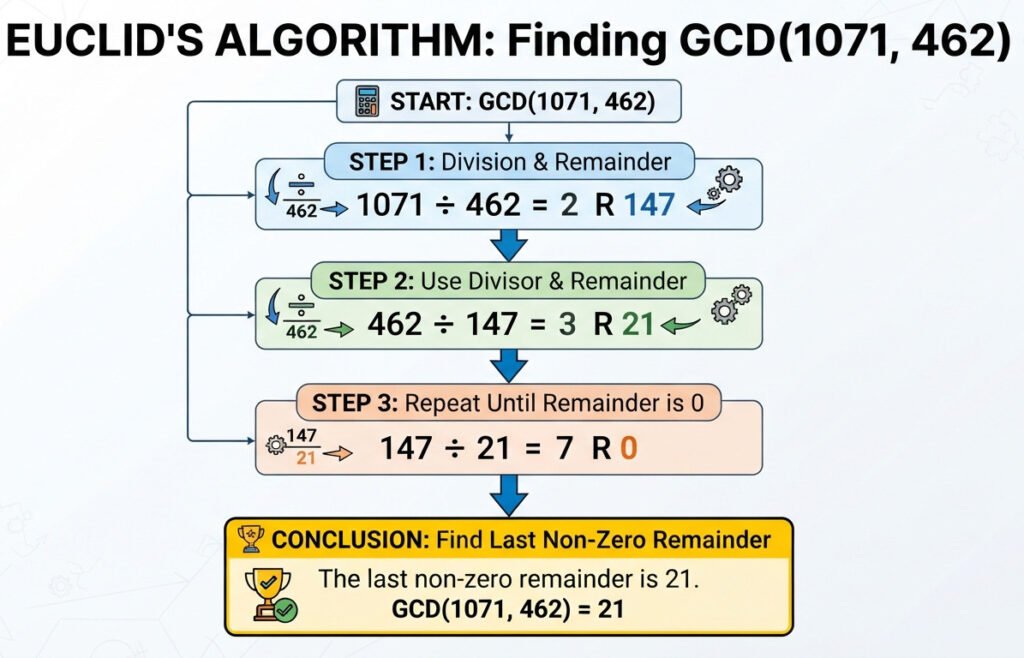
This sounds a bit abstract, so let’s walk through it step-by-step with our example: GCD(1071, 462).
Step 1: Divide the larger number (1071) by the smaller one (462) and find the remainder.
1071 = 2 × 462 + 147
The remainder is 147. The principle tells us that GCD(1071, 462) is the same as GCD(462, 147). We’ve just made our problem much smaller!
Step 2: Repeat the process with our new pair of numbers (462 and 147).
462 = 3 × 147 + 21
The remainder is 21. Now we know GCD(462, 147) is the same as GCD(147, 21). The problem gets even smaller.
Step 3: Repeat again (with 147 and 21).
147 = 7 × 21 + 0
The remainder is 0.
Once we reach a remainder of 0, the algorithm stops. The GCD is the last non-zero remainder we found. In this case, it was 21.
So, GCD(1071, 462) = 21.
This method is incredibly efficient. It reduces the size of the numbers at each step, arriving at the answer in a fraction of the time it would take to list out factors.
Why is the GCD so Important in Cryptography?
The GCD is more than just a mathematical curiosity. It’s a fundamental concept for several critical cryptographic operations.
- Determining Coprime Numbers: Two numbers are considered coprime (or relatively prime) if their greatest common divisor is 1. For example, GCD(8, 9) = 1, so 8 and 9 are coprime. This property of being coprime is a prerequisite for many cryptographic functions. It essentially means the numbers don’t share any common factors besides 1, which makes them “independent” in a mathematical sense.
- Finding Modular Inverses (Crucial!): This is the most significant application for our purposes. In our lecture on modular arithmetic, we discussed addition, subtraction, and multiplication. But what about division? “Dividing” in modular arithmetic is actually accomplished by multiplying by a modular multiplicative inverse.
An inverse of a number a (mod n) is a number a^-1 such that (a × a^-1) ≡ 1 (mod n).
A modular inverse for a (mod n) only exists if a and n are coprime, that is, if GCD(a, n) = 1.
Euclid’s Algorithm is the first step in a more advanced version called the Extended Euclidean Algorithm, which not only finds the GCD but also allows us to efficiently calculate these crucial modular inverses. Without a fast way to find the GCD and determine if an inverse exists, many cryptographic systems, including the famous RSA algorithm, would be computationally impossible.
In essence, Euclid’s elegant, ancient algorithm is a key that unlocks division in the world of clock arithmetic. It provides the mechanism for “undoing” multiplication, a process that is absolutely essential for the decryption part of many public-key cryptosystems.
We’ve now added a 2,300-year-old algorithm to our modern cryptographic toolkit. In our next lecture, we’ll build directly upon this foundation as we explore the Extended Euclidean Algorithm and finally uncover the secret to “division” in the world of modulo.
