Series: The Sequentia Lectures: Unlocking the Math of AI
Part 7: The Frontier – Open Problems & Research Directions
Lecture 65: A Glimpse into Quantum Machine Learning: Where Physics Meets AI
For our final lecture in this “Frontier” series, let’s take a speculative leap into one of the most exciting and mind-bending intersections in all of science: Quantum Machine Learning (QML).
What happens when we combine the strange and powerful rules of quantum mechanics with the data-processing power of machine learning? The result is a field that promises to solve certain types of problems that are currently intractable for even the most powerful supercomputers. This is not about simply making our current AI faster; it’s about a fundamentally new way of computing.
The Classical Limit
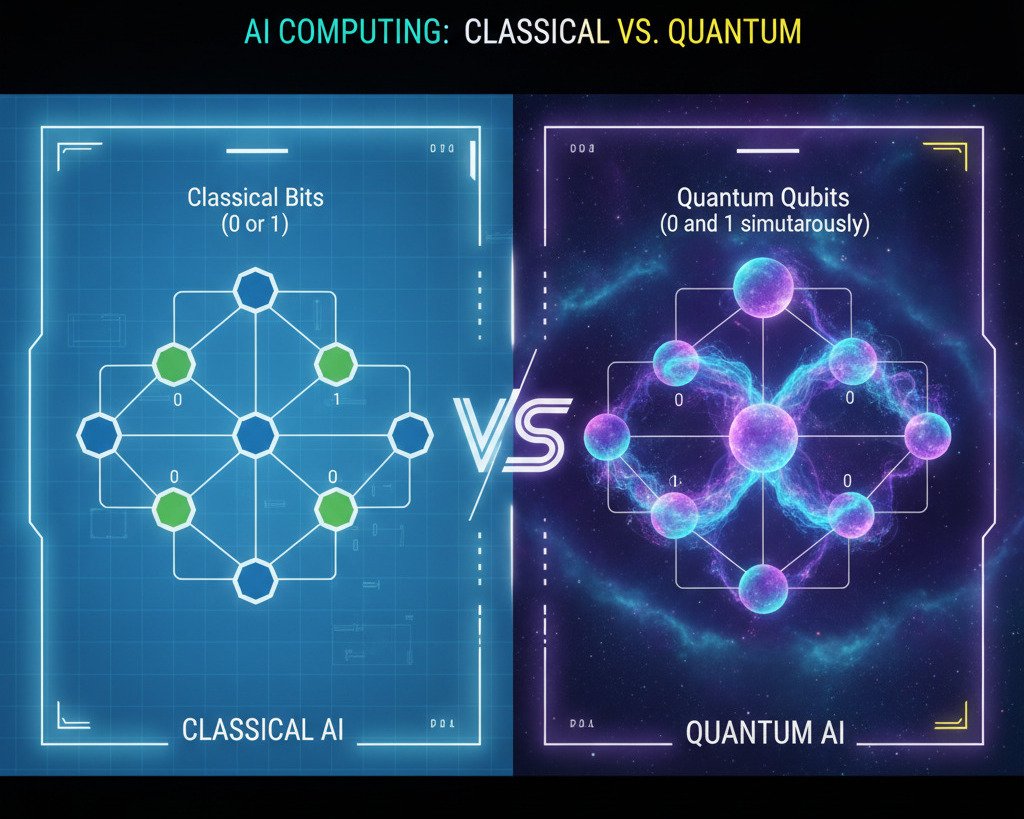
The AI models we’ve discussed so far, from linear regression to massive Transformers, all run on classical computers. At their core, these computers work with bits. A bit is a simple switch that can be in one of two states: 0 or 1. All the complex math we’ve explored—vectors, matrices, gradients—is ultimately performed by manipulating these billions of simple, definite 0s and 1s.
Quantum computers, however, work on a completely different principle.
The Quantum Advantage: Qubits and Superposition
The fundamental unit of a quantum computer is the qubit. A qubit is not just a 0 or a 1. Thanks to a principle called superposition, a qubit can be in a state that is a combination of both 0 and 1 at the same time. It exists in a probabilistic cloud of possibilities until it is measured.
This ability to hold multiple values simultaneously is the source of a quantum computer’s potential power. A system of N classical bits can represent only one N-digit number at a time. A system of N qubits can, in a sense, represent 2^N numbers all at once. This creates an exponentially larger computational space to work in.
Entanglement: Spooky Action at a Distance
Another bizarre quantum phenomenon is entanglement, where two or more qubits become linked in such a way that their fates are intertwined. Measuring the state of one qubit instantly influences the state of the other, no matter how far apart they are. This deep interconnectedness allows for powerful correlations and information processing that have no classical analogue.
How Could This Help Machine Learning?
Researchers in QML are exploring how these quantum properties could revolutionize certain AI tasks. The primary advantage is not in all of AI, but in specific types of mathematical problems that are at the heart of some machine learning algorithms.
- Quantum Linear Algebra: Many machine learning problems boil down to massive linear algebra calculations (like solving systems of equations or finding eigenvalues, as we’ve discussed!). Quantum algorithms, like the HHL algorithm, promise to solve certain types of these problems exponentially faster than any known classical algorithm. This could dramatically speed up models like Support Vector Machines or Principal Component Analysis.
- Quantum Optimization: The process of finding the minimum of a complex cost function (Gradient Descent) is a search problem. A quantum computer, by exploring many possible solutions simultaneously in superposition, could potentially navigate these complex, high-dimensional landscapes much more efficiently, using algorithms like the Quantum Approximate Optimization Algorithm (QAOA) or Quantum Annealing.
- Sampling from Complex Distributions: Generative models like VAEs and GANs often involve sampling from very complex probability distributions. Quantum systems are naturally probabilistic and could potentially model and sample from these distributions more efficiently and accurately than classical methods.
The Current Reality: A Noisy, Exciting Frontier
It’s crucial to be clear: we are still in the absolute earliest days of QML. Today’s quantum computers are “Noisy Intermediate-Scale Quantum” (NISQ) devices. They are small, sensitive to environmental interference (“noise”), and can only maintain their quantum states for very short periods.
Running a large-scale, fault-tolerant quantum algorithm to train a deep neural network is still a distant dream. The challenges are immense, both in building the quantum hardware and in designing the QML algorithms themselves.
However, the theoretical promise is undeniable. Quantum Machine Learning represents a potential paradigm shift, a future where we could tackle optimization and simulation problems of a complexity that is currently unimaginable. It’s a field where the fundamental rules of the universe are being harnessed to solve the fundamental puzzles of intelligence. As we continue our journey into the world of AI, it’s worth keeping an eye on this dazzling intersection where physics meets computation.
