Sequentia Explores: The Mathematics of Crypto
Part II: The Mathematician’s Toolkit
Lecture 6: The Magic of Modulo: A Deep Dive into “Clock Arithmetic”
Welcome to Part II of our series! Having established the foundations of digital trust, we now begin to assemble our “Mathematician’s Toolkit.” These are the core mathematical concepts that serve as the nuts and bolts of cryptographic systems. And the single most important, versatile, and foundational tool in that entire kit is something you already use every day: modular arithmetic.
You might not know it by that name, but you practice it every time you look at a clock, use a calendar, or even think about the days of the week. At its heart, modular arithmetic is the math of cycles, remainders, and numbers that “wrap around.” Because it restricts numbers to a finite, predictable range, it is absolutely essential for cryptography.
Let’s explore this concept using the most intuitive analogy there is: the face of a clock.
Introducing “Clock Arithmetic”
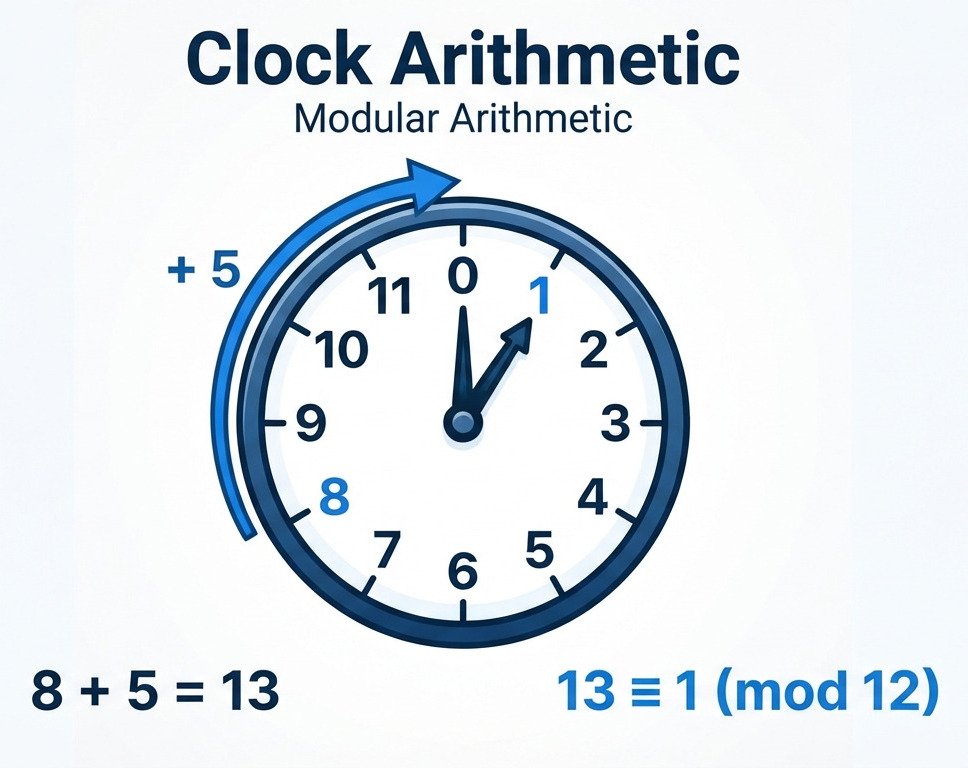
Imagine a standard analog clock with 12 hours. If it’s 8 o’clock now, what time will it be in 5 hours? You instinctively know the answer is 1 o’clock. You don’t say “13 o’clock.” Your brain automatically does the math: 8 + 5 = 13, but since there are only 12 hours on a clock, we “wrap around.” After 12, we start again at 1.
This “wrapping around” is the essence of modular arithmetic. In mathematical terms, we would say:
13 ≡ 1 (mod 12)
This is read as “13 is congruent to 1 modulo 12.”
- The number we are dividing by (12) is called the modulus.
- The ≡ symbol means “is congruent to,” which is like a special form of equals for modular arithmetic.
- The expression (mod 12) tells us we are working in a system with 12 values (let’s think of them as 0 through 11, where “12 o’clock” can be thought of as 0).
What this equation really means is: “When you divide 13 by 12, the remainder is 1.”
That’s it! The “modulo” operation is simply about finding the remainder.
- 14 ÷ 12 is 1 with a remainder of 2. So, 14 ≡ 2 (mod 12).
- 25 ÷ 12 is 2 with a remainder of 1. So, 25 ≡ 1 (mod 12). (25 hours from now is the same as 1 hour from now).
- 7 ÷ 12 is 0 with a remainder of 7. So, 7 ≡ 7 (mod 12).
This works for all the arithmetic operations we know and love.
Modular Addition and Subtraction
This is exactly what we did in our first example.
- Addition: (8 + 5) mod 12
- 8 + 5 = 13
- 13 mod 12 = 1 (The remainder of 13 ÷ 12)
- Subtraction: What if it’s 3 o’clock and you want to know the time 5 hours ago?
- 3 – 5 = -2
- What is -2 (mod 12)? You can think of it as “winding the clock backwards.” From 12 (or 0), go back one hour to 11, then back another hour to 10.
- So, -2 ≡ 10 (mod 12).
- Another way: Just keep adding the modulus to the negative number until it becomes positive. -2 + 12 = 10.
Modular Multiplication
This might seem strange at first, but the principle is the same. Let’s work mod 10 for a moment. What is (8 × 4) mod 10?
- First, multiply the numbers: 8 × 4 = 32.
- Then, find the remainder when divided by the modulus: 32 ÷ 10 is 3 with a remainder of 2.
- So, 32 ≡ 2 (mod 10).
A neat trick with modular arithmetic is that you can apply the modulo at each step, and the result is the same. For (8 × 4) mod 10:
- 8 mod 10 = 8
- 4 mod 10 = 4
- (8 × 4) mod 10 = 32 mod 10 = 2. This doesn’t seem to help much here. But for very large numbers, taking the modulo at intermediate steps can keep the numbers manageable.
Why is this “Magic” for Cryptography?
Modular arithmetic is the MVP (Most Valuable Player) of cryptography for a few key reasons:
- Finite Field: It keeps numbers within a fixed, predictable range. If we’re working mod 26 (for the 26 letters of the alphabet), the result of any operation will always be a number between 0 and 25. This is perfect for computers and for creating ciphers. We’ll see this in action with the Caesar Cipher.
- One-Way Nature (Sometimes): Certain operations in modular arithmetic are easy to do in one direction but incredibly difficult to reverse. For example, calculating (g^x) mod p (modular exponentiation) is fast. But if you only know the result, g, and p, finding the original x can be computationally impossible for large numbers. This “one-way function” property is the foundation of modern public-key cryptography.
- Scrambling Effect: Operations mod p thoroughly mix and scramble numerical relationships. Two numbers that are close together (like 25 and 26) can have vastly different results after a modular operation, hiding the original patterns.
Modular arithmetic provides a mathematical playground where numbers behave in cyclical, predictable, yet often hard-to-reverse ways. It’s the perfect environment for creating the complex, interlocking gears of a cryptographic machine.
In our next lecture, we will put this tool to immediate use. We will finally meet the Caesar Cipher, a simple substitution cipher that relies entirely on modular addition to encrypt and decrypt messages. You’ll see firsthand how this “clock arithmetic” can turn a secret message into gibberish and back again.
