Sequentia Explores: The Mathematics of Crypto
Part VII: Advanced Concepts & The Frontier
Lecture 47: The Math Behind ZK-SNARKs: A Glimpse into the Complexity
In our last lecture, we were introduced to the seemingly magical concept of a Zero-Knowledge Proof (ZKP). Using the Ali Baba’s cave analogy, we understood how it’s possible for a Prover to convince a Verifier they know a secret without revealing the secret itself.
That analogy is great for intuition, but it has a practical flaw: it’s interactive. Alice and Bob had to send messages back and forth multiple times to build up statistical certainty. For many real-world applications, like posting a private transaction on a public blockchain, this back-and-forth isn’t feasible.
We need a way to create a single, compact proof that can be posted publicly and verified by anyone, at any time, without any interaction. This leads us to one of the most powerful and complex constructions in modern cryptography: the ZK-SNARK.
Let’s break down that intimidating acronym:
- ZK (Zero-Knowledge): The proof reveals nothing about the secret information.
- S (Succinct): The proof is incredibly small and easy to verify, even if the computation it’s proving is enormous.
- N (Non-Interactive): The Prover can create a single proof that can be verified by anyone, without any back-and-forth communication.
- ARK (Argument of Knowledge): The proof is computationally sound; it’s practically impossible to fake a proof without actually knowing the secret.
ZK-SNARKs are the cryptographic engine behind privacy-focused cryptocurrencies like Zcash and are a key technology for scaling blockchains like Ethereum. But how do they work? The full mathematics are graduate-level, but we can take a high-level glimpse at the three major steps involved.
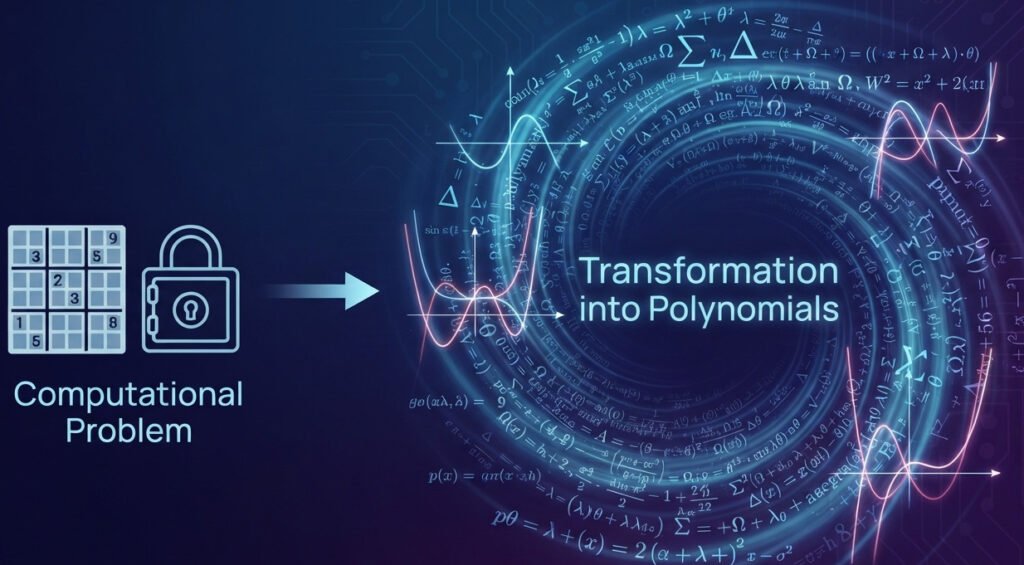
Step 1: The Problem Becomes a Polynomial
The first step in creating a ZK-SNARK is to transform the statement you want to prove into a mathematical form that cryptography can work with. This is done by converting the computational problem into a set of equations involving polynomials.
Imagine you want to prove you’ve solved a Sudoku puzzle. The “statement” is “I know a valid assignment of numbers to this Sudoku grid.”
- Arithmetization: First, this statement is converted into a series of algebraic equations. For a Sudoku, these equations would represent the rules: “the numbers in this row are all different,” “the numbers in this column sum to 45,” etc.
- Polynomial Representation: Then, through a complex process (often using a system like a Quadratic Arithmetic Program or QAP), this entire system of equations is transformed into a single, massive target polynomial.
The final result is this: the original statement (“I know the Sudoku solution”) is true if and only if the Prover can demonstrate they know a specific set of polynomials that satisfy a particular equation related to the target polynomial.
The problem has been shifted from “I know a secret” to “I know a set of polynomials that solve this equation.”
Step 2: Proving Knowledge with Elliptic Curve Pairings (The “Magic”)
Now, the Prover needs to prove they know these polynomials without revealing them. This is where the magic of elliptic curves comes back in, but with a new, advanced tool called pairings.
A pairing is a special mathematical function that takes two points from two different elliptic curve groups and maps them to a third group. Let’s call the pairing function e(P, Q). This function has a special property that is crucial for ZK-SNARKs:
e(aP, bQ) = e(P, Q)^(a×b)
This formula might look dense, but the concept is revolutionary. It allows you to check a multiplication relationship (a×b) in the “exponent world” by performing operations on the elliptic curve points themselves.
The ZK-SNARK protocol cleverly uses this property. The Prover doesn’t send their secret polynomials. Instead, they perform calculations on elliptic curve points using their secret polynomial coefficients as scalars. They then send the results of these elliptic curve calculations (which are just other points on a curve) to the Verifier.
The Verifier then takes these points, plugs them into the pairing equation, and checks if the equation holds true. Because of the special properties of pairings, if the equation balances, it provides mathematical proof that the Prover’s original, secret polynomials must have been valid, and therefore the original statement must be true.
This is the core of the “zero-knowledge” aspect. The Verifier only ever sees a handful of elliptic curve points. They never see the secret polynomials, let alone the original Sudoku solution.
Step 3: The Trusted Setup (A Caveat)
Many ZK-SNARK systems have one controversial requirement: a trusted setup.
Before the system can be used, a one-time setup ceremony must be performed to generate a set of public parameters needed for proving and verifying. This process involves creating a secret piece of data (often called “toxic waste”).
This “toxic waste” must be securely destroyed. If even one person who participated in the setup ceremony keeps a copy of this secret, they could theoretically use it to create fake, plausible-looking proofs.
This is a significant security consideration. Newer ZK-proof systems (like ZK-STARKs) have been developed that do not require a trusted setup, trading this requirement for slightly larger proof sizes.
Putting It All Together: The Big Picture
Let’s not get lost in the weeds. The high-level flow is what’s important:
- Transformation: A real-world problem (“I have enough funds for this transaction”) is transformed into a complex but verifiable polynomial equation.
- Proof: The Prover uses their secret information (the “witness”) and advanced math involving elliptic curve pairings to create a small, non-interactive proof.
- Verification: The Verifier uses public information to run a quick check on the proof. If the check passes, they are convinced the original statement is true, but they have learned nothing else.
ZK-SNARKs are one of the most complex and powerful tools in the modern cryptographic toolkit. They are the culmination of decades of research in abstract algebra, number theory, and computer science. While the math is deep, the result is simple and revolutionary: the ability to prove knowledge succinctly, non-interactively, and with zero information leakage.
