Sequentia Explores: The Mathematics of Crypto
Part VI: Building a Blockchain – The Math of a Distributed Ledger
Lecture 45: UTXOs vs. Accounts: The Mathematical Model of Bitcoin Ownership
When we think about money, our minds almost always jump to the concept of an account with a balance. You have a bank account with a balance of $500. You have an Ethereum account with a balance of 2 ETH. When you spend money, your balance is debited. When you receive money, your balance is credited. This “account model” is intuitive and deeply ingrained in our understanding of finance.
Which is why it can be surprising to learn that Bitcoin does not use this model.
Bitcoin doesn’t have “accounts” in the traditional sense, and the protocol has no concept of a “balance.” Instead, it uses a completely different accounting method known as the UTXO model. Understanding this difference is key to understanding how Bitcoin ownership is tracked and verified.
The UTXO Model: A Wallet Full of Digital Cash
UTXO stands for Unspent Transaction Output.
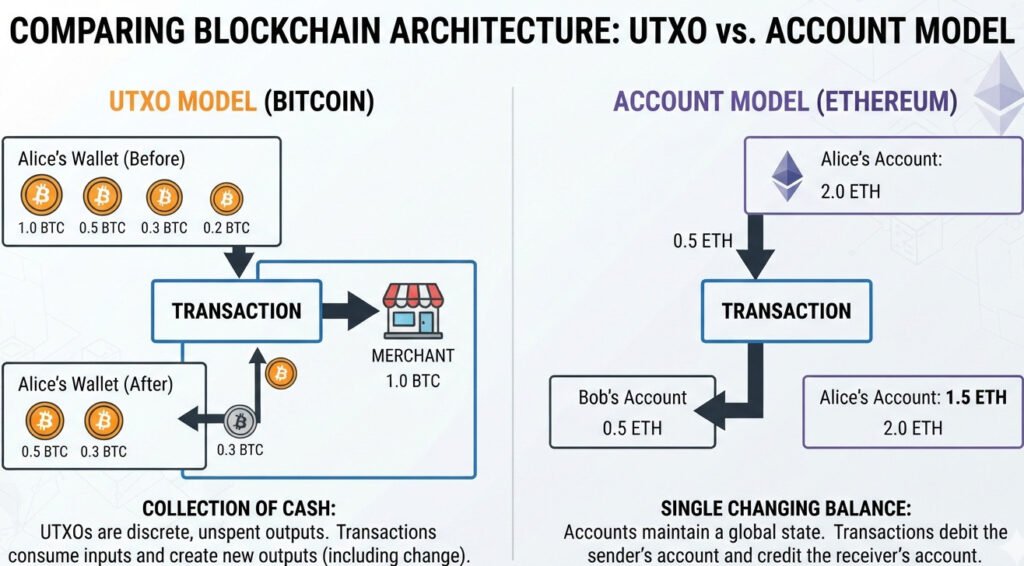
Instead of thinking of your Bitcoin wallet as a bank account with a single balance, it’s more accurate to think of it as a physical wallet full of individual bills and coins.
- If someone sends you 1 BTC, your wallet doesn’t just add “1” to a running total. It now contains a discrete “digital coin” or “note” worth 1 BTC. This is a UTXO.
- If you then receive 0.5 BTC from someone else, your wallet now contains two separate UTXOs: one for 1 BTC and another for 0.5 BTC.
- Your wallet’s “balance” of 1.5 BTC is not a single number stored on the blockchain. It is an abstraction calculated by your wallet software, which has scanned the blockchain and summed up the value of all the individual UTXOs that your private keys can control.
How a Transaction Works with UTXOs
This “digital cash” model fundamentally changes how transactions are constructed. When you want to spend from a bank account, you simply tell the bank, “Debit my account by $20.” When you want to spend bitcoin, you must select which specific “bills” (UTXOs) from your wallet you want to use.
Let’s say your wallet contains two UTXOs:
- UTXO_A = 1.0 BTC
- UTXO_B = 0.5 BTC
You want to buy something that costs 1.2 BTC.
You can’t just send 1.2 BTC from your “balance.” Your transaction must explicitly consume existing UTXOs as inputs and create new UTXOs as outputs.
A fundamental rule of the UTXO model is that an input UTXO must be spent in its entirety. You cannot spend “part” of a UTXO, just like you can’t tear a $20 bill in half to pay for a $10 item. You hand over the full $20 and get $10 back in change.
So, to pay 1.2 BTC, your transaction would look like this:
- Inputs:
- UTXO_A (1.0 BTC) is consumed.
- UTXO_B (0.5 BTC) is consumed.
- Total value of inputs: 1.5 BTC.
- Outputs:
- Output 1: 1.2 BTC is sent to the merchant’s address. This creates a new UTXO that the merchant can now spend.
- Output 2: 0.3 BTC is sent back to one of your own addresses as “change.” This creates a new UTXO that you can now spend.
Once this transaction is confirmed on the blockchain, UTXO_A and UTXO_B are now considered spent (they are no longer UTXOs) and can never be used as inputs again. The only unspent outputs from this transaction are the 1.2 BTC for the merchant and the 0.3 BTC for you.
The Account Model (Used by Ethereum)
To highlight the difference, let’s look at the account/balance model used by Ethereum and many other smart contract platforms.
- Global State: Ethereum maintains a “global state” which is a massive list of all accounts and their current balances (along with other data like smart contract code and storage).
- Transactions as Messages: A transaction is a message that instructs the network to change this state. For example, “Debit Alice’s account by 2 ETH and credit Bob’s account by 2 ETH.”
- Simple Calculation: The Ethereum Virtual Machine (EVM) simply checks if Alice’s balance is sufficient, then updates the two account balances in the global state.
Pros and Cons of Each Model
Neither model is strictly “better”; they are optimized for different things.
- UTXO Model (Bitcoin):
- Pros:
- Higher Privacy (in some ways): Since you can use a new “change” address for every transaction, it’s harder to link all your activity together. It’s like paying with cash—each transaction can be discrete.
- Scalability & Parallelization: Transactions that don’t share the same inputs can be verified independently and in parallel, which can be a performance advantage.
- Simple and Robust: The state of each UTXO is simple: it’s either spent or unspent. There are no complex, shared global states to manage.
- Cons:
- Complex Smart Contracts: Building complex applications with a shared state (like DeFi protocols) is more difficult with the UTXO model, as there’s no single “account” to query or interact with.
- Pros:
- Account Model (Ethereum):
- Pros:
- Intuitive: It works like a bank account, which is easy for developers and users to understand.
- Excellent for Smart Contracts: Having a global state and accounts makes it much easier to write complex smart contracts that involve multiple parties interacting with a shared pool of funds or data.
- Cons:
- Lower Privacy: All activity for a single account is explicitly linked together.
- Replay Attacks: Transactions need to include a “nonce” (a transaction counter) to prevent an attacker from re-broadcasting an old transaction and having it execute again. The UTXO model doesn’t have this problem because once a UTXO is spent, it’s gone forever.
- Pros:
Bitcoin’s UTXO model is a brilliant design choice for its primary purpose: a secure, robust, and highly auditable system for transferring value, akin to digital cash. Ethereum’s account model is better suited for its purpose: a global supercomputer for running complex, stateful applications. Understanding this fundamental architectural difference is key to appreciating the unique design of the Bitcoin blockchain.
