Sequentia Explores: The Mathematics of Crypto
Part VI: Building a Blockchain – The Math of a Distributed Ledger
Lecture 42: The Nonce: The Tiny Number that Secures the Entire Bitcoin Network
In our discussions of Proof-of-Work, we’ve established that “mining” is a high-speed guessing game. Miners take the data for a block, combine it with a random number, hash it, and check if the result is below the network’s target. If not, they change the number and try again, trillions of times per second.
That “random number” they change is called the nonce, which stands for “number used once.”
Today, we’re zooming in on this humble but absolutely critical piece of data. The nonce is the tiny, variable gear in the massive engine of the Bitcoin network, the one moving part that allows the entire Proof-of-Work mechanism to function.
The Nonce as a “Scratch-Off” Lottery Ticket
Think of the data in a block header (the previous block’s hash, the Merkle root, the timestamp) as the fixed numbers printed on a lottery ticket. They are set and cannot be changed. The nonce is the silver, scratch-off portion of that ticket.
- The Ticket: [Block Data] + [Nonce]
- The “Winning Number”: The network’s current target (e.g., a hash starting with 20 zeroes).
- The “Work”: “Scratching off” the ticket means choosing a nonce, combining it with the block data, and calculating the hash. hash([Block Data] + [Nonce]).
- Checking the Ticket: Does the resulting hash match the winning criteria? If not, you throw the ticket away and grab another one by changing the nonce.
The nonce is simply a counter. A miner starts with nonce = 0, hashes, checks. Then tries nonce = 1, hashes, checks. Then nonce = 2, and so on, iterating through possibilities at an incredible rate.
The Size of the Nonce: A Small Scratch-Off Area
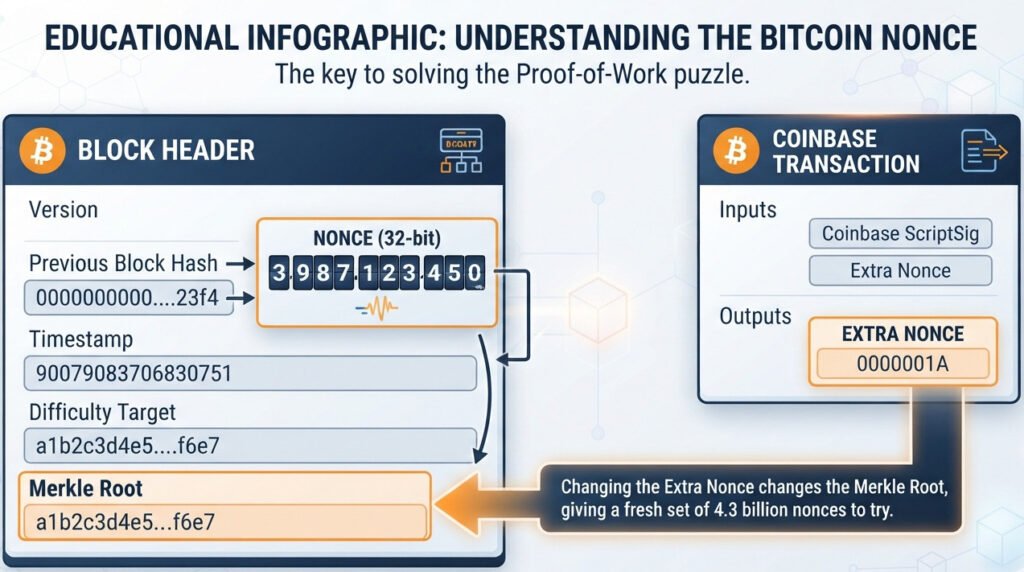
In the Bitcoin block header, the field allocated for the nonce is surprisingly small: just 32 bits.
How many possible nonces does this allow?
2^32 = 4,294,967,296
That’s approximately 4.3 billion possible values.
In the early days of Bitcoin, when the network’s total hash rate was low, this was more than enough. A single miner could cycle through all 4.3 billion nonces in a reasonable amount of time, and one of those attempts was very likely to produce a valid hash.
However, the total hash rate of the Bitcoin network has grown exponentially. Today, the entire network performs many quintillions of hashes per second. A single modern mining machine (an ASIC) can exhaust the entire 32-bit nonce space in a fraction of a second.
This leads to a problem: what happens if a miner tries all 4.3 billion nonces and none of them produce a hash that meets the difficulty target?
Expanding the Search Space: When the Nonce Isn’t Enough
If the 32-bit nonce were the only thing miners could change, the mining process would frequently grind to a halt. They would exhaust the entire “scratch-off” area on their lottery ticket in under a second and be stuck.
To solve this, miners have clever ways to change the block header data just enough to get a “fresh set” of 4.3 billion nonce attempts. They are essentially grabbing a whole new book of lottery tickets.
There are two primary ways they do this:
1. Rolling the Timestamp:
The block header includes a timestamp. While this is meant to be the current time, there is a small amount of flexibility allowed by the protocol. A miner can slightly adjust the timestamp value (by a few seconds) and this change, while small, will completely alter the input to the hash function. This gives them a brand new block header to hash, allowing them to restart the nonce counter from 0 and try all 4.3 billion possibilities again.
2. The “ExtraNonce” (The Real Secret Weapon):
The most common and flexible method involves a part of the block we’ve discussed before: the coinbase transaction. This is the special transaction that the miner includes to award themselves the new bitcoin.
A part of this coinbase transaction, called the coinbase script or scriptSig, can contain arbitrary data. Miners use a portion of this space as an “extra nonce.”
When a miner exhausts the 32-bit nonce in the block header, they simply increment the extra nonce within the coinbase transaction.
- This changes the coinbase transaction.
- This, in turn, changes the hash of the coinbase transaction.
- This changes the Merkle Root of the block (since the Merkle tree must be recalculated).
- This changes the block header (since the Merkle root is in the header).
Voila! The miner now has a completely new block header to work with and can restart the main 32-bit nonce counter from 0 again. By combining the 32-bit header nonce with a variable-sized extra nonce, miners have a virtually infinite search space to explore, ensuring they can always keep hashing until a solution is found.
The nonce, in its simplicity, is the beating heart of the Proof-of-Work algorithm. It’s the small, moving part that allows miners to perform their brute-force search. While the 32-bit field in the header is small, the clever use of the extra nonce ensures that the lottery can continue indefinitely, providing the continuous, costly, and verifiable “work” that secures the entire Bitcoin network.
