Sequentia Explores: The Mathematics of Crypto
Part III: Historical Ciphers & the Dawn of Cryptanalysis
Lecture 35: The Hash Puzzle: Finding a Number That Starts with Zeros
In technology, few terms are as hyped and misunderstood as “mining” in the context of cryptocurrencies like Bitcoin. It conjures images of complex financial wizardry. But what if I told you that, at its core, “mining” is nothing more than a global, high-speed guessing game—a simple but profoundly difficult hash puzzle?
Today, we’re going to demystify the concept of Proof-of-Work and explain the elegant hash-based puzzle that miners around the world are competing to solve every ten minutes.
The Goal: Finding a “Golden Hash”
As we learned, a cryptographic hash function like SHA-256 takes some input data and produces a fixed-size, seemingly random output. For SHA-256, this is a 256-bit number.
The Bitcoin network sets a target for the next block’s hash. This target is an extremely small number. The puzzle for miners is to find a hash for their candidate block that is less than or equal to the current target.
The easiest way to think about this is that the resulting hash must start with a certain number of leading zeroes.
- A hash is just a big number, usually represented in hexadecimal.
- FFFF… is a very large number.
- 0000… is a very small number.
So, the puzzle can be simplified to: Find a hash that starts with a long string of zeroes.
The number of required leading zeroes is determined by the network’s difficulty. The more zeroes required, the smaller the target number, and the harder the puzzle becomes.
The Ingredients for the Hash
To solve this puzzle, a miner assembles a “candidate block.” This block’s data includes:
- The hash of the previous block (linking them in a chain).
- A summary of all the new transactions to be included (the Merkle root).
- A timestamp.
- And one special, variable piece of data: the nonce.
The nonce (which stands for “number used once”) is simply a random number that the miner can change. This is the only part of the block’s header data that miners have control over.
The “Work” in Proof-of-Work: A Brute-Force Guessing Game
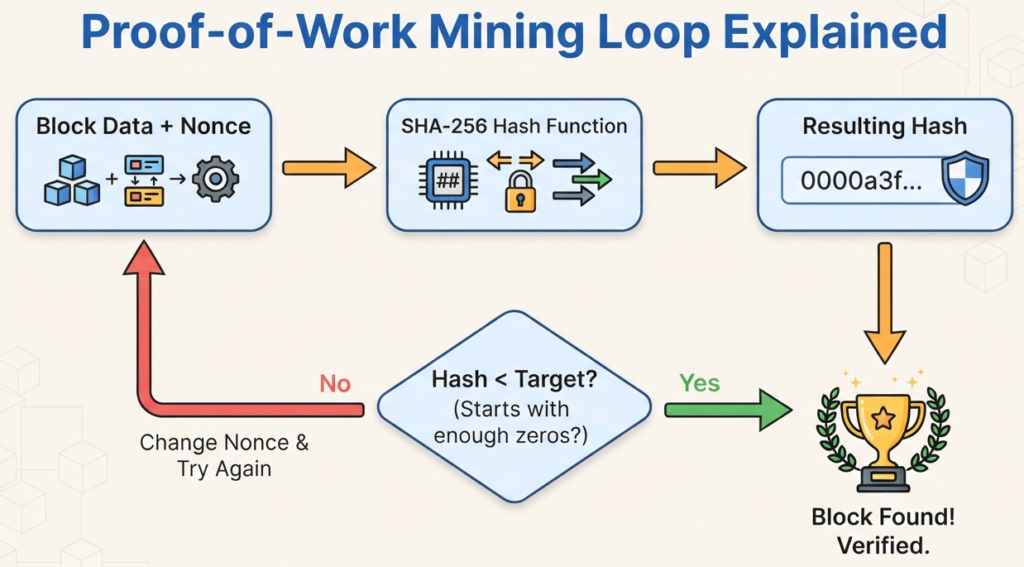
Here is the entire process of mining, stripped of all jargon:
- A miner takes all the fixed data for their block (previous hash, transaction summary, etc.).
- They pick a random number for the nonce.
- They combine the block data and the nonce.
- They calculate the SHA-256 hash of this combined data.
- They look at the resulting hash. Does it start with the required number of zeroes (i.e., is it less than the target)?
- If yes: Success! The miner has “found” the block. They broadcast their solution (the block with the winning nonce) to the network.
- If no: Failure. The miner changes the nonce slightly (e.g., adds 1 to it) and goes back to Step 3.
That’s it. That is the entirety of the “work.” It is a massive, high-speed, brute-force guessing game.
Why is This Difficult?
The difficulty comes from the properties of cryptographic hash functions we’ve already learned about.
- Pre-image Resistance (One-Way): A miner cannot start with the desired hash (e.g., 00000…) and work backward to figure out what the nonce should be. The one-way nature of SHA-256 makes this impossible.
- Avalanche Effect: A tiny change to the input (like changing the nonce from 123 to 124) results in a completely different and unpredictable output hash. There is no way to “get closer” to a solution. A hash that starts with one zero is no more likely to lead to a hash with twenty zeroes than a hash that starts with an ‘F’.
Because of these properties, the only strategy is to guess, hash, and check, over and over again, trillions of times per second, across a global network of specialized hardware. The first miner to get lucky and find a nonce that produces a “golden hash” wins the right to add their block to the blockchain and is rewarded with newly created bitcoin.
Why is This Verifiable?
This is the second, equally brilliant part of the system. While finding the solution is incredibly difficult, verifying it is trivially easy.
When a winning miner broadcasts their block and the winning nonce, any other node on the network can verify it in a fraction of a second:
- They take the same block data.
- They use the winning nonce provided by the miner.
- They perform a single SHA-256 hash calculation.
- They check if the result is indeed less than the target.
This asymmetry between the difficulty of solving and the ease of verifying is what makes Proof-of-Work so effective. It costs an immense amount of energy (work) to find a valid block, but it costs virtually nothing for the rest of the network to confirm that the work was done correctly. This is what secures the network and makes it prohibitively expensive for an attacker to try and rewrite the history of the blockchain.
The hash puzzle, in its elegant simplicity, is a system that converts raw computational power into provable, verifiable trust.
