Sequentia Explores: The Mathematics of Crypto
Part III: Historical Ciphers & the Dawn of Cryptanalysis
Lecture 33: Pre-image Resistance: The “One-Way” Nature of Hashes
In our last lecture, we explored the crucial concept of collision resistance—the property that makes it infeasible to find two different inputs that produce the same hash. This is vital for protecting against forgery. Today, we turn our attention to another core property, one that is fundamental to the very idea of a “one-way” function: pre-image resistance.
The concept is simple and direct:
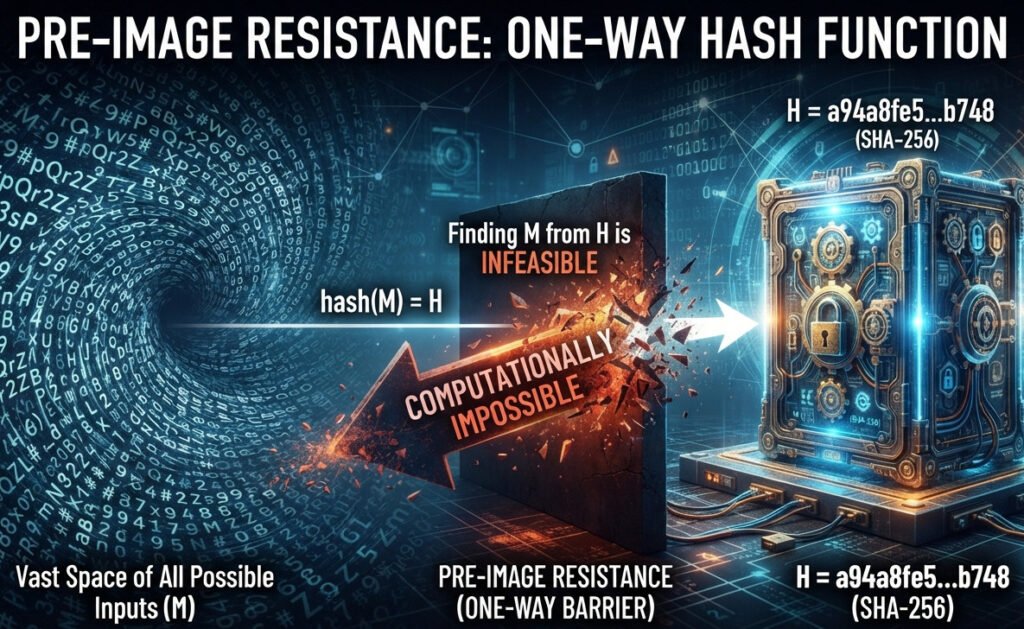
Pre-image resistance means that given a specific hash output H, it is computationally infeasible to find any input M such that hash(M) = H.
Think back to our blender analogy. Pre-image resistance is the guarantee that if I show you a cup of a finished smoothie, you cannot figure out the original recipe of fruits that went into it. You can’t “un-blend.” The process is irreversible.
This property is what makes a hash function a true one-way function.
Pre-image Resistance vs. Collision Resistance
It’s easy to confuse these two properties, but they describe different security goals against different types of attacks.
- Collision Resistance: An attacker is free to generate any two inputs they want, M1 and M2, in an effort to make their hashes match. hash(M1) = hash(M2). The attacker controls both inputs. This is what the Birthday Attack targets.
- Pre-image Resistance: An attacker is given a specific, fixed target hash, H. Their only goal is to find any input M that produces that exact hash. hash(M) = H. The attacker does not control the target hash.
Finding a pre-image is significantly harder than finding a collision. For a secure n-bit hash function:
- Finding a collision takes roughly 2^(n/2) operations (due to the Birthday Problem).
- Finding a pre-image takes roughly 2^n operations (you have no choice but to guess inputs until you get a match).
For SHA-256 (with a 256-bit output), a pre-image attack would require 2^256 operations on average—a number so vast it is physically impossible.
The Most Famous Application: Protecting Your Passwords
Pre-image resistance is the single most important property for secure password storage.
When you create an account on a well-designed website, the service should never store your actual password in its database. Doing so would be a massive security risk; if the database were ever stolen, the attackers would have a list of all users’ plain-text passwords.
Instead, the website does the following:
- When you sign up, you enter your password, say, P@ssw0rd123!.
- The server calculates the cryptographic hash of your password: hash(“P@ssw0rd123!”), which might result in something like ef92…
- The server stores your username and this hash, ef92…, in the database. Your original password is immediately discarded.
When you log in later:
- You enter your password P@ssw0rd123! again.
- The server hashes the password you just entered.
- It then compares the newly generated hash to the hash it has stored in the database.
- If the hashes match, the server knows you entered the correct password and logs you in. If they don’t match, access is denied.
At no point does the server need to know or see your original password. Now, imagine an attacker steals this database. They will have a list of usernames and their corresponding password hashes. Can they log in as you?
Not directly. To log in, they need your original password. To find your original password from the hash ef92…, they would have to reverse the hash function. But because the hash function has pre-image resistance, this is computationally infeasible. They can’t “un-hash” it to get your password.
(Note: This is a simplified explanation. Modern password hashing uses additional techniques like “salting” and “key stretching” to make even dictionary attacks on stolen hash databases much harder, a topic we’ll explore later.)
The “Proof-of-Work” Puzzle in Mining
Pre-image resistance is also the property that makes cryptocurrency mining (like in Bitcoin) a valid “proof-of-work” system.
In simple terms, Bitcoin miners are constantly trying to solve a hash puzzle. The Bitcoin network gives them a target hash value (e.g., a hash that must start with a certain number of zeroes). The miners’ job is to find an input (by combining transaction data with a random number called a “nonce”) that, when hashed, produces a result less than the target value.
Because of pre-image resistance, there is no “shortcut” to solving this. They cannot start with the desired hash output and work backward to find the right nonce. Their only strategy is to:
- Try a nonce.
- Hash the data.
- Check if the hash meets the criteria.
- If not, increment the nonce and repeat.
They are essentially brute-force guessing inputs until they get lucky. This process requires an enormous amount of computational work (energy), which is the “work” in “proof-of-work.” The pre-image resistance of the SHA-256 hash function guarantees that this work is genuinely difficult and cannot be cheated.
Pre-image resistance is the embodiment of a one-way function. It’s the mathematical guarantee that once data has gone down the hashing rabbit hole, there’s no coming back, providing a robust foundation for password protection and proof-of-work systems.
In our next lecture, we’ll take a conceptual look inside the SHA (Secure Hash Algorithm) family to see how these one-way, collision-resistant functions are actually constructed.
