Sequentia Explores: The Mathematics of Crypto
Part III: Historical Ciphers & the Dawn of Cryptanalysis
Lecture 31: Cryptographic Hashing: The Unbreakable Digital Fingerprint
Welcome to Part V of our series! We’re temporarily shifting our focus away from the confidentiality of encryption and turning to a different, but equally vital, pillar of information security: Integrity. How can we be certain that a file, a message, or a piece of data has not been altered, either accidentally or maliciously?
The tool for this job is a special kind of one-way function called a cryptographic hash function.
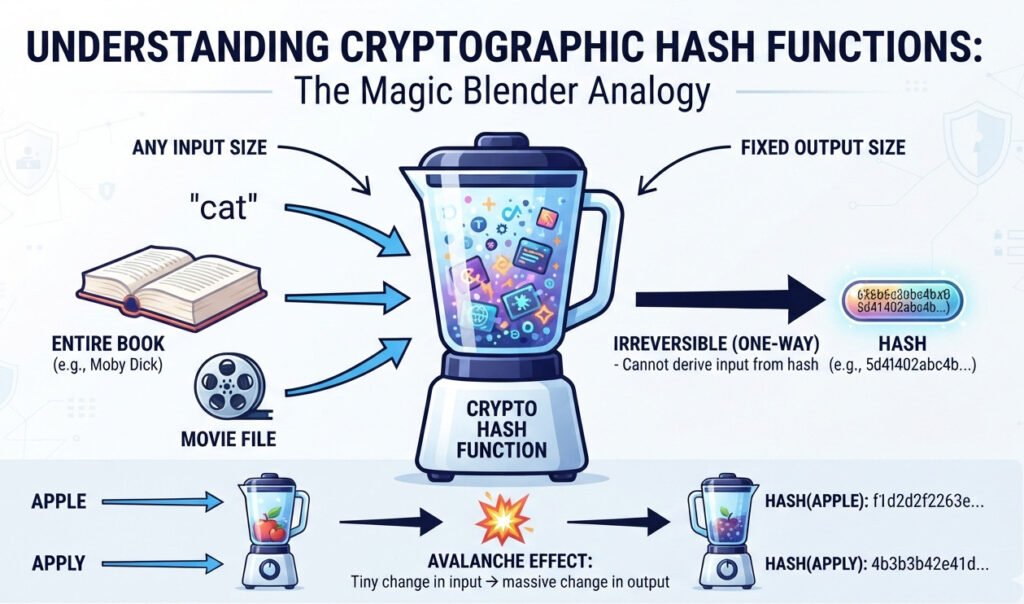
We’ve mentioned hashes briefly before, especially when we discussed digital signatures. Today, we give them the full spotlight. A hash function is a mathematical algorithm that takes an input of any size—a single word, a 1000-page book, an entire movie file—and produces a fixed-size, seemingly random string of characters as its output. This output is called a hash, a hash value, or a digest.
Think of a cryptographic hash as a unique, unbreakable digital fingerprint for your data.
The Blender Analogy
To build an intuition for how this works, imagine a hyper-advanced, irreversible blender.
- You can put anything into the blender: a single strawberry, a whole pineapple, or an entire fruit salad.
- You press the button.
- The blender always runs for the exact same amount of time and produces exactly one cup of smoothie.
- The final smoothie’s color and texture are a complex mix of everything you put in, but the output is always the same size (one cup).
This is what a hash function does. The input is your data (the fruit), the function is the blender, and the output is the hash (the smoothie). But this blender has some special, “magical” properties that make it cryptographically secure.
The Core Properties of a Cryptographic Hash Function
For a hash function to be useful in cryptography, it must have the following essential properties:
1. Deterministic:
- The Rule: The same input will always produce the exact same output.
- Analogy: If you put the exact same fruit combination into our magic blender, you will get the exact same smoothie every single time.
- Why it Matters: This reliability is crucial. If hashing the same file produced different fingerprints, we could never use it to verify data integrity.
2. Fixed-Size Output:
- The Rule: The output hash is always the same length, regardless of the input’s size.
- Analogy: Our blender always produces exactly one cup of smoothie, whether you started with a single grape or a whole watermelon.
- Why it Matters: A well-known hash function like SHA-256 will always produce a 256-bit (64-character hexadecimal) hash. This makes hashes predictable in size and easy to store and compare.
3. Pre-image Resistance (One-Way):
- The Rule: It is computationally infeasible to reverse the process. Given a hash output, you cannot figure out the original input.
- Analogy: Looking at the finished smoothie and trying to perfectly reconstruct the original fruits. It’s impossible. You can’t “un-blend.”
- Why it Matters: This is the one-way property that makes hashes useful for things like password storage. A website can store the hash of your password, not the password itself. When you log in, they hash the password you enter and compare it to the stored hash. They can verify your password without ever knowing what it is.
4. Second Pre-image Resistance (Cannot Find a Match):
- The Rule: Given a specific input and its hash, it is computationally infeasible to find a different input that produces the exact same hash.
- Analogy: You have a strawberry and the smoothie it makes. You cannot find another fruit or combination of fruits that will produce that identical strawberry smoothie.
- Why it Matters: This prevents an attacker from taking a legitimate document (like a contract), creating a fraudulent version, and having it produce the same hash as the original.
5. Collision Resistance (The “Avalanche Effect”):
- The Rule: It is computationally infeasible to find any two different inputs that produce the same hash output. More importantly, even a tiny, single-bit change in the input will result in a completely different, unpredictable output hash. This is called the avalanche effect.
- Analogy: If you make a smoothie with a strawberry, and then make another one with the exact same ingredients but add a single grain of sugar, the second smoothie will come out as a completely different, unrecognizable color and texture.
- Why it Matters: This is the key to data integrity. Let’s see it in action. Using the SHA-256 hash function:
- Input: Hello Sequentia!
- Hash: 3a4f… (abbreviated)
- Input: Hello Sequentia. (Just adding a period)
- Hash: e7f2… (Completely different!)
If Alice hashes her document and sends both the document and the hash to Bob, Bob can re-hash the document he receives. If his calculated hash matches the one Alice sent, he can be virtually certain that the document has not been altered by so much as a single comma.
Hashes vs. Encryption: A Key Difference
It’s crucial to remember that hashing is not encryption.
- Encryption is a two-way process. You encrypt data to keep it secret, with the intention of decrypting it later. It requires a key.
- Hashing is a one-way process. You hash data to create a fingerprint for integrity verification. You can never recover the original data from its hash.
Cryptographic hash functions are the workhorses of data integrity. They provide a powerful, efficient, and unbreakable way to create a digital fingerprint for any piece of data, forming the basis for everything from secure password storage to the very structure of blockchains.
In our next lecture, we’ll look at the most famous and widely used hash algorithm family in the world: SHA (Secure Hash Algorithm).
