Sequentia Explores: The Mathematics of Crypto
Part III: Historical Ciphers & the Dawn of Cryptanalysis
Lecture 28: Why ECC is Winning: Smaller, Faster, Stronger than RSA
For the past several lectures, we’ve explored two giants of public-key cryptography: RSA and Elliptic Curve Cryptography (ECC). Both are brilliant systems that solve the key exchange problem using trapdoor one-way functions. Both allow Alice and Bob to communicate securely without a pre-shared secret.
- RSA’s security is built on the Integer Factorization Problem: it’s hard to find the two prime factors of a very large number.
- ECC’s security is built on the Elliptic Curve Discrete Logarithm Problem (ECDLP): it’s hard to find how many times a base point P was “added” to itself to reach a final point Q.
Given that both work, a natural question arises: is one better than the other? And why, in many modern applications, from your smartphone’s messaging app to the world of cryptocurrencies, is ECC increasingly the preferred choice?
The answer is simple and profound: for a given key size, the “hard problem” in ECC is believed to be significantly harder than the “hard problem” in RSA.
“Hard” vs. “Harder”: A Tale of Two Problems
While we’ve described both factoring and the ECDLP as “computationally infeasible” for large numbers, they are not equally difficult. Mathematicians and computer scientists have spent decades developing algorithms to attack these problems.
The best-known algorithms for factoring the large numbers used in RSA (like the General Number Field Sieve) are more efficient than the best-known algorithms for solving the ECDLP (like Pollard’s rho algorithm).
This doesn’t mean RSA is “easy” to break—it’s not! A 2048-bit RSA key is still considered secure for the foreseeable future. However, it does mean that to achieve the same level of security, the numbers used in RSA need to be dramatically larger than the numbers used in ECC.
The Power of Smaller Keys: Security per Bit
This difference in difficulty leads to the single greatest advantage of ECC: superior security per bit.
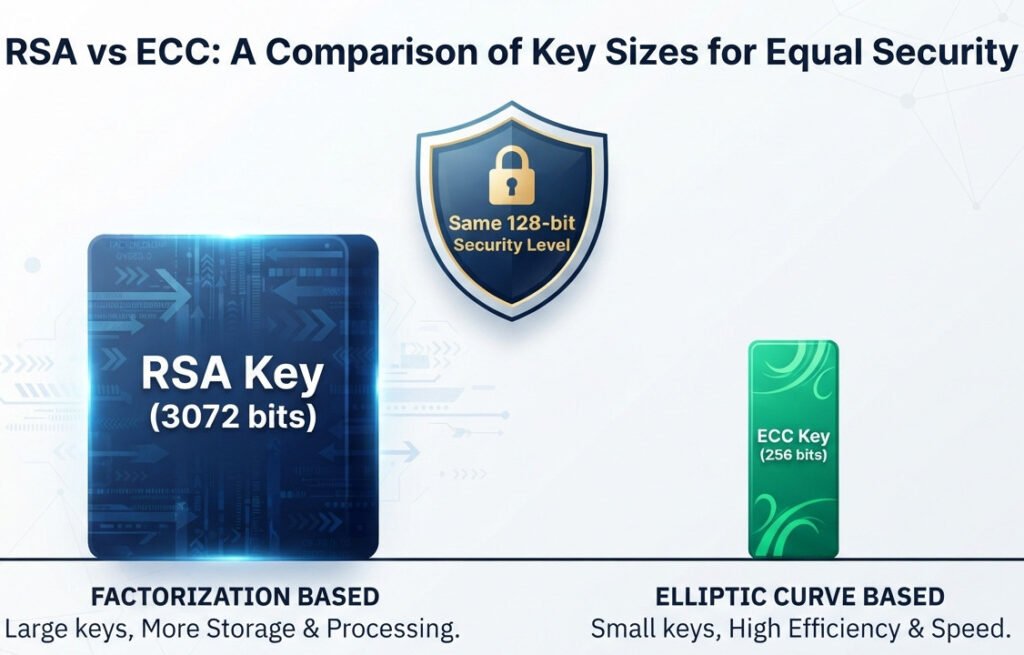
ECC can provide the same level of security as RSA but with much, much smaller key sizes. Let’s look at the standard key size comparisons recommended by security agencies like NIST:
| Symmetric Key Equivalent (Security Level) | RSA Key Size (bits) | ECC Key Size (bits) |
| 80 bits (low security) | 1024 | 160 |
| 128 bits (standard security) | 3072 | 256 |
| 192 bits (high security) | 7680 | 384 |
| 256 bits (top secret/long-term) | 15360 | 521 |
As you can see, the difference is dramatic. To get the same 128-bit level of security:
- An RSA key needs to be 3072 bits long.
- An ECC key only needs to be 256 bits long.
That means the ECC key is over 10 times smaller! This isn’t just a trivial difference; it has massive practical implications.
Why Smaller Keys are a Game-Changer
- Faster Computations: The mathematical operations in cryptography (like exponentiation or point multiplication) become significantly more intensive as the numbers get larger. A calculation involving a 256-bit number is vastly faster than the same type of calculation involving a 3072-bit number. This means:
- Faster Key Generation: Creating a new ECC key pair is quicker.
- Faster Encryption/Decryption (for signatures): The signing and verification process is much faster. This is crucial for servers that need to handle thousands of secure connections per second (like with TLS/HTTPS).
- Less Data to Transmit: When establishing a secure connection, keys and signatures need to be sent over the network. A smaller ECC key/signature takes up less bandwidth. This might not matter for your home broadband, but it’s a huge deal for:
- Mobile Devices: Less data usage means lower battery consumption and faster performance on cellular networks.
- Internet of Things (IoT): Tiny, low-power devices (like smart sensors) have very limited processing power and bandwidth. ECC is often the only feasible public-key option for them.
- Less Storage Required: Smaller keys require less storage space. This is important for devices like smart cards, hardware security modules, and any system that needs to store a large number of certificates or keys.
The Cryptocurrency Connection
This efficiency is precisely why cryptocurrencies like Bitcoin and Ethereum rely on ECC. In a decentralized system, every transaction must be cryptographically signed, and every node on the network must verify that signature.
- The chosen ECC curve (secp256k1) uses 256-bit private keys.
- The resulting signatures are small and can be verified very quickly.
If Bitcoin had been built on RSA with an equivalent level of security, the signatures would be much larger and the verification process much slower. The entire blockchain would be bloated, and the network would be less efficient. ECC’s “security per bit” is essential for the scalability and performance of such systems.
Is RSA Dead?
Not at all. RSA is a brilliant, foundational algorithm that is still widely used and secure at appropriate key lengths (2048-bit or 4096-bit). It has been around for longer, is arguably simpler to understand conceptually, and is deeply embedded in much of the internet’s infrastructure.
However, for new applications, especially those where performance, bandwidth, and power consumption are critical, ECC is the clear winner and the modern standard. It represents a more advanced and efficient application of the core principles of public-key cryptography.
In our next lecture, we’ll see ECC in action as we explore the Elliptic Curve Diffie-Hellman (ECDH) protocol, the modern solution to the key exchange problem.
