Sequentia Explores: The Mathematics of Crypto
Part III: Historical Ciphers & the Dawn of Cryptanalysis
Lecture 23: The One-Way Function: A Mathematical Roach Motel
Welcome to Part IV of our series and a monumental shift in our cryptographic journey! In our last lecture, we hit a wall. We saw that symmetric cryptography, for all its power and speed, suffers from the intractable Key Exchange Problem: how to share a secret key over an insecure channel.
The solution to this problem required a complete paradigm shift, a revolutionary idea that has since become the bedrock of nearly all modern digital security. This idea is built upon a special kind of mathematical process known as a trapdoor one-way function.
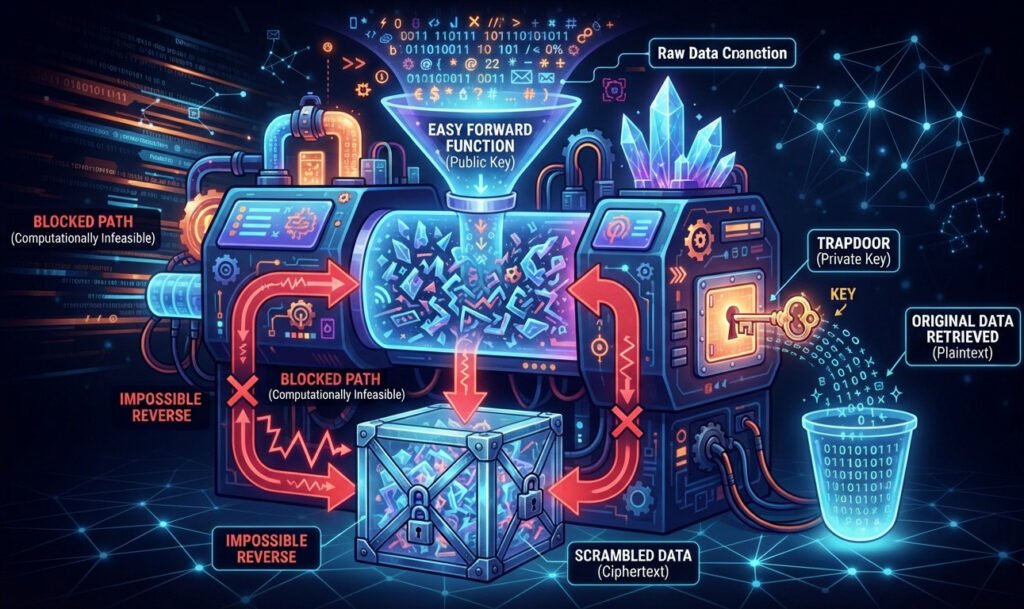
You can think of it as a mathematical “roach motel”: data checks in, but it can’t check out… unless you have a secret key.
What is a One-Way Function?
In mathematics, a one-way function is a function that is easy to compute in the forward direction, but computationally infeasible to compute in the reverse direction (to find the original input from the output).
Let’s use a non-mathematical analogy.
- Easy Forward Operation: Mixing eggs, flour, sugar, and milk to bake a cake. Given the ingredients, it’s a straightforward process to produce the cake.
- Hard Reverse Operation: Looking at a finished cake and trying to determine the exact original ingredients. You can’t “un-bake” the cake. You might be able to guess the ingredients, but you’ll never be able to perfectly retrieve the original eggs, flour, and milk.
Cryptography relies on mathematical versions of this principle. We’ve already encountered two prime candidates in our toolkit:
- Integer Factorization:
- Easy Forward: Multiplying two large prime numbers p and q to get N.
- Hard Reverse: Given N, finding the original factors p and q.
- The Discrete Logarithm Problem (DLP):
- Easy Forward: Calculating y = g^x mod p.
- Hard Reverse: Given y, g, and p, finding the original exponent x.
These are one-way functions. They provide a way to scramble data that is incredibly difficult to unscramble. But for a public-key system, we need one more crucial component. We need a way for the intended recipient to be able to reverse the function easily.
Introducing the “Trapdoor”
A trapdoor one-way function is a special kind of one-way function that has a secret “backdoor.” The function is still incredibly hard to reverse for everyone except for someone who possesses a secret piece of information—the trapdoor. With this trapdoor, the reverse operation becomes just as easy as the forward one.
Let’s revisit our analogies:
- The Cake Analogy with a Trapdoor: Imagine our cake-baking process. It’s still a one-way function. But what if the baker kept a secret, hyper-detailed logbook (the “trapdoor”) of the exact brand of flour, the temperature of the eggs, and the precise mixing time? For anyone else, “un-baking” the cake is impossible. But for the baker with the logbook, they can perfectly replicate or “reverse” the process by knowing the secret inputs.
- The Lockbox Analogy: A high-security lockbox is a perfect real-world example.
- Forward Operation (Easy for Anyone): Anyone can put a message into the mail slot of the lockbox and close the lid. The message is now secure.
- Reverse Operation (Hard for Everyone): No one can get the message back out through the mail slot. The box is designed to be one-way.
- The Trapdoor (Easy for One Person): The owner of the lockbox has a key. With this secret key (the trapdoor), they can easily open the lockbox and retrieve the message.
The Foundation of Public-Key Cryptography
This “lockbox” model is exactly how public-key cryptography works.
The public key defines the “easy forward” part of the function—the open mail slot. Anyone can use the public key to encrypt a message.
Ciphertext = Encrypt(Plaintext, PublicKey)
The mathematical difficulty of reversing the one-way function is what prevents anyone else from opening the lockbox. Eve, who knows the public key and sees the ciphertext, is stuck. She can’t reverse the encryption because she’s missing the secret information.
The private key is the trapdoor. It’s the secret information that makes the “hard reverse” problem easy. Only the holder of the private key can decrypt the message.
Plaintext = Decrypt(Ciphertext, PrivateKey)
The Asymmetric Relationship
This is why this system is called asymmetric cryptography. The key used to encrypt (the public key) is different from the key used to decrypt (the private key). They are mathematically linked, but it is computationally infeasible to derive the private key from the public key.
- Alice’s Public Key: The open mail slot.
- Alice’s Private Key: The physical key to the lockbox.
This elegantly solves the key exchange problem. Bob can publicly broadcast his public key. Alice can use it to encrypt a message for him. Even if Eve intercepts the public key and the encrypted message, she cannot decrypt it. Only Bob, with his corresponding private key, can unlock the message.
The entire revolution of public-key cryptography rests on the existence of these mathematical trapdoor one-way functions. The genius of cryptographers in the 1970s was in discovering and proving that problems from number theory—like integer factorization and the discrete logarithm problem—could be cleverly engineered to serve as this mathematical roach motel, finally allowing two strangers to share a secret in public.
In our next lecture, we’ll see the very first practical application of this idea: the Diffie-Hellman Key Exchange.
