Sequentia Explores: The Mathematics of Crypto
Part VII: Advanced Concepts & The Frontier
Lecture 48: Ring Signatures: The Math of Anonymous Group Signatures
In our journey through digital signatures, we learned how a signature provides authenticity—unforgeable proof that a specific individual, Alice, authorized a specific message. This is fantastic for accountability, but what if the goal is the opposite? What if you need to prove a message came from a legitimate member of a group, but you want to protect the anonymity of the specific individual within that group?
Imagine a high-level government whistleblower needs to leak a document to a journalist. They want the journalist to know the document is authentic—that it came from a “senior official” in a specific department—but they don’t want to reveal which senior official they are, for fear of reprisal.
A standard digital signature would reveal their identity. They need a different tool. This is the problem solved by a clever cryptographic construction called a Ring Signature.
What is a Ring Signature?
A Ring Signature is a type of digital signature that can be created by any member of a defined “ring” or group of users, each with their own unique private/public key pair. The signature provides two key properties:
- Correctness: A verifier can check that the signature was indeed created by a legitimate member of the specified ring.
- Anonymity: The verifier has no way of knowing which specific member of the ring created the signature. To an outsider, all members of the ring are equally plausible signers.
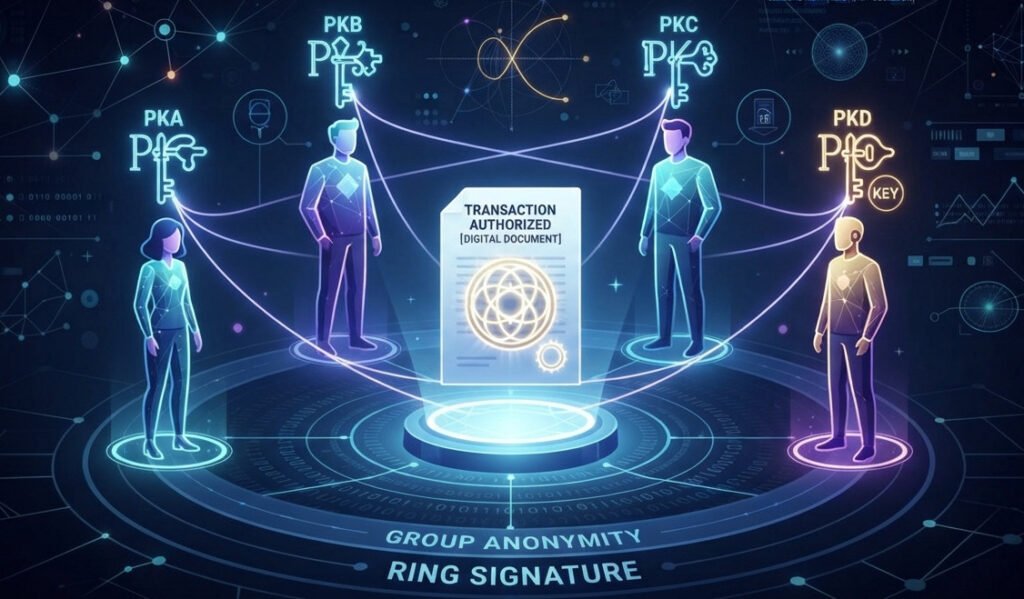
Think of it like an anonymous joint statement. Imagine four executives in a boardroom sign a press release. With a normal signature, you’d see four distinct names. With a ring signature, the document is simply stamped with “Signed by a Member of the Board of Executives,” and this stamp is mathematically verifiable, yet the individual who applied it remains anonymous.
How Do They Work? (A High-Level Conceptual Look)
The mathematics behind ring signatures can be quite complex, but we can understand the core idea conceptually without diving into the full equations.
Let’s say Alice wants to sign a message M on behalf of a ring that includes herself, Bob, Carol, and Dave. Each of them has a public key (P_A, P_B, P_C, P_D) and a corresponding secret private key (S_A, S_B, S_C, S_D). Alice is the actual signer.
- Define the Ring: Alice starts by defining the group of possible signers. She gathers the public keys of everyone she wants to include in the ring (including her own): {P_A, P_B, P_C, P_D}.
- The “Signing” Process (The Clever Part):
- For everyone in the ring except herself (Bob, Carol, Dave), Alice can perform a cryptographic operation using their public keys. She essentially creates a series of “fake” signature components that are mathematically consistent but could not have been created without knowing their private keys.
- For her own signature component, she uses her private key S_A. This is the one piece of the puzzle that only she can create.
- Closing the Ring: She then combines her one “real” signature component with all the “fake” components for the other members and mathematically “locks” them together in a ring-like structure using a hash function. The final output is the single, unified ring signature.
The Verification Process:
When a verifier receives the message M and the ring signature, they also have the list of public keys {P_A, P_B, P_C, P_D}.
The verification algorithm checks the signature against the entire set of public keys. The mathematics are designed such that the signature will be valid if and only if one of the components was created with a corresponding private key.
However, because all the components (the one real one and all the “fake” ones) are mathematically indistinguishable from each other without the private keys, the verifier cannot tell which public key corresponds to the private key that was actually used. All they can prove is that someone in the ring must be the true signer.
Key Properties:
- No Setup or Coordination: Alice can create a ring signature including anyone’s public key without their consent or cooperation. She just needs their public key, which is, by definition, public.
- Signer Anonymity: As the size of the ring (the number of public keys included) increases, the anonymity of the actual signer increases proportionally. If there are 100 members in the ring, the signer has a 1-in-100 chance of being identified by a pure guess.
Real-World Application: Privacy-Focused Cryptocurrencies
While useful for whistleblowing or anonymous voting, the most prominent use of ring signatures today is in privacy-focused cryptocurrencies, most famously Monero (XMR).
In Bitcoin, every transaction is public. If you know someone’s address, you can trace all their incoming and outgoing payments. Monero aims to break these links and provide financial privacy. It uses ring signatures to obscure the sender of a transaction.
When Alice sends Monero, her transaction is signed by a ring that includes her own UTXO (the “coin” she is spending) and a number of other random UTXOs pulled from the blockchain (the “decoys”). The resulting ring signature proves that a valid, unspent coin from that group was used, but no one on the network can tell which one was the real one being spent and which were just decoys.
This provides sender anonymity, a core feature of Monero’s privacy model.
Ring signatures are a powerful cryptographic tool that elegantly solves the problem of group anonymity. By cleverly combining one secret private key with many public keys, they create a verifiable signature that points to the authority of a group while protecting the identity of the individual.
