Sequentia Explores: The Mathematics of Crypto
Part VI: Building a Blockchain – The Math of a Distributed Ledger
Lecture 46: Zero-Knowledge Proofs: Proving a Secret Without Revealing It (Conceptual)
Welcome to Part VII of our series, where we venture to the cutting edge of modern cryptography. So far, our tools have focused on hiding information (encryption) or verifying its origin (digital signatures). But what if you need to prove you know a secret without revealing the secret itself?
This sounds like a logical paradox. How can you prove you know a password without saying the password? How can you prove you solved a Sudoku without showing the solution?
This is the challenge addressed by one of the most powerful and mind-bending concepts in all of cryptography: the Zero-Knowledge Proof (ZKP).
A Zero-Knowledge Proof is a cryptographic protocol in which one party (the Prover) can prove to another party (the Verifier) that a given statement is true, without conveying any information whatsoever apart from the fact that the statement is indeed true.
Let’s unpack that with the most famous analogy for ZKPs.
The Parable of Ali Baba’s Cave
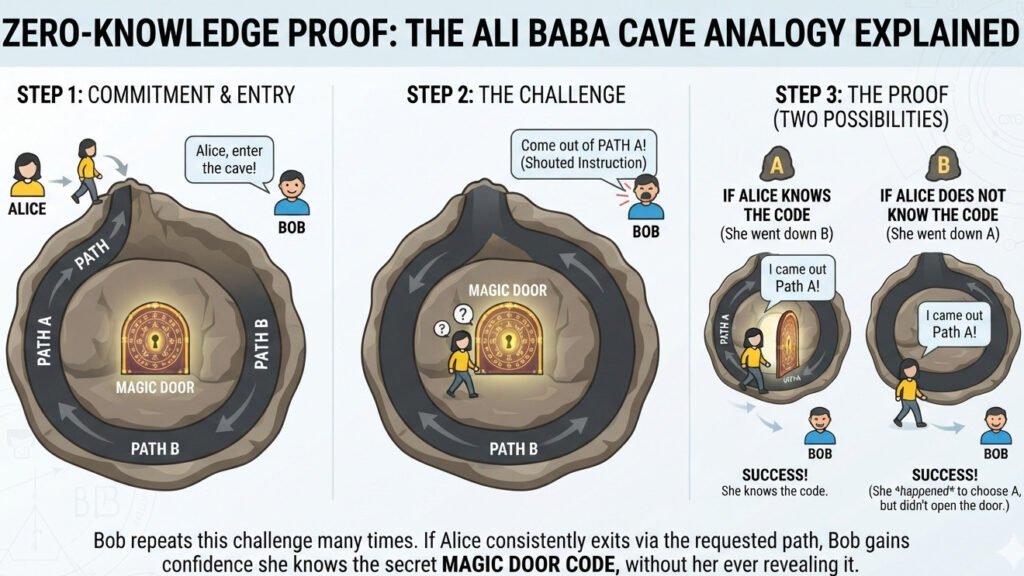
Imagine a circular cave with a single entrance and a magic door deep inside that connects the two paths. This magic door can only be opened by speaking a secret password.
- Alice is the Prover. She wants to prove to Bob that she knows the secret password to the magic door.
- Bob is the Verifier. He wants to be sure Alice knows the password, but Alice doesn’t want to tell him the password itself.
Here is the protocol they follow:
- Bob stands outside the cave entrance, where he cannot see which path Alice takes.
- Alice enters the cave and walks down one of the two paths, either Path A or Path B, chosen at random.
- After Alice has disappeared inside, Bob walks to the entrance and shouts, “Come out of Path A!” (or Path B, chosen at random).
- Alice hears the instruction and complies:
- If she initially went down Path A and Bob shouts “Come out of Path A,” she simply walks back out.
- If she initially went down Path B and Bob shouts “Come out of Path A,” she must use the secret password to open the magic door, cross over to Path A, and then walk out.
- Bob sees Alice emerge from the correct path. He is now a little more convinced that she knows the password.
Why is this a proof?
If Alice doesn’t know the password, she is stuck in the path she chose. She would only be able to emerge from the correct path Bob calls out if, by sheer luck, he happened to call the path she originally went down. This means an imposter has a 50% chance of fooling Bob in a single trial.
But what happens if they repeat the experiment?
- Chance of fooling Bob twice in a row: 50% × 50% = 25%
- Chance of fooling him three times: 12.5%
- After 10 trials, the chance is less than 0.1%.
- After 20 trials, the chance of an imposter succeeding is less than one in a million.
After a sufficient number of successful trials, Bob can be statistically certain, to an arbitrarily high degree of probability, that Alice must know the secret password.
And why is it “Zero-Knowledge”?
This is the most brilliant part. During this entire process, Bob has learned nothing about the secret password itself. He only sees Alice entering the cave and emerging from the path he called. He never hears the password, sees the door open, or learns anything that would help him figure out the password later. Alice has proven her knowledge of the secret while revealing zero information about the secret itself.
The Three Properties of a Zero-Knowledge Proof
For a protocol to be a true ZKP, it must satisfy three properties:
- Completeness: If the Prover’s statement is true (i.e., they really do know the secret), they will always be able to convince an honest Verifier. (Alice will always pass the test).
- Soundness: If the Prover’s statement is false (i.e., they are lying), they cannot convince an honest Verifier, except with a very small, negligible probability. (An imposter will eventually be caught).
- Zero-Knowledge: The Verifier learns nothing other than the fact that the statement is true. They cannot reconstruct the secret from the interaction. (Bob learns nothing about the password).
Why Do We Need ZKPs? Real-World Applications
This might seem like a clever party trick, but ZKPs are revolutionizing digital privacy and security.
- Authentication: You could prove to a website that you know your password without ever sending the password over the network, making it immune to interception.
- Privacy-Preserving Transactions (e.g., Zcash): In cryptocurrencies, ZKPs can be used to prove that a transaction is valid (e.g., you have sufficient funds, you haven’t double-spent) without revealing the sender, the receiver, or the amount of the transaction. This provides a powerful layer of financial privacy.
- Identity Verification: You could prove to a service that you are over 18 years old by providing a ZKP of your government-issued ID, without revealing your actual birth date, name, or address. You prove the fact (“I am over 18”) without revealing the data.
- Scalability (Blockchain Rollups): In advanced blockchain solutions (like ZK-Rollups), a ZKP can be used to prove that a massive batch of thousands of off-chain transactions were all executed correctly, and then only this tiny, valid proof is submitted to the main blockchain. This dramatically improves scalability.
Zero-Knowledge Proofs are a frontier of cryptography that shifts the paradigm from “encrypting data” to “proving facts without revealing data.” They are complex, built on the advanced mathematics of elliptic curves and polynomial commitments, but their conceptual power is simple: they allow us to achieve verification without sacrificing privacy.
