Sequentia Explores: The Mathematics of Crypto
Part VI: Building a Blockchain – The Math of a Distributed Ledger
Lecture 41: The Math of Bitcoin’s 21 Million Coin Limit
One of the most defining and widely cited features of Bitcoin is its hard cap: there will only ever be a maximum of 21 million bitcoins in existence. This isn’t just a policy or a gentleman’s agreement; it’s a fundamental mathematical rule encoded directly into the core of the Bitcoin protocol.
This scarcity is a key driver of Bitcoin’s economic properties, but how is it actually enforced? The answer lies in a simple, elegant, and unchangeable schedule of diminishing returns, governed by two core parameters: the block reward and the halving event.
The Block Reward: How New Bitcoins are Born
As we’ve discussed, “miners” expend enormous computational power (Proof-of-Work) to solve a hash puzzle. The miner who successfully finds a valid block is granted the right to add it to the blockchain. As a reward for this crucial security work, the protocol allows them to include a special transaction in the block they’ve found, called the coinbase transaction.
This transaction has no inputs; it magically creates new bitcoin out of thin air and awards it to the miner’s address. This “block reward” is the only way new bitcoins are ever introduced into the system.
The Halving: A Predictable Schedule of Scarcity
The genius of Bitcoin’s monetary policy, as designed by Satoshi Nakamoto, is that this block reward is not constant. It is programmed to decrease over time in a perfectly predictable event known as the “halving” (sometimes called the “halvening”).
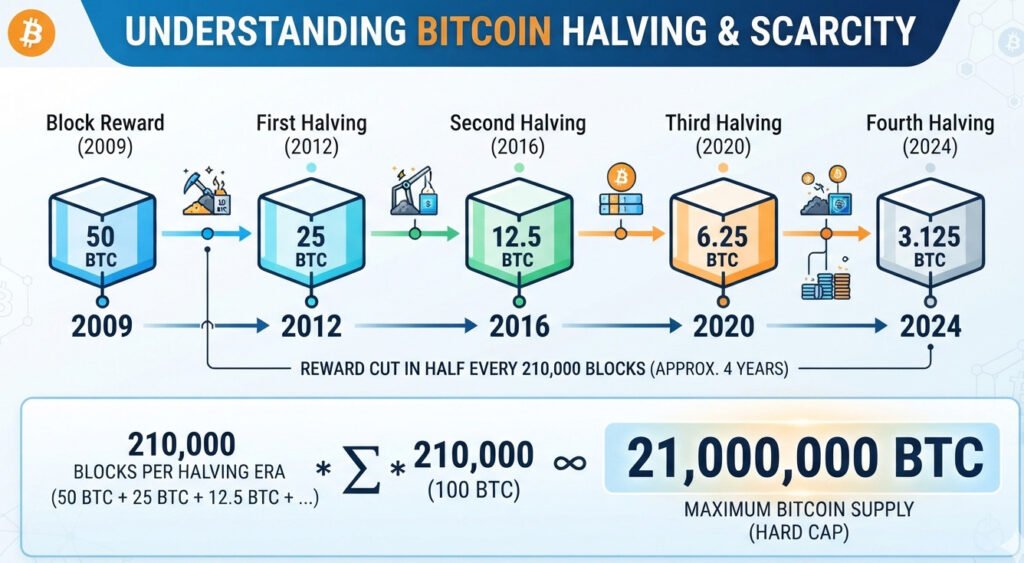
The rule is simple: Every 210,000 blocks, the block reward is cut in half.
- The Bitcoin network is designed to find a new block approximately every 10 minutes.
- 210,000 blocks × 10 minutes/block ≈ 4 years.
- So, approximately every four years, the rate at which new bitcoins are created is slashed by 50%.
Let’s look at the schedule:
- Blocks 1 – 210,000 (2009-2012): The block reward was 50 BTC.
- Blocks 210,001 – 420,000 (2012-2016): The reward halved to 25 BTC.
- Blocks 420,001 – 630,000 (2016-2020): The reward halved to 12.5 BTC.
- Blocks 630,001 – 840,000 (2020-2024): The reward halved to 6.25 BTC.
- Sometime in 2024: The next halving will occur, and the reward will drop to 3.125 BTC.
…and this process will continue.
The Math of an Infinite Series: Why it’s 21 Million
This schedule creates a geometric series. We can calculate the total number of bitcoins that will ever be created by summing the rewards from all these “epochs” (the 210,000-block periods).
Total Bitcoin = (Blocks per Epoch × Reward Epoch 1) + (Blocks per Epoch × Reward Epoch 2) + …
Total Bitcoin = (210,000 × 50) + (210,000 × 25) + (210,000 × 12.5) + (210,000 × 6.25) + …
We can factor out the 210,000:
Total Bitcoin = 210,000 × (50 + 25 + 12.5 + 6.25 + 3.125 + …)
The part in the parentheses is an infinite geometric series where the first term is 50 and the common ratio is 1/2. There is a simple formula for the sum of such a series:
Sum = a / (1 – r)
Where a is the first term and r is the common ratio.
Sum = 50 / (1 – 1/2) = 50 / (1/2) = 100
Now, we can plug this back into our main equation:
Total Bitcoin = 210,000 × 100 = 21,000,000
And there it is. The mathematics is undeniable. The sum of all the block rewards that will ever be created will asymptotically approach, but never exceed, exactly 21 million.
When Will the Last Bitcoin Be Mined?
Because the reward keeps halving, the final fractions of a bitcoin will be mined over a very long period. The block reward will drop to less than one “satoshi” (the smallest unit of bitcoin, 0.00000001 BTC) around the year 2140. At that point, no new full satoshis can be created, and the total supply will be infinitesimally close to 21 million.
What Happens When the Reward Runs Out?
If miners are no longer rewarded with new bitcoin, what is their incentive to continue securing the network with their expensive Proof-of-Work?
The system was designed with a second incentive: transaction fees. Every Bitcoin transaction includes a small fee paid by the sender to the miner who includes their transaction in a block. As the block reward diminishes over the decades, it is anticipated that the total value of transaction fees will rise, providing a sufficient and sustainable incentive for miners to continue their crucial work of securing the network.
The 21 million coin limit is not an arbitrary number. It is the direct and inevitable mathematical consequence of a simple, elegant, and unchangeable algorithm. This programmed scarcity, enforced by the consensus of every node on the network, is one of the fundamental properties that makes Bitcoin a unique economic and technological experiment.
