Sequentia Explores: The Mathematics of Crypto
Part III: Historical Ciphers & the Dawn of Cryptanalysis
Lecture 24: The Public Key Breakthrough: A Box with Two Different Keys
In our last lecture, we introduced the brilliant idea of a trapdoor one-way function: a mathematical process that’s easy to do in one direction, but incredibly difficult to reverse without a secret piece of information. This trapdoor is the key to unlocking (pun intended!) the world of public-key cryptography.
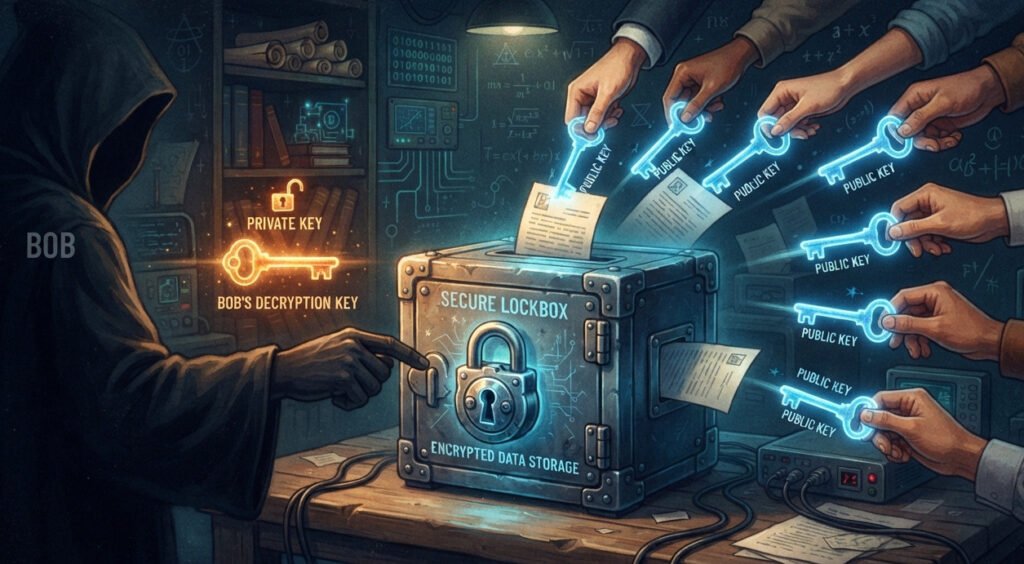
To truly grasp this revolutionary concept, let’s ditch the equations for a moment and focus on a powerful analogy: Imagine a special kind of lockbox that operates in a completely new way. This isn’t your grandfather’s padlock. This is a cryptographic marvel.
This lockbox has two different keys, each with a very specific and limited function.
- The Public Key (The “Locking” Key): This key can only lock the box. You can give copies of this key to everyone you know. Anyone can use it to secure a message inside the box. But—and this is crucial—the public key cannot unlock the box. It is a one-way key.
- The Private Key (The “Unlocking” Key): This key can only unlock the box. This key is a secret known only to you. It’s the only way to retrieve the message from inside.
The genius of this design is that anyone can send you a secret message even if they have never met you before and have no pre-existing secure channel. They simply use your public “locking” key to secure their message inside the box. Only you, with your private “unlocking” key, can open the box and read it.
Let’s put our characters to work to illustrate how this solves the key exchange problem that has plagued symmetric cryptography for centuries.
Alice and Bob’s Asymmetric Communication:
- Bob Creates a Public Key and a Private Key: Bob uses a special algorithm (like RSA or Elliptic Curve Cryptography, which we’ll explore later) to generate his two keys: a Public Key and a Private Key. These keys are mathematically linked but are not the same. He carefully protects his Private Key, keeping it secret and secure.
- Bob Publicly Shares His Public Key: Bob publishes his Public Key on his website, on his social media profiles, or sends it to Alice in an unencrypted email. It doesn’t matter if Eve intercepts it because the Public Key can only be used to encrypt messages to Bob, not to decrypt them.
- Alice Encrypts Her Message Using Bob’s Public Key: Alice writes her secret message. She then uses Bob’s Public Key to encrypt it. This process is designed so that it can only be reversed by Bob’s Private Key. Think of it as Alice dropping the message into the special lockbox and snapping the lid shut with Bob’s “locking” key.
- Alice Sends the Encrypted Message to Bob: Alice sends the encrypted message to Bob over the internet, through the open air, or via carrier pigeon. It doesn’t matter if Eve intercepts it, because even with Bob’s Public Key, Eve cannot decrypt the message.
- Bob Decrypts the Message Using His Private Key: When Bob receives the encrypted message, he uses his Private Key to unlock the box and retrieve Alice’s original secret message. The Private Key is the only key that can do this!
The Key Exchange Problem Solved!
Notice that at no point did Alice and Bob need to share a secret key over a secure channel. Bob simply made his “locking” key public, and only he had the “unlocking” key. This is the core breakthrough of asymmetric cryptography. It solved the centuries-old key exchange problem and made secure communication possible between parties who have never met before.
It all hinges on that special lockbox—the one that has two different keys with one-way properties guaranteed by the mathematics of trapdoor functions.
Analogies and Visualizations
It can be helpful to visualize this. Think of:
- Alice’s Public Key: An open mailbox that anyone can drop a letter into.
- Bob’s Private Key: The key that only Bob has to unlock that mailbox and retrieve the letters.
- The Ciphertext: The locked box that can’t be opened without Bob’s private key.
- Eve: Someone watching people drop letters in the mailbox but unable to read them.
Or think of:
- Alice’s Public Key: A public shredder. Anyone can feed a document into it.
- Bob’s Private Key: A special machine that can reassemble the shredded document perfectly, but only works on documents shredded with that specific public shredder.
The Power of Asymmetry
It all sounds a bit magical, but it’s actually just clever mathematics. In our next lecture, we’ll see our first real implementation of public-key cryptography with the Diffie-Hellman Key Exchange.
With these concepts in mind, prepare to meet this elegant dance of numbers that allows two strangers to share a secret right in front of everyone else.
