Sequentia Explores: The Mathematics of Crypto
Part III: Historical Ciphers & the Dawn of Cryptanalysis
Lecture 22: The Key Exchange Problem: How Do Alice and Bob Share Their Secret Key?
Over the last several lectures, we’ve explored the beautiful and powerful world of symmetric cryptography. From the simple Caesar cipher to the robust, modern AES, the underlying principle has been the same: a single, shared secret key is used for both encryption and decryption. Alice uses the secret key to scramble her message, and Bob uses the exact same secret key to unscramble it.
These systems are fast, efficient, and when implemented correctly (like AES with a 256-bit key), they provide unbreakable confidentiality. They are the workhorses of modern encryption.
But they have one giant, glaring weakness. It’s a problem so fundamental it can be summed up in a simple “chicken-and-egg” question:
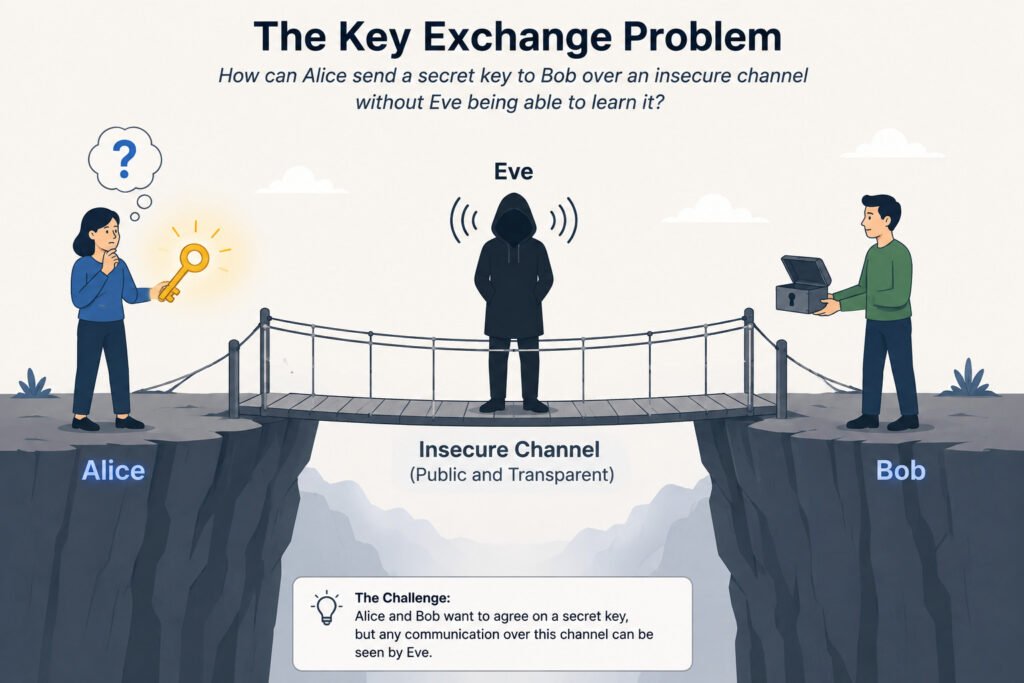
If Alice and Bob need a secret key to communicate securely, how do they get that secret key to each other in the first place, especially if their only way to communicate is over an insecure channel where Eve is already listening?
This is the Key Exchange Problem, and it is the Achilles’ heel of symmetric cryptography.
The Ancient Solution: The Trusted Courier
For most of history, the solution to this problem was physical. If Julius Caesar wanted to send encrypted messages to his generals, he would first have to establish the key (e.g., “we will use a shift of 3”). He might tell them in person before they left for the campaign, or he would send the key via a separate, highly trusted courier. This separate, secure channel was used only for key distribution.
This works for armies and governments, but it completely fails in the modern digital world.
Imagine you want to buy something from an online store for the first time. To encrypt your credit card information, your browser and the store’s server need to share a secret key. Are you supposed to drive to their headquarters to get the key? Should they mail it to you in a letter? Of course not. The entire transaction, from start to finish, happens over the internet—the very same insecure channel we are trying to protect.
We need a way to create a shared secret without a pre-existing secure channel.
Framing the Problem with Alice, Bob, and Eve
Let’s put our characters back on the stage.
- Alice and Bob are in different cities and can only talk on a public “party line” phone.
- Eve is listening to every single word spoken on this line.
- Alice and Bob want to have a private conversation using a powerful symmetric cipher, but first, they need to agree on a secret key.
Alice can’t just say, “Bob, let’s use the key ‘swordfish’!” because Eve would hear it and instantly be able to decrypt all their subsequent messages.
Alice could try to encrypt the key itself, but with what? Another key? This just pushes the problem back a step. You can’t use a secret key to protect the transfer of that same secret key.
This is the key exchange dilemma. Symmetric encryption provides a powerful, locked box for your messages, but it offers no way to securely deliver the key for that box to your recipient.
The Limitations We Face
For centuries, this problem was considered unsolvable. It was a fundamental paradox. To have a private conversation, you needed to first have a private conversation (to exchange the key). This limitation meant that secure communication was only possible between parties who had a prior arrangement or could establish a secure channel through physical means. It was not possible for two complete strangers to spontaneously decide to communicate securely over an open network.
This is the problem that stalled cryptography for decades, if not centuries. How can you pull a secret out of thin air? How can you create privacy from a public conversation?
The Dawn of a Revolution: A New Kind of Cryptography
The solution, when it finally arrived in the 1970s, was so brilliant and counter-intuitive that it completely revolutionized the field. It required a brand new way of thinking about keys.
What if you didn’t need one shared secret key?
What if, instead, you had two keys?
- A Public Key, which you could shout from the rooftops, post on your website, and give to anyone who asks. This key can be used to lock a message (encrypt it), but it cannot be used to unlock it.
- A Private Key, which you guard with your life and never, ever share. This key is the only thing that can unlock messages locked by your public key.
This is the core concept of asymmetric cryptography, or public-key cryptography.
In this system, Bob generates a public/private key pair. He sends his public key to Alice over the insecure channel. Eve can see it, and that’s perfectly fine! Alice uses Bob’s public key to encrypt her message. Once encrypted, the message can only be decrypted by Bob’s corresponding private key. Since Eve doesn’t have the private key, the message remains secure, even though she saw both the public key and the encrypted message.
The Key Exchange Problem is solved.
This monumental breakthrough is what makes modern e-commerce, secure messaging, and virtually the entire trusted internet possible. It’s the solution that allows two strangers (like your browser and Amazon’s server) to establish a secure connection out of public data.
This concludes our look at the world of symmetric ciphers. We’ve seen their power and now, their one great limitation. In Part IV of our series, we will dive headfirst into the revolutionary world of asymmetric cryptography, starting with the very first practical solution to the Key Exchange Problem: the Diffie-Hellman Key Exchange.
