Series: The Sequentia Lectures: Unlocking the Math of AI
Part 7: The Frontier – New Paradigms & Unsolved Puzzles
Lecture 66: The Efficiency Puzzle: Making AI Faster, Smaller, and Cheaper
We’ve spent this series exploring the incredible power of modern AI. We’ve seen how massive models with billions of parameters, trained on internet-scale datasets, have achieved breathtaking capabilities. But this power comes at a staggering cost.
Today’s state-of-the-art models are computational behemoths. They require warehouse-sized clusters of GPUs, consume megawatts of electricity (with a significant environmental footprint), and can cost millions of dollars to train. This creates a huge barrier to entry and limits the widespread deployment of the most powerful AI.
This has sparked a critical and intensely practical research frontier: the quest to solve the Efficiency Puzzle. How can we create AI that is faster, smaller, and cheaper, without sacrificing its intelligence?
The Human Brain: A Model of Efficiency
For inspiration, we can look at the human brain. It’s the most sophisticated intelligence we know of, yet it runs on roughly 20 watts of power—less than a standard light bulb. It’s a marvel of efficiency. In contrast, training a large AI model can consume as much energy as a small town.
Clearly, our current approach is brute-force. The efficiency puzzle is about finding more elegant, brain-like solutions. Researchers are tackling this from several mathematical angles.
1. Model Pruning & Sparsity: Can AI Work with Half its Brain?
When we train a massive neural network, not all of its connections (weights) are equally important. Research has shown that many, and sometimes most, of the learned weights are very close to zero. They contribute almost nothing to the final output.
Model Pruning is the process of identifying and removing these unimportant weights, effectively “pruning” the neural network like a gardener trims a tree. This creates a sparse model.
- The Puzzle: Can we remove 50%, 80%, or even 95% of a model’s weights after training without significantly degrading its performance? The answer is often yes!
- The Benefit: A sparse model has far fewer calculations to perform, making it dramatically faster and smaller. The mathematical challenge lies in finding the best criteria for deciding which weights to prune and developing techniques to “retrain” the pruned model to recover any lost accuracy.
2. Quantization: Teaching AI to Think with Less Precise Numbers
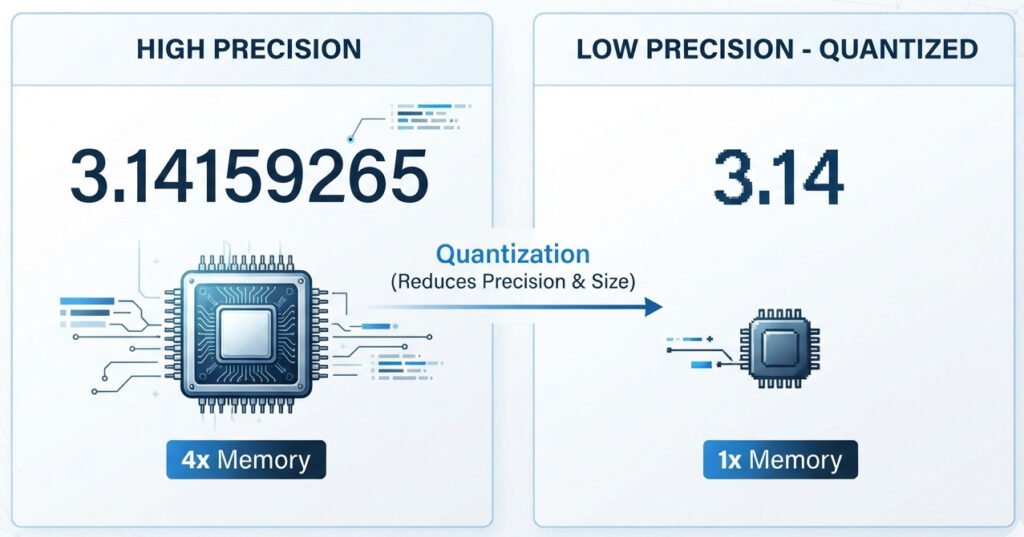
Modern AI models typically store their weights as 32-bit floating-point numbers (high precision). But is all that precision really necessary?
Quantization is the process of converting these high-precision numbers into lower-precision formats, like 16-bit, 8-bit integers, or even binary (1s and 0s).
- The Analogy: It’s like rounding your calculations from 7.001345 to just 7.0. For many tasks, the tiny bit of lost precision doesn’t matter, but the memory and computational savings are enormous. An 8-bit number takes up four times less memory and is often much faster for a computer chip to process than a 32-bit number.
- The Puzzle: How do you quantize a model without the accumulated rounding errors causing a major drop in accuracy? This involves clever techniques for “quantization-aware training,” where the model learns during the training process how to be robust to this lower precision.
3. Architectural Innovations & New Algorithms
Beyond optimizing existing models, researchers are also designing entirely new architectures and algorithms with efficiency built-in from the ground up.
- Efficient Architectures: Models like MobileNets (for computer vision) are designed with special, computationally cheap convolutional layers that provide excellent performance on mobile devices.
- Knowledge Distillation: This is a “student-teacher” approach. A large, powerful “teacher” model is trained first. Then, a much smaller, faster “student” model is trained not just on the data, but on mimicking the outputs and internal representations of the teacher model. The student learns a compressed version of the teacher’s “knowledge.”
- Beyond Gradient Descent?: While Gradient Descent is king, it’s computationally intensive. Researchers are constantly exploring alternative optimization methods that might converge faster or with less computational cost.
The Goal: Powerful AI Everywhere
Solving the efficiency puzzle is about more than just saving money or energy. It’s about democratizing AI. The ultimate goal is to create powerful, capable models that can run efficiently and privately on your local device—your phone, your laptop, your car—without needing a constant connection to a massive data center.
This frontier is a fascinating blend of theoretical mathematics, computer architecture, and clever algorithmic design, all aimed at solving the puzzle of creating intelligence that is not just powerful, but also practical, accessible, and sustainable.
