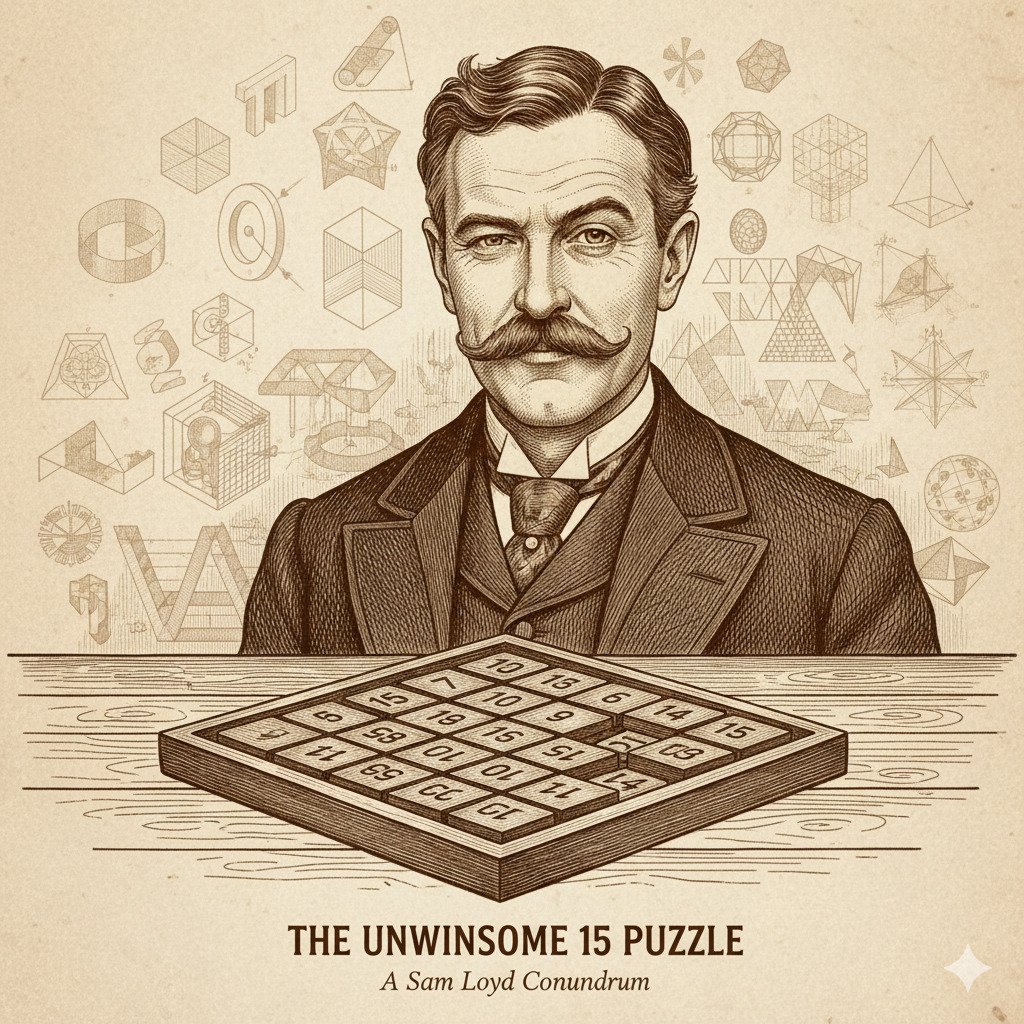
Have you ever stared at a puzzle, convinced you were just one move away from solving it, only to find yourself going in circles? What if the puzzle was designed from the start to be impossible? Welcome to the world of Sam Loyd, arguably the greatest American puzzle-maker and a master of brilliant misdirection.
Sam Loyd (1841-1911) was more than just a creator of chess problems and mathematical teasers; he was a showman. He understood the psychology of the puzzle solver and delighted in crafting challenges that played with our assumptions. Today at Sequentia, let’s dive into two of his most famous tricks that baffled a nation.
The $1,000 Swindle: The 15 Puzzle
You’ve probably seen it: a 4×4 grid with 15 numbered tiles that can be slid around, with one empty space. The goal is to arrange the tiles in numerical order, from 1 to 15. It’s a classic, solvable logic puzzle.
But in the 1880s, Sam Loyd unleashed a craze by marketing the puzzle with a specific, tantalizing challenge. He presented a version where the tiles were in perfect order, except for the last two – the 14 and 15 tiles were swapped. Loyd then offered a massive prize of $1,000 (a fortune at the time) to the first person who could solve it from this position.
America went mad. People were obsessed, playing day and night. Businesses complained of employees being too distracted to work. But the prize was never claimed. Why?
The Reveal: It was mathematically impossible.
The solution to the 15 Puzzle is based on a mathematical concept called “parity.” Think of it this way: every single valid slide of a tile is like one “step.” To get from the tricked 14-15 position back to the solved 1-15 position requires an odd number of individual tile swaps. However, every valid sliding move you make within the puzzle’s constraints always results in an even number of swaps.
You can slide tiles around for eternity, but you can never take an even number of steps to arrive at a destination that is an odd number of steps away. It’s like trying to get to the next room by only taking two steps at a time, but the doorway is only one step away. Loyd knew this, and his “puzzle” was actually a brilliant mathematical trap.
The Vanishing Act: “Get Off the Earth”
Loyd’s genius wasn’t limited to numbers. He was also a master of visual paradoxes. One of his most famous was the “Get Off the Earth” puzzle.
It consisted of two circular pieces of card. The bottom piece showed the Earth, and the top piece, which could be rotated, had 13 warriors printed on it. In the first position, you count 13 warriors. You then rotate the top piece slightly to a new position. Suddenly, when you count again, there are only 12! One warrior has completely vanished. Where did he go?
The Reveal: A clever optical illusion.
No single warrior actually disappears. Instead, the “vanished” warrior is cleverly absorbed, piece by piece, into the other 12 warriors. When the top piece is rotated, the parts of the warriors don’t line up perfectly anymore. The head of one warrior now attaches to the slightly different body of another. Each of the 12 “new” warriors is a composite, made slightly larger by incorporating a sliver of their vanished comrade. It’s a masterful trick of perception where our brain overlooks the subtle changes in the individuals and only registers the change in their total number.
Sam Loyd’s puzzles remind us that sometimes the greatest challenge isn’t the problem itself, but our own assumptions. He was a master of framing a question in a way that sent us down the wrong path, and his legacy is a testament to the enduring power of a clever trick.
Have you ever been fooled by a puzzle with a secret twist? Share your stories in the comments!
