Puzzles often live in the world of numbers and shapes, but what happens when you apply logical sequencing to language itself? You get one of the most elegant and deceptively simple brain teasers ever invented: the Word Ladder!
Also known as word-links or doublets, this classic puzzle challenges you to transform one word into another, one letter at a time, creating a valid new word at each step. Ready to climb? Welcome back to Sequentia, where today we’re exploring the intersection of vocabulary and logic!
What is a Word Ladder? The Rules of the Climb
The concept was famously invented by Lewis Carroll (the author of Alice’s Adventures in Wonderland), a man who clearly loved a good logic puzzle. The rules are straightforward:
- Start and End: You are given a starting word and an ending word (they must be the same length).
- One Letter Change: On each step, or “rung” of the ladder, you may change only one letter of the previous word.
- Valid Words: Every new combination of letters you create must be a valid word in the dictionary.
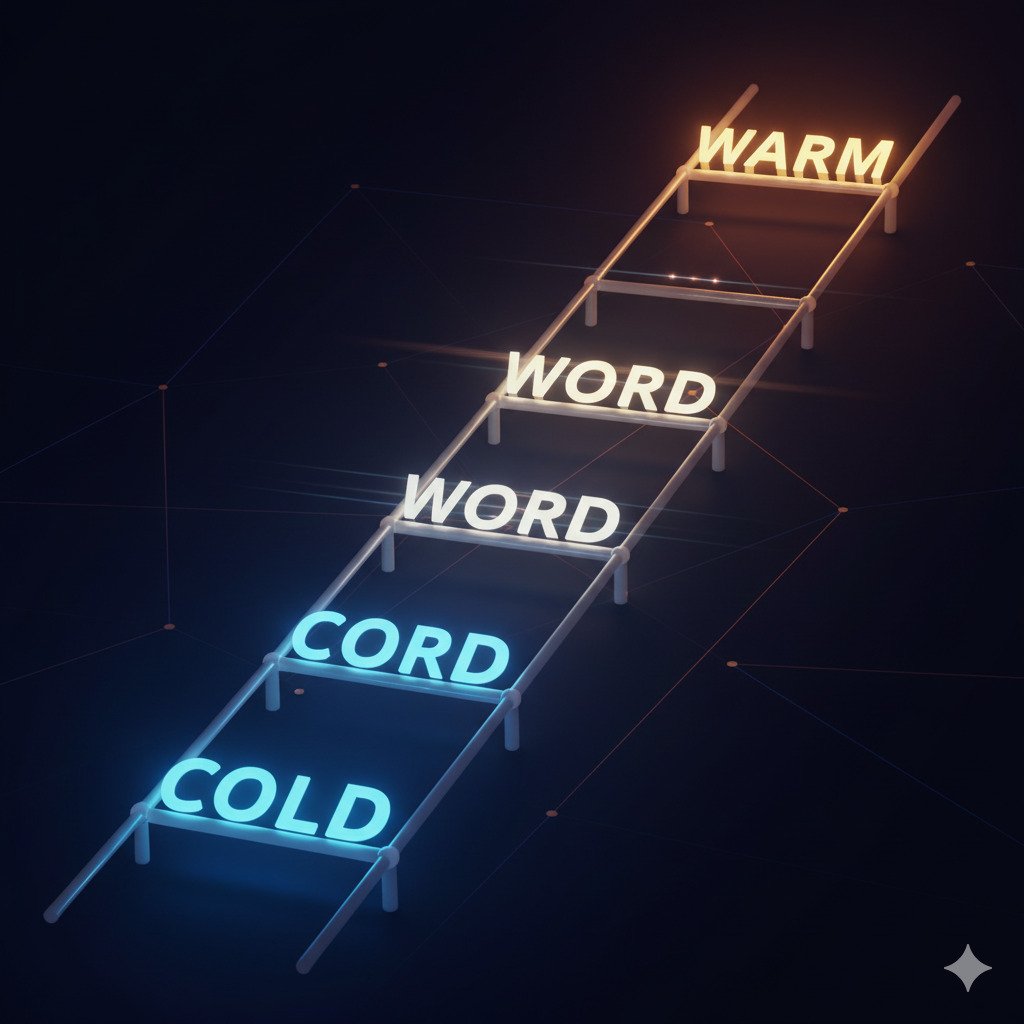
For example, let’s turn the word “COLD” into “WARM”.
A possible solution could be:
COLD
CORD (Changed ‘L’ to ‘R’)
WORD (Changed ‘C’ to ‘W’)
WARD (Changed ‘O’ to ‘A’)
WARM (Changed ‘D’ to ‘M’)
See how each step is a legitimate word and only one letter changes at a time? That’s the beauty of it! The challenge lies in finding the shortest path and navigating the vast possibilities of the dictionary.
Why Word Ladders Are Such a Great Mental Workout
Word ladders are more than just a vocabulary test; they are a fantastic exercise for your brain, engaging multiple cognitive skills simultaneously:
- Logic and Strategy: You can’t just guess randomly. You need to think ahead. Which letter change gets you closer to the target word? Sometimes you have to move “sideways” with a word that seems unrelated to get to the right path.
- Vocabulary: The puzzle naturally encourages you to dredge up words you might not use every day. The more words you know, the more potential paths you can find.
- Problem-Solving: It’s a classic problem-solving task. You have a starting state (COLD) and a goal state (WARM), and you must find a valid sequence of operations (letter changes) to connect them.
- Cognitive Flexibility: You have to remain flexible in your thinking, ready to abandon one path if it leads to a dead end and try another.
Your Word Ladder Challenge!
Time to put your brain to the test. Can you solve this classic word ladder? Turn “HEAD” into “TAIL”.
We’ll give you a hint: It can be done in just 4 steps (meaning 3 words in between).
HEAD
?
?
?
TAIL
Stuck? Think about words that are similar to “HEAD” but use letters found in “TAIL.” Post your solutions in the comments below! We’d love to see the different paths everyone takes, as there is often more than one correct solution.
Word ladders are a wonderful reminder that patterns and sequences aren’t just for numbers. They exist within the very structure of our language, waiting to be discovered one letter at a time.
