It’s a classic puzzle format we’ve all seen, from childhood activity books to challenging aptitude tests: a set of shapes is presented, and your task is to identify the “odd one out.” It seems simple, but these puzzles are a powerful workout for a crucial mental muscle known as abstract reasoning.
This skill is all about identifying patterns, relationships, and principles in information that isn’t presented in words or numbers. It’s the ability to see the underlying logic. So, how do you master the art of spotting the shape that doesn’t belong?
Welcome to Sequentia, where today we’re focusing our pattern-seeking eyes on visual logic!
How to Spot the Odd One Out: Your Detective’s Toolkit
Solving these puzzles is like being a detective. You have a lineup of suspects (the shapes) and you need to find the one that doesn’t fit the common “rule” or pattern. To do that, you need to know what kind of clues to look for. Here are the most common attributes to check:
- Shape: The most obvious one! Are three shapes curved and one is angular? Are they all polygons except for one?
- Size: Are all the shapes large except for one small one?
- Color or Shading: Is there a difference in color, fill, or pattern?
- Rotation or Orientation: Are all shapes pointing up, except for one that’s pointing down or sideways?
- Number of Elements: Count everything! Number of sides, corners, internal lines, or dots.
- Position: Where is the shape located within its frame?
- Abstract Properties: This is where it gets fun!
- Symmetry: Does one shape lack the line of symmetry that all the others possess?
- Open vs. Closed: Is one shape an open line while the others are closed figures?
- Presence of a Feature: Does one shape lack a right angle, a curve, or an intersection that all the others have?
Let’s Put It to the Test!
Ready to flex your abstract reasoning skills? Here are three challenges, ranging from easy to tricky. The answers are at the bottom of the post!
Challenge #1: The Warm-Up
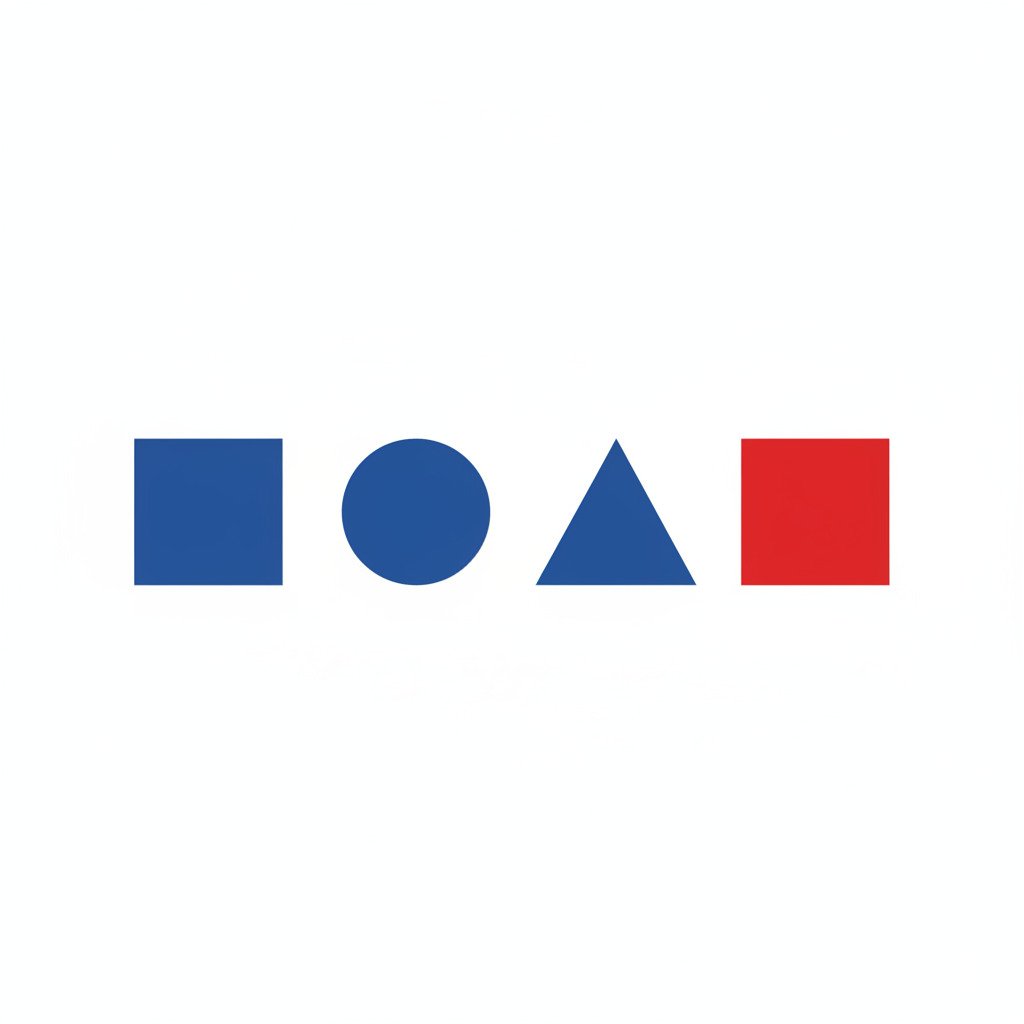
Challenge #2: A Step Up

Challenge #3: The Thinker

More Than Just a Game: Why Abstract Reasoning Matters
This skill is far from trivial. It’s a cornerstone of creative problem-solving and critical thinking. Programmers use it to find bugs in code, designers use it to create visual harmony, strategists use it to see the “big picture” in complex systems, and scientists use it to form hypotheses based on disparate data. Every time you solve one of these puzzles, you’re training your brain to find order in chaos.
So, how did you do on the challenges? Let us know in the comments!
Answers:
- Challenge #1: The red square. The rule is color; all other shapes are blue.
- Challenge #2: The circle. The rule is being a polygon (having straight sides and angles). A circle is the only one with no straight sides.
- Challenge #3: The J-shape/scalene triangle. The rule is symmetry. The square, circle, and equilateral triangle all have at least one line of symmetry, while the J-shape/scalene triangle has none.
