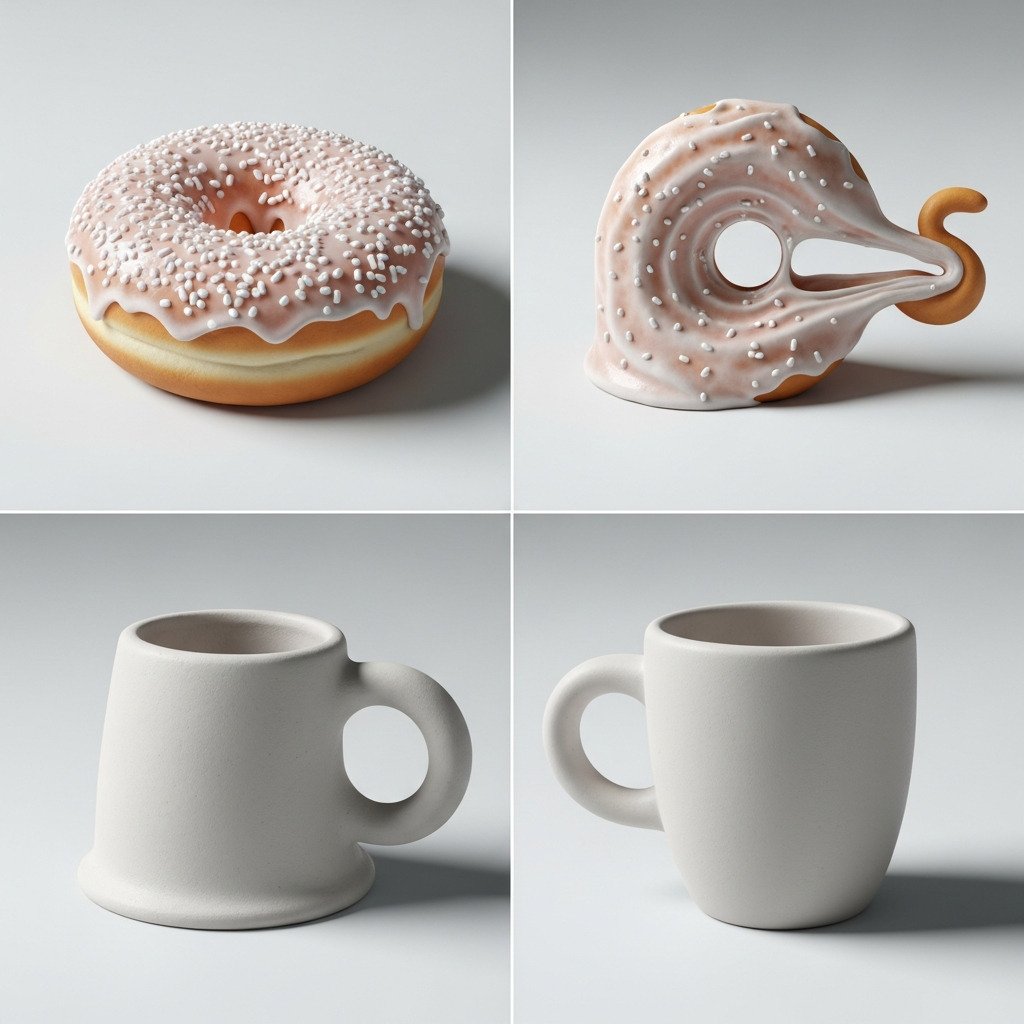
What do a glazed donut and your morning coffee cup have in common? On the surface, absolutely nothing. One is for eating, the other for drinking. One is soft and round, the other hard and ceramic. Yet, in a wonderfully strange and playful field of mathematics called topology, they are considered exactly the same.
How is this possible? Welcome to Sequentia, where today we’re stretching our minds to explore the “rubber sheet geometry” of topology!
Geometry’s Wild Cousin: Topology
Imagine if all geometric shapes were made of an infinitely stretchy, bendable, and squeezable material, like a magical piece of rubber. In this world, you could squish a long, thin rectangle into a perfect square, or stretch a small circle into a giant oval. From this “stretchy” perspective, a square and a circle are fundamentally the same.
This is the core idea of topology. Topologists are mathematicians who study the properties of objects that remain unchanged even when the object is stretched, twisted, or deformed—as long as it isn’t torn or glued together. They don’t care about angles, lengths, or straight edges. They care about more fundamental properties, like connectivity and, most famously, the number of holes an object has.
The Main Event: Why a Donut is a Coffee Cup
This brings us back to our breakfast table. The single most important topological feature of a donut is that it has one hole right through the middle.
Now, think about the coffee cup. It has a main basin for the coffee, but it also has a handle. If you trace a path through the handle, you can go all the way around and end up back where you started without ever leaving the object. Topologically speaking, that handle is a hole!
Because both a donut and a coffee cup possess exactly one hole, a topologist considers them equivalent. You could, in theory, take a lump of magical modeling clay shaped like a donut and, by carefully pressing, stretching, and shaping it (without tearing!), transform it into a coffee cup. The hole of the donut would become the handle of the cup.
By contrast, a sphere (like a marble) is different because it has zero holes. A pretzel is different because it has three holes!
Topology in Puzzles and Games
This might seem like an abstract curiosity, but this way of thinking is at the heart of many puzzles we enjoy:
- Mazes: A maze is a pure topological puzzle. It doesn’t matter if a corridor is long or short, straight or winding. All that matters is which points are connected.
- Knot Theory: A direct branch of topology, this field studies mathematical knots. The classic puzzle of trying to untangle a complex loop of string without cutting it is a topological problem.
- Network Puzzles: Ever seen those puzzles that ask you to draw a shape without lifting your pen or retracing a line? That’s a problem of graph theory, which is deeply connected to topology.
Topology teaches us to look past the surface details and see the fundamental structure of things. It’s a playful and powerful reminder that math can be beautifully weird and wonderfully insightful.
So, the next time you enjoy a coffee and a donut, you can smile knowing they share a secret mathematical identity. Can you think of any other objects that are topologically the same? Let us know in the comments!
