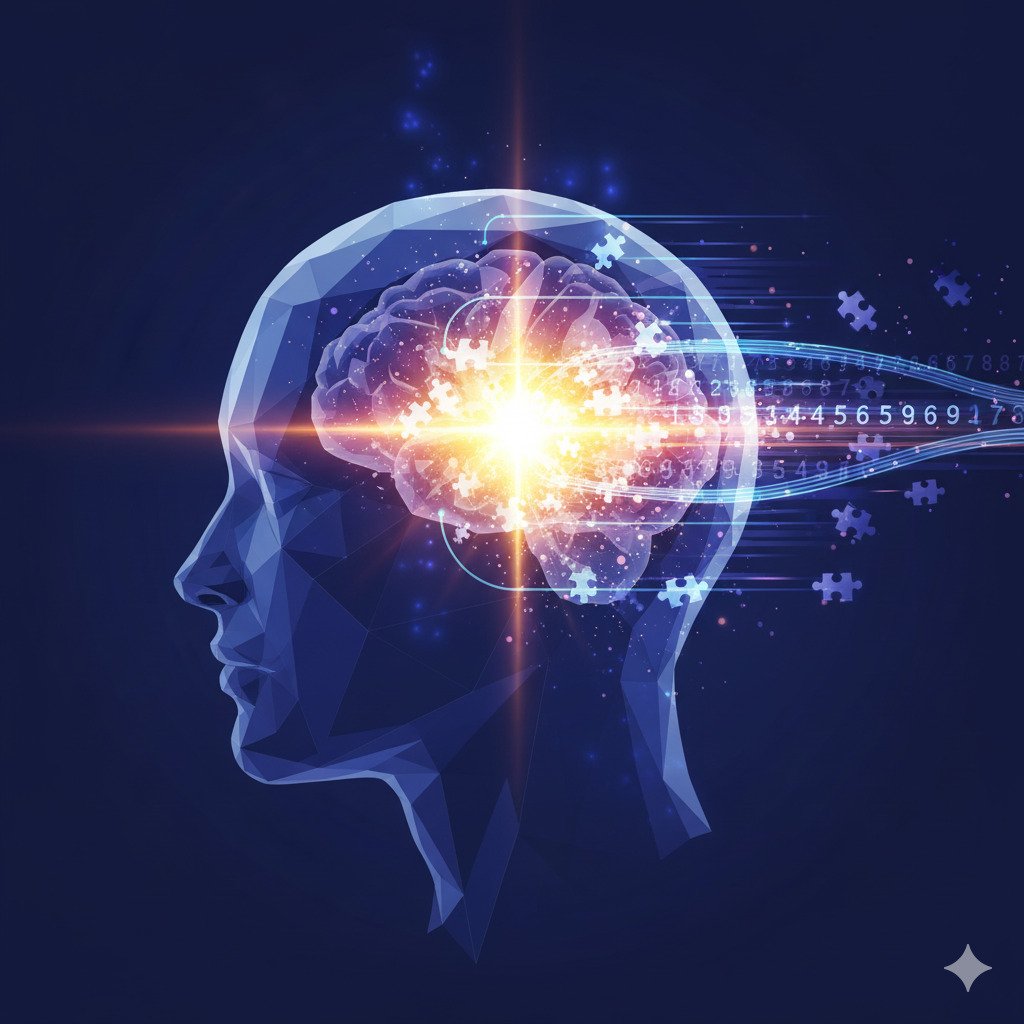
You’re in the zone. The puzzle, which seemed impenetrable moments ago, suddenly starts to yield its secrets. You’re not consciously calculating every single step; instead, you’re moving with a fluid certainty. A number just feels right. A pattern seems to leap out at you. You solve it with a speed that surprises even yourself. Was it luck? A random guess? Or was it something else – your intuition?
Many expert puzzle solvers, from chess grandmasters to competitive Sudoku players, rely on this powerful, almost subconscious skill. But what exactly is intuition in the context of puzzle solving, and how does it contribute to that lightning-fast speed?
It’s Not Magic, It’s Trained Pattern Recognition
The first thing to understand is that puzzle intuition isn’t a mystical sixth sense. It’s a highly refined form of pattern recognition, built over countless hours of practice.
Think of it like learning to read. When you first started, you sounded out each letter and laboriously pieced them together. Now, you don’t read letters; you instantly recognize entire words and even phrases. Your brain has created a massive internal library of these patterns.
Puzzle intuition works the same way. After seeing hundreds of number sequences, your brain starts to subconsciously recognize the “shape” of a Fibonacci sequence, an arithmetic progression, or a series of prime numbers without needing to consciously test each rule. This rapid, subconscious matching process feels like a “gut feeling,” but it’s actually your brain’s experience-based supercomputer at work.
The Brain as a High-Speed Prediction Machine
Our brains are constantly making predictions about the world around us. When you solve a puzzle, your brain is doing the same thing on a micro-level. It sees the first few elements and immediately starts generating hypotheses based on your past experiences.
- “The numbers are getting bigger, but not by a lot… could it be addition?”
- “The numbers are jumping rapidly… could it be multiplication or powers?”
- “I see a 1, 1, 2… my brain is already screaming Fibonacci!”
An experienced solver’s brain does this so quickly and efficiently that the prediction feels instantaneous. High-speed solving isn’t about calculating faster; it’s about making better, faster predictions fueled by intuition.
Trust, But Verify: The Partnership of Intuition and Logic
So, should you always trust your gut? Yes and no. The true art of high-speed solving lies in the seamless partnership between intuition and logic.
- Intuition proposes: Your gut feeling points you in a promising direction, suggesting a potential pattern or solution. This saves you from testing every single random possibility.
- Logic verifies: You then use your conscious, logical mind to quickly check if the intuitive hunch holds up. Does the proposed rule work for all the given numbers? If yes, you proceed with confidence. If no, you discard it and let your intuition offer another hypothesis.
This rapid cycle of “intuitive guess -> logical check” is the engine of high-speed puzzle solving.
How to Train Your Puzzle Intuition
The great news is that intuition is a skill you can actively develop.
- Volume is Key: The more puzzles you solve, the larger the mental library of patterns your brain builds.
- Variety is Crucial: Don’t just stick to one type of puzzle. Solving number sequences, logic grids, visual puzzles, and cryptograms exposes your brain to a wider range of logical structures.
- Analyze Solutions: When you solve a puzzle (or look up a solution), don’t just move on. Take a moment to understand why the solution works. Internalize the pattern.
- Solve Under Time Pressure (Sometimes): Occasionally trying to solve puzzles against the clock can force your brain to rely more on these rapid, intuitive processes.
Ultimately, that flash of insight you feel isn’t magic. It’s the well-earned reward of a mind that has been trained to see the beautiful, logical patterns hidden just beneath the surface.
What are your experiences with puzzle intuition? Do you find yourself relying on gut feelings? Let us know in the comments!
