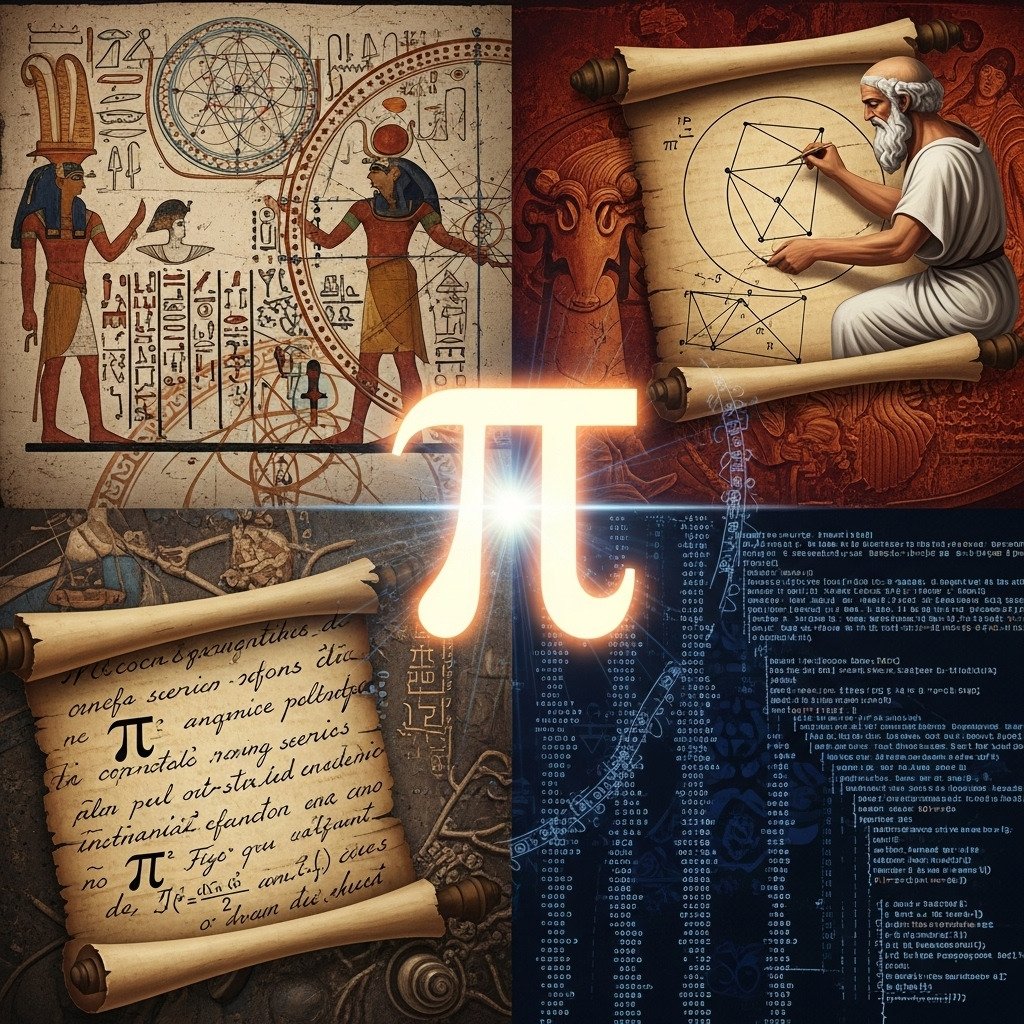
It’s a number you likely learned about in school, a symbol that’s instantly recognizable to millions: π (Pi). We know it as the ratio of a circle’s circumference to its diameter, and we often round it to 3.14. But the story of this humble constant is a sprawling, epic tale that spans millennia, involves some of history’s greatest thinkers, and continues to unfold to this day.
Welcome back to Sequentia! Today, we’re not just looking at a number; we’re looking at a 4,000-year-long quest to understand one of the most fundamental constants in the universe.
Ancient Beginnings: A Practical Need
The quest for Pi didn’t start as an abstract mathematical pursuit; it began out of practical necessity. Ancient civilizations needed a way to calculate the area of circular plots of land, build cylindrical structures, and design wheels. The Babylonians, around 1900 BC, estimated Pi to be about 3.125. The ancient Egyptians, in the famous Rhind Papyrus (c. 1650 BC), calculated a value of approximately 3.16.
These early estimates were remarkably good for their time, derived from measurement and geometric approximations. They knew a circle’s circumference was about three times its diameter, but the quest for a more precise “about” would drive mathematics for centuries.
Archimedes and the Method of Polygons
The first major theoretical leap came from the brilliant Greek mathematician Archimedes of Syracuse (c. 250 BC). Instead of just measuring, he devised a revolutionary method. He reasoned that he could approximate the area of a circle by “squeezing” it between two polygons: one inscribed inside the circle and one circumscribed around it.
He started with hexagons, then doubled the sides to 12-gons, 24-gons, and so on, all the way up to 96-sided polygons. As the number of sides increased, the polygons’ perimeters got closer and closer to the circle’s true circumference. Through this painstaking process, Archimedes proved that Pi was greater than 3 10/71 and less than 3 1/7. This value, approximately 3.1419, was the most accurate estimate for over a thousand years!
A Global Pursuit and the Dawn of Infinity
The chase for Pi became a global endeavor. Chinese mathematicians like Zu Chongzhi in the 5th century AD used similar polygon methods to calculate Pi to an astonishing seven decimal places, a record that stood for nearly 800 years. Indian and Islamic mathematicians also made significant contributions, refining calculation techniques.
A profound shift occurred with the development of calculus and infinite series in the 17th and 18th centuries. Mathematicians like Isaac Newton and Gottfried Wilhelm Leibniz discovered that Pi could be represented by infinite sums of simple fractions. This meant Pi could now be calculated with ever-increasing precision through computation, not just geometry.
The “π” Symbol and the Irrational Truth
It wasn’t until 1706 that the Welsh mathematician William Jones first used the Greek letter π to represent this constant, a notation later popularized by Leonhard Euler. Then, in 1761, Johann Lambert delivered a bombshell proof: Pi is an irrational number. This means it cannot be expressed as a simple fraction (like 22/7), and its decimal representation goes on forever without ever repeating a pattern.
This discovery changed everything. The story was no longer about finding the “true” value of Pi, but about calculating its infinite digits and understanding its mysterious nature.
The Modern Era: A Never-Ending Computation
Today, with the power of supercomputers, the calculation of Pi has become a benchmark for computational power. We now know Pi to over 100 trillion decimal places! This isn’t for practical application – a few dozen decimal places are enough for any conceivable scientific calculation – but for the pure challenge and the drive to push the boundaries of mathematics and computing.
The history of Pi is a mirror of human ingenuity itself – a never-ending story of curiosity, persistence, and our timeless quest to find order and meaning in the universe.
