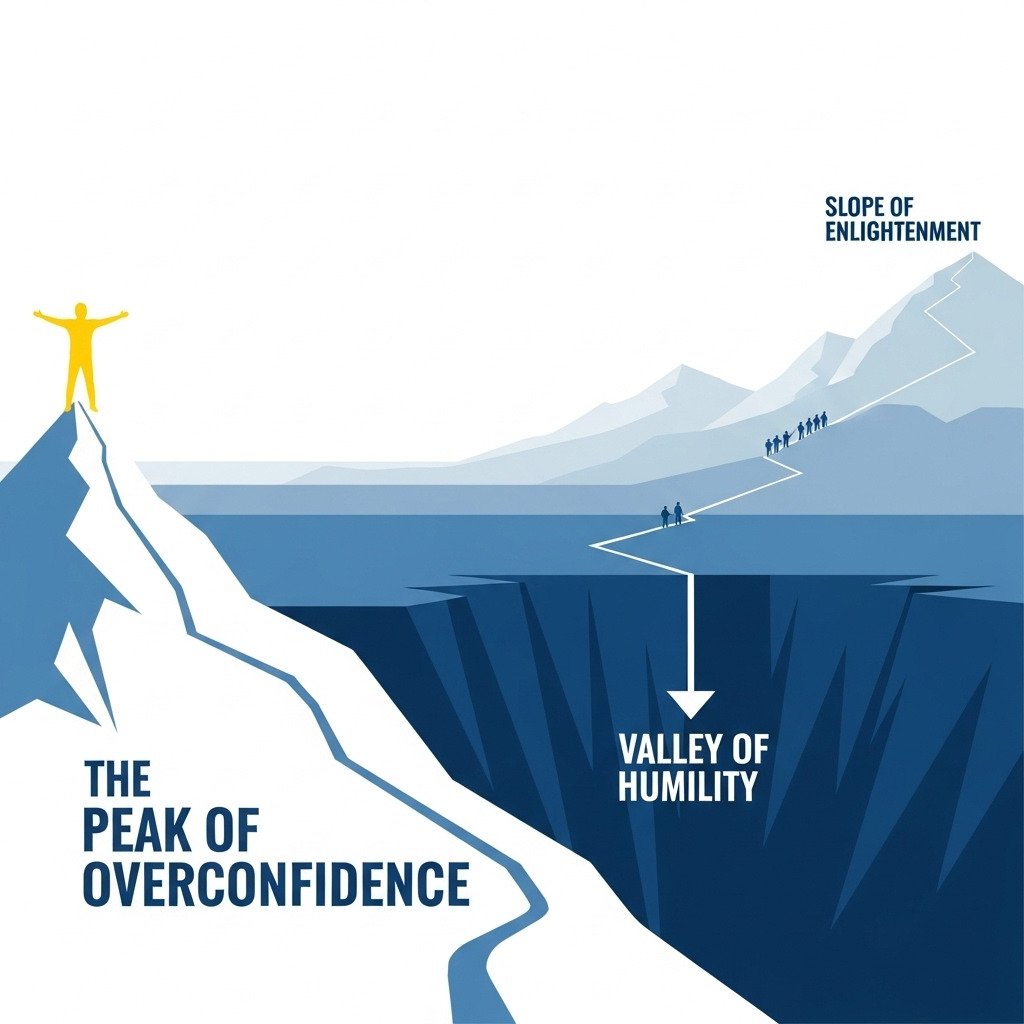
Have you ever solved a few number sequences in a row and thought, “I’ve totally got this. I’m a natural!” only to be completely stumped by the very next puzzle? Or perhaps you’ve seen someone declare a tricky puzzle “flawed” or “impossible” when, in fact, it just required a different kind of logic?
If these scenarios sound familiar, you’ve likely encountered a fascinating and common cognitive bias: the Dunning-Kruger effect.
Welcome back to Sequentia! Today, we’re stepping back from the puzzles themselves to explore the intriguing ways our own minds perceive our skills—and how understanding this can actually make us better solvers.
What is the Dunning-Kruger Effect?
In simple terms, the Dunning-Kruger effect is a bias where people with low ability or knowledge in a particular area tend to overestimate their competence. Conversely, experts in that same area often slightly underestimate their own abilities.
Psychologists David Dunning and Justin Kruger described it as a metacognitive problem: the very skills required to be good at something are the same skills needed to recognize competence (or a lack thereof) in oneself and others. A popular metaphor for this journey is climbing “Mount Stupid,” falling into the “Valley of Despair,” and then slowly climbing the “Slope of Enlightenment.”
How Dunning-Kruger Shows Up in Puzzling
The world of puzzles is a perfect playground for this effect to manifest:
- The Peak of “Mount Stupid”: A beginner solves a few simple arithmetic sequences (e.g., +2, x3). Their brain gets a rush of dopamine, and they confidently conclude they’ve mastered “sequence puzzles.” When faced with a more complex pattern (like alternating operations or a Fibonacci variation), they might get frustrated and blame the puzzle’s design rather than recognizing the gap in their own knowledge.
- The Expert’s Humility: In contrast, a seasoned puzzle enthusiast who has seen hundreds of different logical patterns—from prime numbers to geometric series to palindromic sequences—knows just how vast the world of puzzles is. They are more likely to approach a tough problem with caution, knowing there are many possibilities they haven’t yet considered. They are aware of what they don’t know.
Why Does It Happen?
The core reason is a lack of self-awareness driven by a lack of knowledge. If you only know two types of puzzle patterns, you can’t possibly recognize when a puzzle requires a third, fourth, or fifth type. Your toolbox for evaluating both the puzzle and your own performance is limited. You don’t know what you don’t know.
How to Use This Knowledge to Become a Better Puzzler
Understanding the Dunning-Kruger effect isn’t about feeling bad; it’s a powerful tool for growth! Here’s how to keep yourself on the healthy “Slope of Enlightenment”:
- Stay Curious: Assume there’s always a new technique or pattern to learn. When you get stuck, ask “What am I not seeing?” instead of “Is this puzzle broken?”
- Challenge Your Comfort Zone: If you’re great at number sequences, try a logic grid puzzle. If you love Sudoku, try a cryptogram. Broadening your puzzle horizons reveals the true scope of logical thinking.
- Seek Feedback (and Solutions): Don’t be afraid to look up the solution to a puzzle you couldn’t solve. The goal isn’t just to “win,” but to learn the logic so you can apply it next time.
- Embrace Humility: Recognize that being stumped is not a sign of failure, but an opportunity to learn. The best puzzle solvers are perpetual students.
So, are you as good as you think? The most enlightening answer is, “I’m always learning.” The true satisfaction in puzzling comes not just from the “Aha!” moments, but from the journey of discovery itself.
What puzzle type currently challenges you the most? Share it in the comments and let’s learn together!
