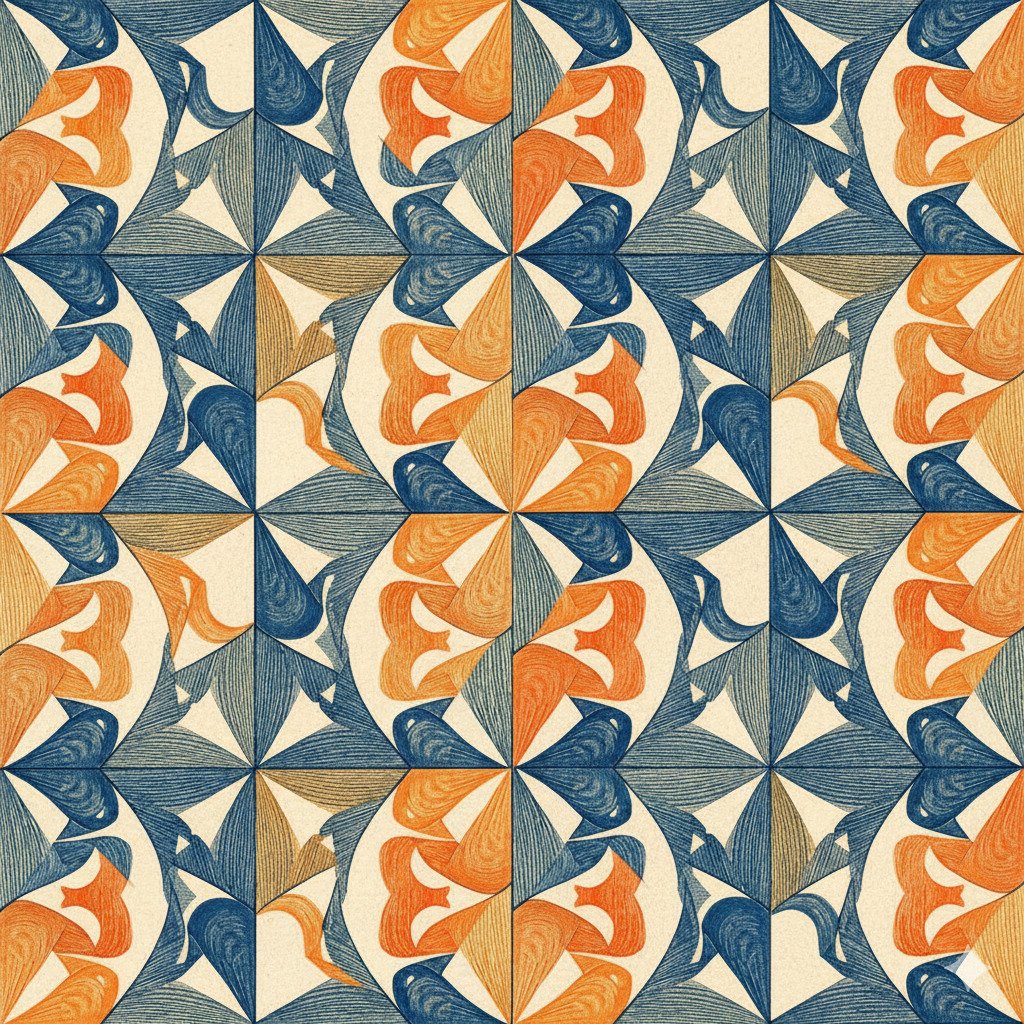
Ever marveled at the perfect hexagonal grid of a honeycomb, the intricate tilework of an ancient mosaic, or the seamless pattern on a cobblestone street? If so, you’ve been appreciating a tessellation. These repeating patterns are all around us, forming a stunning bridge between the worlds of rigid mathematics and boundless artistic creativity.
At Sequentia, we’re all about uncovering the logic in the world around us. Today, let’s explore the beautiful and brain-bending concept of tessellations!
What Exactly is a Tessellation?
A tessellation, also known as a tiling, is a repeating pattern of geometric shapes (called tiles) that fit together perfectly, edge to edge, with no gaps and no overlaps, covering a flat surface. The name comes from the Latin word tessella, which was a small square stone or tile used in Roman mosaics.
While it sounds simple, the rules of tessellation create a fascinating set of constraints that have challenged artists and mathematicians for centuries.
The Math: Regular & Semi-Regular Tessellations
At its core, tessellation is a geometric puzzle. For a shape to tessellate, the angles of the corners that meet at any single point (or vertex) must add up to exactly 360 degrees. If they add up to less, there will be a gap. If they add up to more, the shapes will overlap.
This simple rule leads to a surprising conclusion:
- Regular Tessellations: There are only three regular polygons (shapes with equal sides and angles) that can form a tessellation all by themselves: squares, equilateral triangles, and hexagons. The angles of a square (90°) meet perfectly in groups of four (4×90=360), triangles in groups of six (6×60=360), and hexagons in groups of three (3×120=360). Pentagons, with their 108° angles, just won’t work!
- Semi-Regular Tessellations: These are formed by using two or more types of regular polygons, with the arrangement of polygons at every vertex being identical. Think of the classic octagonal and square tile pattern.
The Art: M.C. Escher and Irregular Tessellations
This is where things get truly mind-bending! The legendary artist M.C. Escher was a master of tessellation. He didn’t just use simple squares or triangles; he created intricate, interlocking figures of birds, fish, lizards, and people.
How did he do it? He would start with a simple tessellating shape, like a square or a hexagon, and then modify its sides. The key was that whatever piece he “cut out” from one side, he would “paste” onto the opposite side. This ensured the modified shape would still fit together perfectly with its neighbors, creating a complex and often surreal repeating pattern.
Tessellations as a Puzzle
Understanding and creating tessellations is a fantastic exercise in spatial reasoning and pattern recognition. It forces you to think about:
- Constraints: How do the shapes need to fit together?
- Symmetry & Repetition: What is the core unit that repeats to create the whole?
- Transformation: How can one shape be altered to create another that still fits the pattern?
It’s a visual puzzle on a grand scale, proving that math can be breathtakingly beautiful.
Where have you seen some amazing tessellations in your daily life? Share your finds in the comments below!
