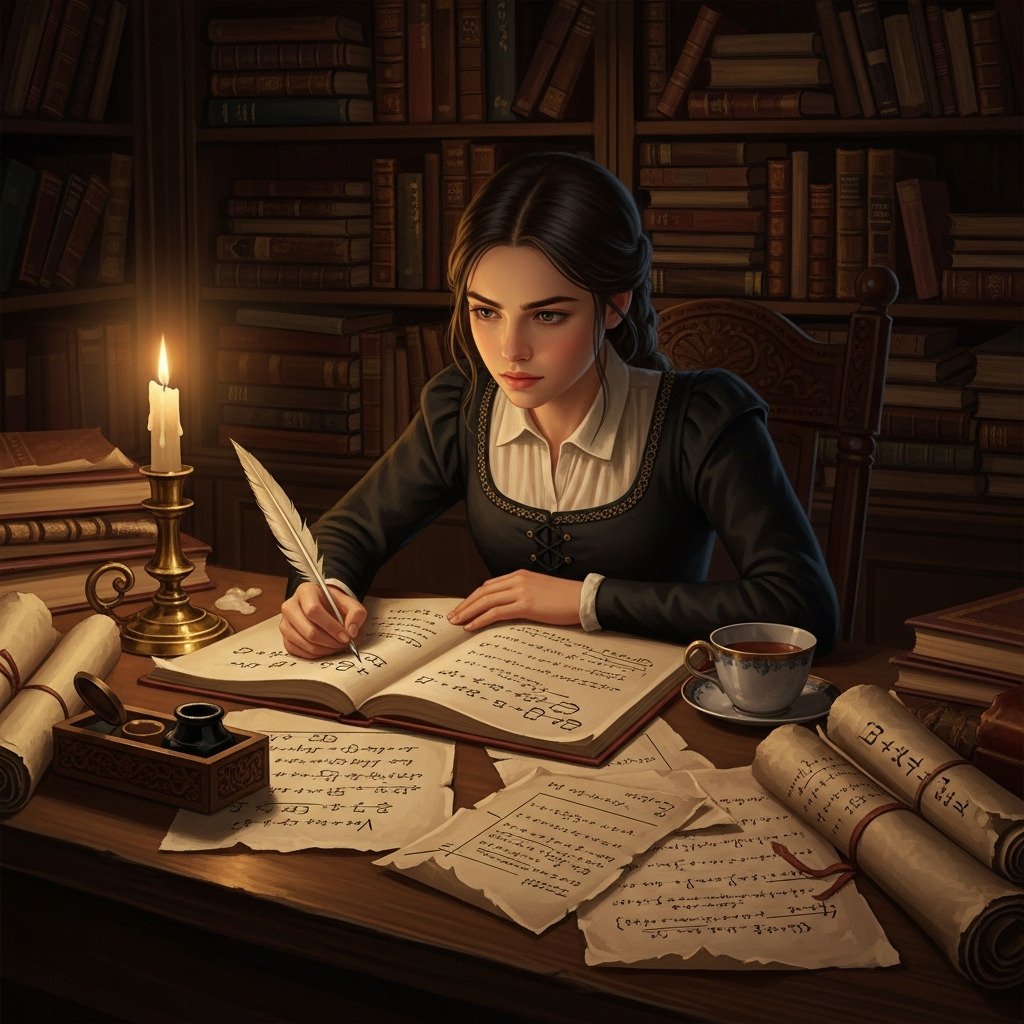
Imagine a world that tells you your passion is forbidden. Imagine your family trying to stop you, taking away your candles and heat in the dead of winter to keep you from studying. For most, this would be the end of a dream. For Marie-Sophie Germain, it was just the beginning of a lifelong battle to change the world of mathematics.
Welcome back to Sequentia! Today, we’re not looking at a puzzle of numbers, but at the incredible life of a person who solved the puzzle of a society determined to exclude her.
A Forbidden Passion
Born in Paris in 1776, during the turbulent era of the French Revolution, a young Sophie Germain found refuge in her father’s library. There, she discovered mathematics and fell deeply in love with its certainty and logic. However, the conventions of the time were rigid: mathematics was not a subject for women.
Her parents, concerned for her health and adherence to social norms, did everything they could to discourage her. They forbade her from studying, confiscated her candles, and even let her fire go out. Undeterred, Sophie would secretly wrap herself in quilts and study by the light of smuggled candles, a testament to a passion that refused to be extinguished.
The Birth of “Monsieur Le Blanc”
When the prestigious École Polytechnique opened in Paris, it was an institution for men only. Sophie couldn’t attend, but she managed to obtain the lecture notes for several courses. To submit her work and observations, she needed an identity. She adopted the name of a former student, “Monsieur Le Blanc.”
Under this male pseudonym, her work was brilliant. The renowned mathematician Joseph-Louis Lagrange was so impressed by the insights of “M. Le Blanc” that he requested a meeting. Sophie was forced to reveal her true identity. Lagrange was stunned, but recognized her extraordinary talent and became her mentor, opening the first of many doors.
Impressing the Prince of Mathematicians
Her confidence growing, Sophie began corresponding with the legendary Carl Friedrich Gauss, the “prince of mathematicians,” about number theory—specifically, Fermat’s Last Theorem. For years, they exchanged letters, with Gauss praising the profound work of his correspondent, M. Le Blanc.
When Gauss learned that his brilliant peer was, in fact, a woman, his admiration only grew. He wrote: “But when a person of the sex which, according to our customs and prejudices, must encounter infinitely more difficulties than men… succeeds in surmounting these obstacles… she must no doubt have the noblest courage, extraordinary talent, and superior genius.”
A Legacy in Numbers and Steel
So what did this incredible mind achieve?
- Germain Primes: She developed a theorem and a special category of prime numbers (now called “Sophie Germain primes”) that represented a major step towards proving Fermat’s Last Theorem for a specific set of cases.
- Theory of Elasticity: She entered a competition sponsored by the Paris Academy of Sciences to explain the mathematical principles behind the vibration of elastic surfaces (think of a drum skin or a metal plate). After several attempts and fighting institutional prejudice, she became the first woman to win the grand prize from the Academy.
Sophie Germain’s legacy isn’t just in her theorems; it’s in her unwavering persistence. She proved that a brilliant mind knows no gender. Her story is the ultimate puzzle: how to find a solution when society has removed all the obvious paths. She reminds us that sometimes, the most profound solutions require creating a new path entirely.
Who are other hidden figures in science or math that inspire you? Share their stories in the comments!
