Series: The Sequentia Lectures: Unlocking the Math of AI
Part 2: The AI Toolkit: Linear Algebra
Lecture 10: The Identity Matrix & Inverse: “Doing” and “Undoing” in AI
Throughout this series, we’ve explored how vectors represent data points and matrices represent powerful actions—rotations, scaling, and transformations. But in any system of actions, two special concepts are always crucial: a “do nothing” action and an “undo” button.
In the world of linear algebra, these roles are played by the Identity Matrix and the Inverse Matrix. Understanding them provides a deeper intuition for the mechanics of data manipulation in AI.
The Identity Matrix: The Mathematical “Do Nothing”
In regular arithmetic, the number 1 is the “multiplicative identity.” Any number you multiply by 1 remains unchanged (e.g., 7 * 1 = 7).
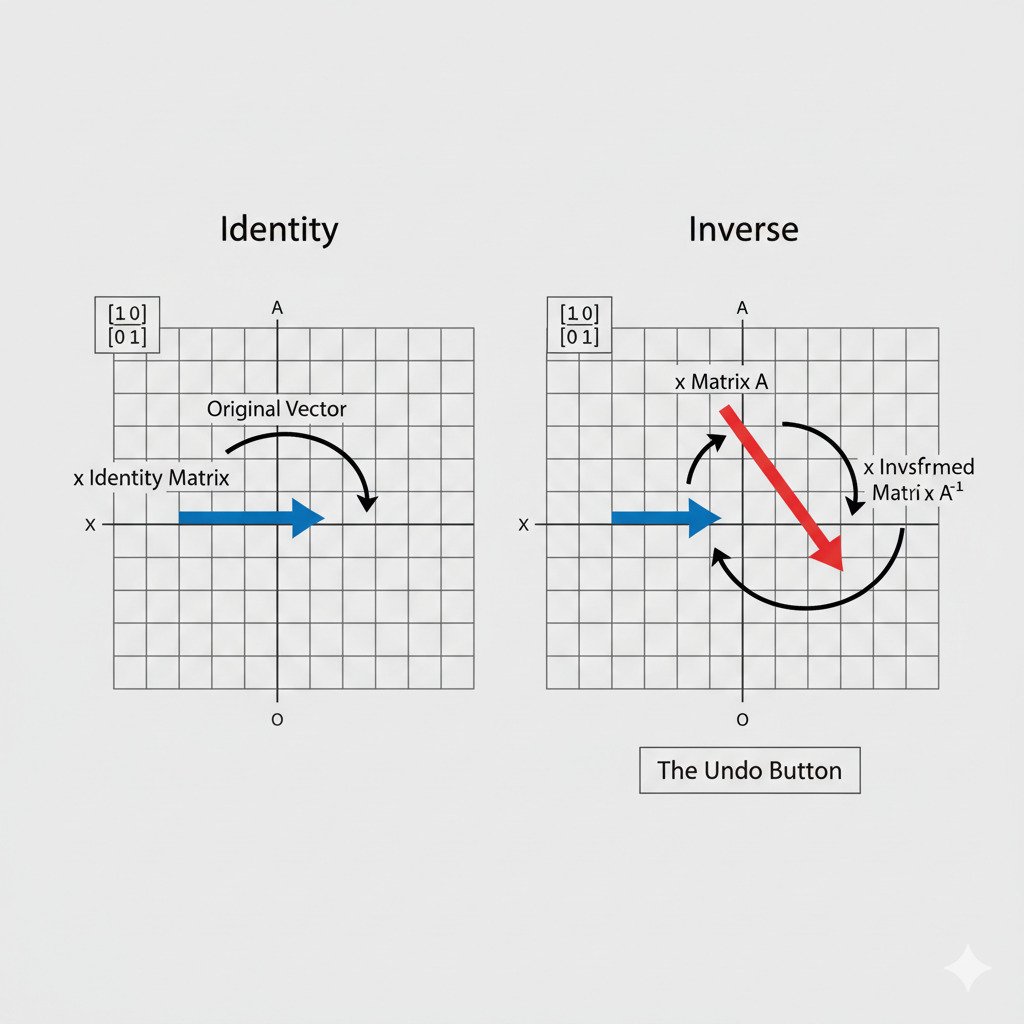
The Identity Matrix, often denoted as I, is the matrix equivalent of the number 1. It represents a transformation that leaves every vector exactly as it was. It’s the “do nothing” matrix.
An identity matrix is always a square matrix (same number of rows and columns) with 1s on the main diagonal (from top-left to bottom-right) and 0s everywhere else.
A 2×2 Identity Matrix:
[ 1 0 ][ 0 1 ]
A 3×3 Identity Matrix:
[ 1 0 0 ][ 0 1 0 ][ 0 0 1 ]
If you take any vector and multiply it by the appropriately sized identity matrix, you get the exact same vector back. Similarly, if you multiply any matrix A by the identity matrix I, you get matrix A back (A * I = A).
While it might seem useless on its own, the identity matrix is a fundamental concept in linear algebra. It serves as a baseline or a starting point for transformations and is crucial in defining the concept of an inverse.
The Inverse Matrix: The “Undo” Button
If a matrix A represents an action, like “rotate 90 degrees clockwise,” then its Inverse Matrix, denoted as A⁻¹, represents the opposite action: “rotate 90 degrees counter-clockwise.”
The inverse matrix is the “undo” button for a transformation.
Formally, if you multiply a matrix A by its inverse A⁻¹, the result is the Identity Matrix I.
A * A⁻¹ = I
This is just like in arithmetic, where multiplying a number by its inverse gives you 1 (e.g., 7 * (1/7) = 1). Applying an action and then its “undo” action results in “doing nothing.”
Analogy: Scrambling and Unscrambling a Message
Imagine you have a secret message represented as a vector of numbers. You use a special “Scrambling Matrix” (A) to encrypt it by transforming the vector. The result is a scrambled message vector.
Scrambled_Message = Original_Message * A
How does your friend read the message? They don’t need to guess your scrambling process. They just need the “Unscrambling Matrix” (A⁻¹). They multiply the scrambled message by the inverse matrix, and it transforms the vector right back to its original form.
Original_Message = Scrambled_Message * A⁻¹
The Catch: Not All Actions Can Be Undone
This is a crucial point in both mathematics and AI. Not every matrix has an inverse.
A transformation can only be “undone” if it doesn’t lose any information.
- Invertible (Can be undone): Transformations like rotation, scaling (as long as you don’t scale by zero), and shearing are invertible. You can always rotate back or scale back to the original position.
- Non-Invertible (Cannot be undone): The classic example is a projection. Imagine a transformation matrix that takes a 3D object and projects its shadow onto a 2D wall. You’ve now lost all the depth information. You can’t look at the 2D shadow and perfectly reconstruct the original 3D object. There’s no “undo” button for that loss of information.
Matrices that don’t have an inverse are called singular or degenerate. In AI, this concept is important. If a transformation matrix in a neural network is singular, it means the network is squashing the data in a way that loses information, which can be problematic for learning.
Conclusion
The Identity and Inverse matrices complete our foundational toolkit. The Identity matrix gives us a neutral baseline, and the Inverse gives us the powerful concept of reversibility. While we don’t always need to explicitly calculate inverses in modern AI (many techniques work around it), understanding that some transformations are reversible while others are information-losing is a key piece of intuition.
This concludes our whirlwind tour of Linear Algebra for AI! We’ve learned about vectors, matrices, dot products, and transformations. With these tools in hand, we are now ready to build our very first AI model from scratch.
