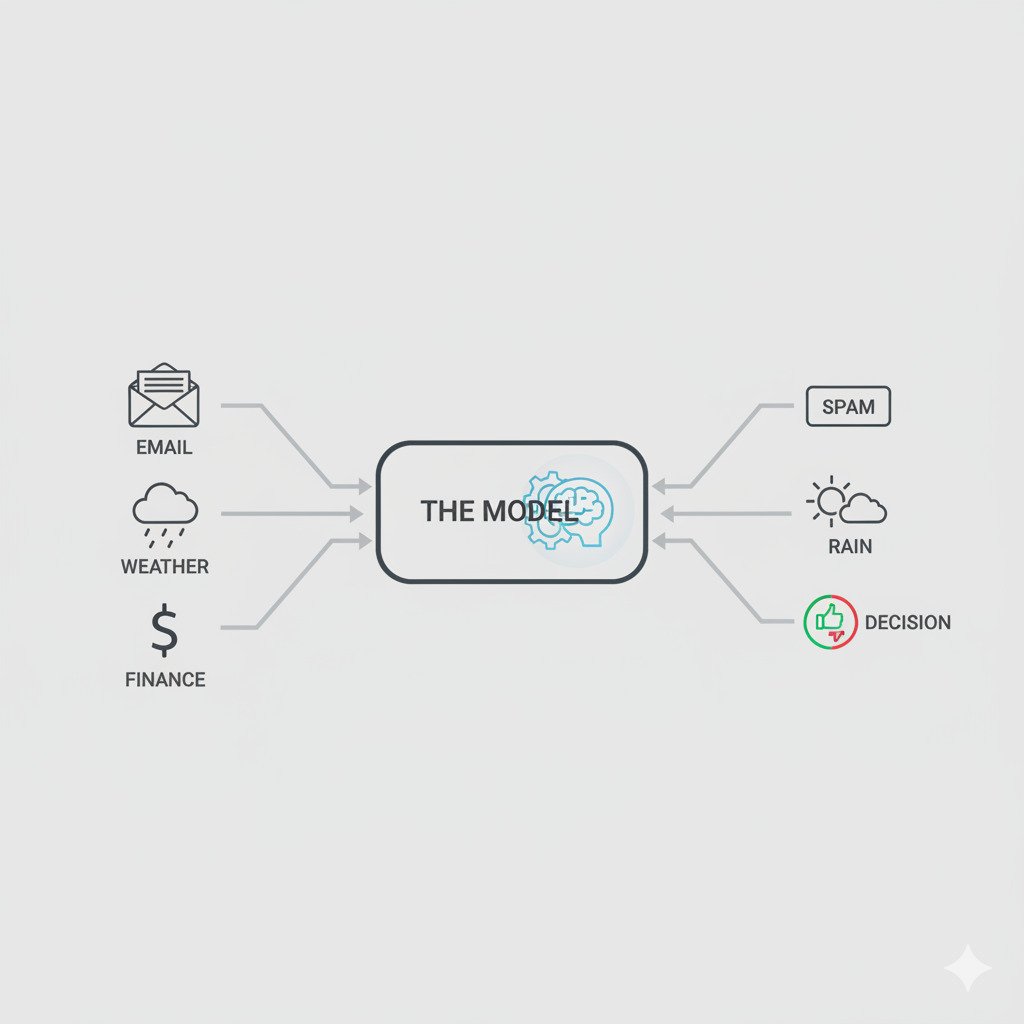
Series: The Sequentia Lectures: Unlocking the Math of AI
Part 1: The Foundation – Thinking Like a Machine
Lecture 1: What is a “Model”? Thinking in a World of Inputs and Outputs.
Welcome to the first installment of the Sequentia Lectures, a series where we’ll demystify the fascinating mathematics that powers Artificial Intelligence. Before we can dive into complex algorithms and equations, we need to grasp the single most fundamental concept in all of AI: the “model.”
Forget about lines of code or complex neural networks for a moment. At its heart, an AI model is simply a recipe. It’s a structured process, a “black box,” that has been designed or trained to do one thing: take specific ingredients (inputs) and follow a set of rules to produce a specific dish (an output). The entire goal of building an AI is to perfect this recipe.
Inputs: The Ingredients of AI
An input is any piece of information you provide to the model. Think of it as the raw data or the variables of a puzzle. Inputs can be anything:
- Numbers: Temperature (25°C), humidity (60%), wind speed (10 km/h).
- Text: The subject line and body of an email.
- Images: A picture of an animal, represented as a grid of pixels.
- Sound: A recording of someone speaking, represented as a waveform.
For an AI model to work, these inputs need to be in a format it can understand – usually numbers. An image becomes a vast collection of numbers representing the color of each pixel. Words in an email can be converted into numerical representations that capture their meaning and context. The first step in any AI process is preparing these ingredients.
The Model: A “Black Box” Recipe
Once we have our inputs, we feed them into the model. For now, let’s treat the model as a “black box.” We don’t need to know exactly what’s happening inside just yet. All we need to understand is that the box contains a specific set of rules or a recipe for transforming the inputs.
Let’s consider a few simple analogies:
- The Spam Filter Model:
- Inputs: An incoming email (sender’s address, subject line keywords like “free,” “winner,” “urgent,” body text).
- The “Black Box”: A set of rules that assigns “points” based on these inputs. For instance, +10 points if the word “viagra” is present, +5 for all caps, -2 if the sender is in your contacts.
- Output: A simple decision. If the total score is above a certain threshold (e.g., 20), the output is “Spam.” Otherwise, the output is “Not Spam.”
- The Weather Prediction Model:
- Inputs: Today’s temperature, humidity, wind direction, and atmospheric pressure.
- The “Black Box”: A complex mathematical formula (a recipe!) derived from analyzing decades of historical weather data. This formula has learned the relationship between today’s conditions and tomorrow’s weather.
- Output: A prediction, such as “80% chance of rain” or “Tomorrow’s high will be 27°C.”
- The Loan Approval Model:
- Inputs: An applicant’s credit score, annual income, loan amount, and years of employment.
- The “Black Box”: A decision-making process, perhaps a “decision tree,” that asks a series of questions: “Is the credit score > 700? If yes, is the income > $50,000?”
- Output: A classification: “Approve Loan” or “Deny Loan.”
In each case, the model is simply a structured way of mapping specific inputs to a desired output.
Outputs: The Prediction or Decision
The output is the model’s answer. It’s the result of applying the internal recipe to the inputs we provided. Outputs typically fall into a few categories:
- A Continuous Value (Regression): Predicting a number, like the price of a house or tomorrow’s temperature.
- A Category (Classification): Choosing from a set of labels, like “Spam” vs. “Not Spam,” “Cat” vs. “Dog,” or “Approve” vs. “Deny.”
- A Probability: Giving a score of confidence, like “80% chance of rain” or “95% confidence this is a cat.”
The Goal of AI: Finding the Perfect Recipe
So, where does the “intelligence” come in? The magic of AI and machine learning, which we will explore in our upcoming lectures, is the process of discovering the best possible recipe for the black box. We don’t always have to write the rules ourselves (like in the simple spam filter). Instead, we can provide a machine with thousands of examples of inputs and their correct outputs (e.g., 10,000 emails already labeled as spam or not spam) and have it learn the optimal recipe on its own.
This is the foundation upon which everything else is built. Understanding this simple “Input -> Model -> Output” flow is the first and most crucial step in thinking like a machine. It demystifies AI, reframing it from an unknowable, complex entity into a series of logical (though sometimes very sophisticated) recipes designed to solve specific puzzles.
Join us in Lecture 2, where we’ll start to peek inside this “black box” and explore the simplest form of a model: a straight line.
