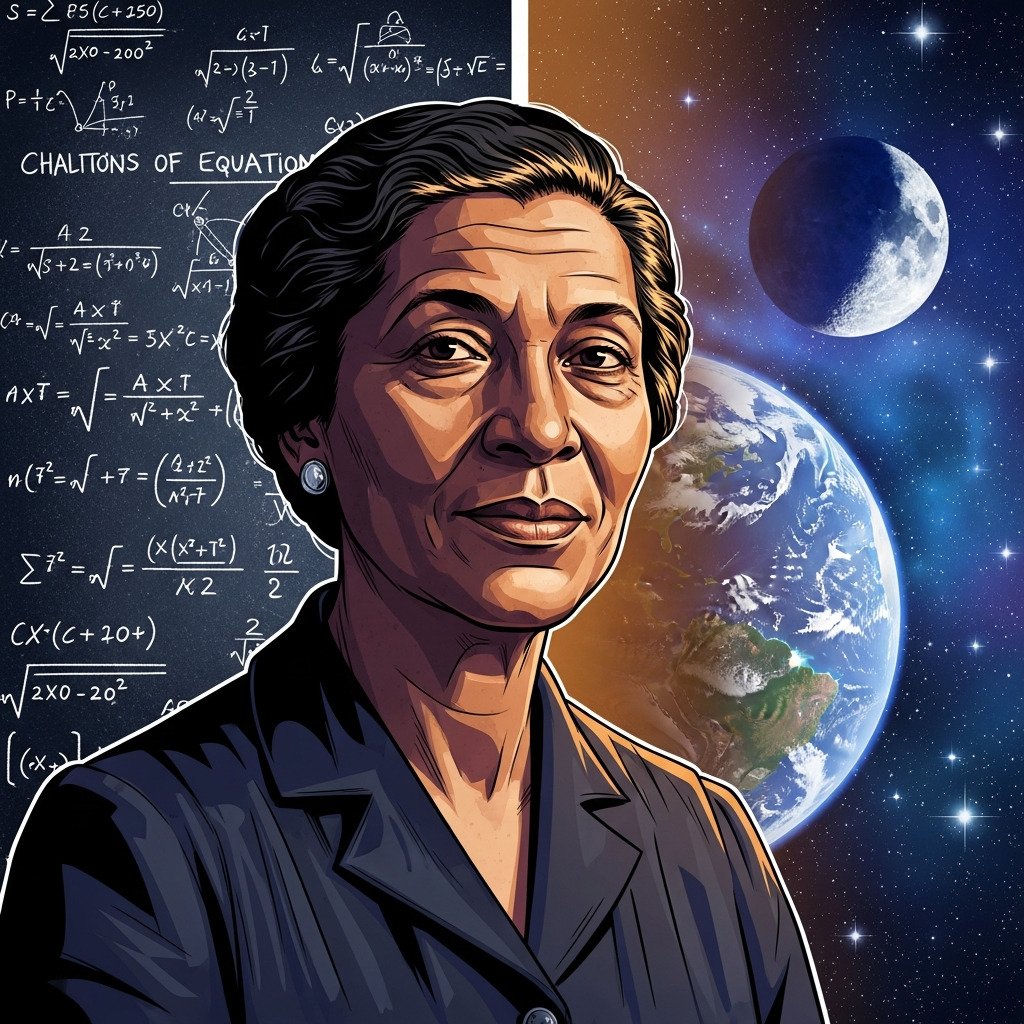
In the age of supercomputers that can perform billions of calculations per second, it’s almost impossible to imagine a time when the fate of astronauts and the success of space missions rested on the brilliant minds and lightning-fast calculations of human beings. At the forefront of this incredible era stood Katherine Johnson, a true pioneer whose mathematical genius was as essential to the space race as the rockets themselves.
Today at Sequentia, we’re taking a break from abstract puzzles to celebrate a real-life problem-solver whose work was, quite literally, out of this world.
From Gifted Child to NASA Trailblazer
Born in 1918 in White Sulphur Springs, West Virginia, Katherine Johnson displayed an extraordinary talent for numbers from a very young age. Her intense curiosity and intellectual brilliance were undeniable. In an era of segregation and limited opportunities for African American women, Johnson’s determination was as formidable as her mind. She graduated high school at 14, college at 18, and became one of the first three Black students to desegregate West Virginia University’s graduate school.
In 1953, she found her calling at the National Advisory Committee for Aeronautics (NACA), the agency that would later become NASA. She joined a pool of African American women known as the “West Area Computers,” who performed and verified complex calculations for the engineers. Johnson, however, quickly distinguished herself with her insatiable curiosity about the “why” behind the numbers, not just the “what.”
Calculating the Trajectories of Legends
Katherine Johnson’s work was not just about checking sums; she was a core part of the mission. Her calculations were critical to the success of America’s first forays into space.
- Alan Shepard’s Freedom 7 Mission: She calculated the trajectory for the first American in space.
- John Glenn’s Orbital Flight: When NASA began using electronic computers for the first time to calculate the orbit for Friendship 7, astronaut John Glenn was famously wary. He requested that they “get the girl”—Katherine Johnson—to run the numbers by hand. “If she says they’re good,” Glenn reportedly said, “then I’m ready to go.” Johnson’s calculations matched the computer’s, giving the mission the green light.
- The Apollo 11 Moon Landing: Perhaps her most famous contribution was her work on the Apollo program. She calculated the precise trajectory—the “window”—that would get the Apollo 11 command module to the Moon and, just as importantly, bring it back safely. Her calculations were instrumental in syncing the lunar lander with the orbiting command module.
The Ultimate Problem-Solver
Katherine Johnson’s story is the ultimate testament to the power of mathematics and human intellect. The “puzzles” she solved had no answer key and no margin for error. The variables were immense—gravity, velocity, orbital mechanics, the timing of rocket burns. Her work was a high-stakes sequence of logic, precision, and unwavering confidence in her own calculations.
She broke barriers of race and gender, not with rhetoric, but with the undeniable power of her competence. She was known for asking questions, for insisting on being in the briefings, and for ensuring she understood the entire problem, not just her small piece of it.
In 2015, at the age of 97, she was awarded the Presidential Medal of Freedom, America’s highest civilian honor. Her legacy, immortalized in the book and film “Hidden Figures,” reminds us that behind every great technological leap, there are brilliant human minds seeing the patterns, solving the problems, and charting the course.
Katherine Johnson didn’t just solve puzzles; she calculated the path to the stars.
