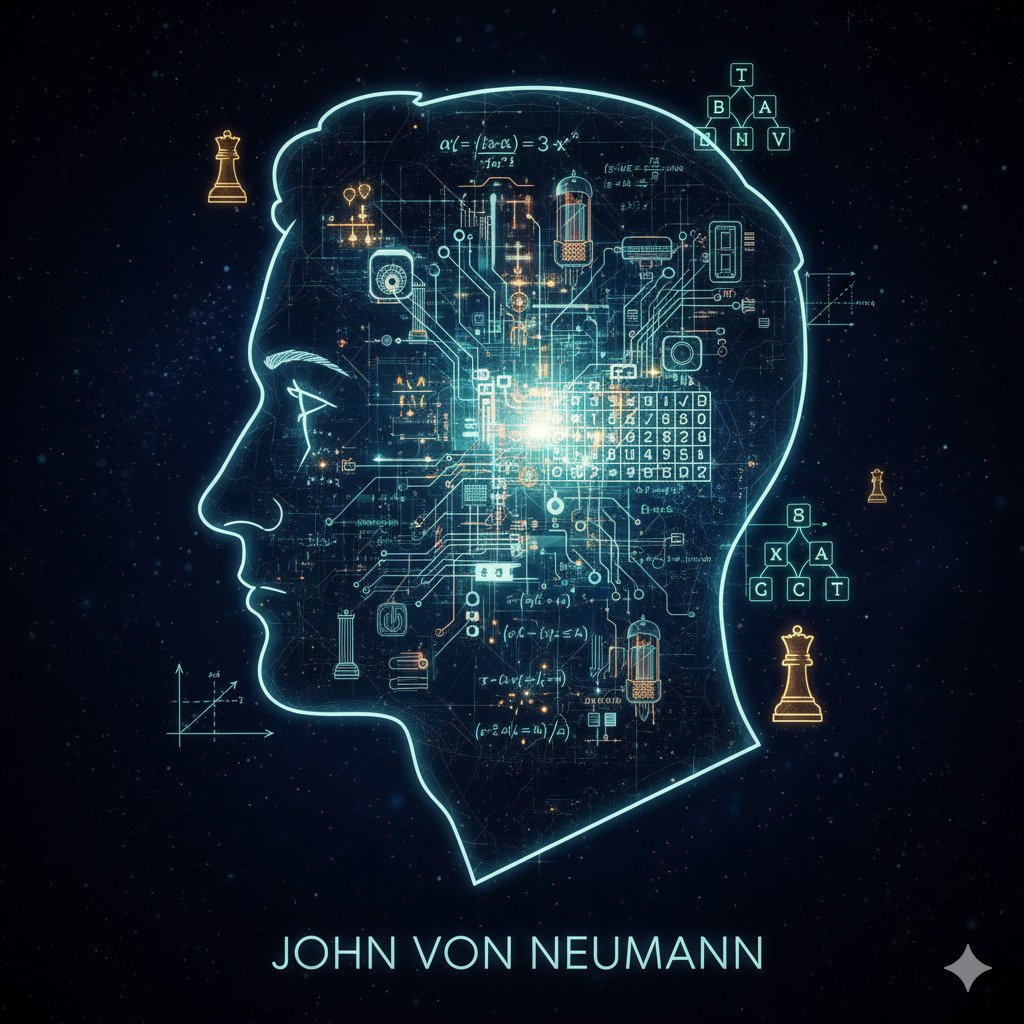
In the history of science and thought, there are specialists, and then there are polymaths. And then, in a category almost all his own, there was John von Neumann. If you’re reading this on a computer or smartphone, or if you’ve ever thought about the strategy in a game like poker or chess, you’ve been touched by his legacy. He was a mathematician, a physicist, a computer scientist, an engineer, and an economist—a true giant whose intellect reshaped the 20th century.
Welcome back to Sequentia, where we explore the great minds and ideas behind the puzzles we love. Today, we’re taking a look at the astonishing mind of John von Neumann.
The Birth of Game Theory: Logic in a World of Strategy
For many puzzle and game lovers, von Neumann’s most fascinating contribution is the creation of Game Theory. Before him, strategy was intuitive. Von Neumann gave it a mathematical foundation.
Game Theory is, simply put, the mathematical study of strategic decision-making. It analyzes situations where multiple “players” make choices that influence each other’s outcomes. Von Neumann’s groundbreaking 1928 paper and his later book, “Theory of Games and Economic Behavior,” introduced core concepts like the minimax theorem. In a two-player, zero-sum game (like many classic board games), this theorem proves there’s a strategy that allows a player to minimize their maximum possible loss.
Sound familiar? It’s the kind of deep, logical thinking that every competitive puzzle solver uses! He turned the art of bluffing in poker and the strategic moves in chess into a field of rigorous, predictable mathematics, with applications stretching from economics to military strategy.
The Architect of the Modern Computer
If you’ve ever heard the term “von Neumann architecture,” you’ve heard of his single most influential idea in computing. In the era of early, room-sized computers that had to be physically rewired for each new task, von Neumann proposed a revolutionary design.
His architecture described a computer with:
- A processing unit (CPU).
- A memory unit to hold both data and the program instructions.
- Input and output mechanisms.
This concept—storing the program in memory just like data—was the breakthrough that made computers the flexible, programmable machines they are today. From your laptop to your smartphone, nearly every digital device you own follows this fundamental blueprint. He didn’t just help build the first computers; he defined what a computer is.
“And More…” — The Astonishing Breadth of a Genius
Limiting von Neumann to just game theory and computing would be a disservice. His mind was constantly at work on the world’s most complex problems:
- He was a key figure in the Manhattan Project, performing crucial calculations for the atomic bomb.
- He created the field of cellular automata, simple grid-based systems that can evolve into incredibly complex patterns, laying groundwork for research in artificial life.
- He even theorized about self-replicating machines, exploring how a machine could build a copy of itself—a concept straight out of science fiction.
John von Neumann’s legacy is a testament to the power of pure, unadulterated logic. He saw the underlying mathematical structure in everything, from a game of cards to the fabric of the universe. For anyone who loves the thrill of finding a hidden pattern or crafting the perfect strategy, his work is a profound inspiration.
What part of von Neumann’s work do you find most fascinating? Let us know in the comments!
