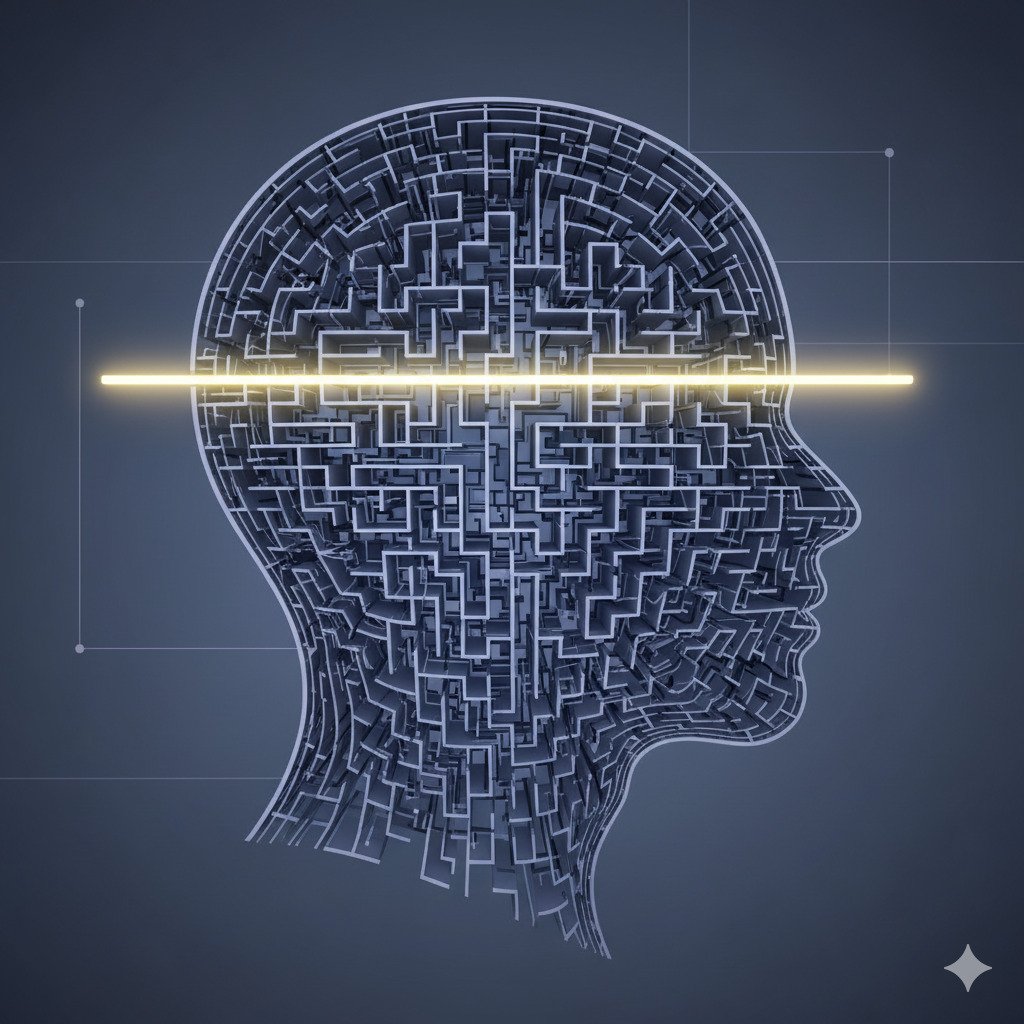
How many decisions do you think you make in a day? Hundreds? Thousands? From choosing what to wear to navigating traffic, our brains are constantly processing information. If we had to deeply analyze every single choice, we’d be mentally exhausted by breakfast! So, how do we manage? We use heuristics.
Heuristics are essentially mental shortcuts or “rules of thumb” that our brains use to make judgments and solve problems quickly and efficiently. They are the unsung heroes of our cognitive world, allowing us to operate without getting bogged down.
But these shortcuts, while incredibly useful, can sometimes lead us down the wrong path. Today at Sequentia, let’s explore these fascinating mental tools and see how they both help and hinder us, especially when solving puzzles.
Why We Need Heuristics: The Brain as an Efficiency Expert
Think of your brain as a CEO with a limited energy budget. It can’t afford to spend precious resources on every minor decision. Heuristics are its delegation strategy. Instead of a full-blown analysis, the brain applies a simple rule that is good enough most of the time. This saves an immense amount of time and mental energy.
Common Heuristics You Use Every Day
Let’s look at a few famous examples:
- The Availability Heuristic: We tend to overestimate the likelihood of events that are more easily recalled in our memory. For instance, after hearing extensive news coverage of a plane crash, people might feel that flying is more dangerous than driving, even though statistics show the opposite is true. The vivid memory of the crash is more “available” than the mundane data about car accidents.
- The Representativeness Heuristic: We often judge the likelihood of something by comparing it to a mental prototype or stereotype. Consider this classic puzzle: Is a quiet, shy person who loves to read more likely to be a librarian or a farmer? Many people jump to “librarian” because the description fits the stereotype, ignoring the fact that there are vastly more farmers than librarians in the world, making “farmer” statistically more probable.
- The Anchoring and Adjustment Heuristic: We tend to rely heavily on the first piece of information offered (the “anchor”) when making decisions. If a product is marked down from $200 to $100, the $200 acts as an anchor, making the $100 price seem like a fantastic deal, even if the product’s true value is only $80. We anchor to the first number and adjust from there.
Heuristics in Puzzle Solving: Friend and Foe
So, how does this apply to our favorite brain teasers?
- The Friend: Heuristics can be incredibly helpful. If you see a sequence like 1, 1, 2, 3, 5, ?, the representativeness heuristic screams “Fibonacci!” and you’re likely right. Your brain matched the pattern to a known prototype. This saves you from having to test every possible mathematical operation.
- The Foe: This is where puzzles get clever! A puzzle designer might create a sequence like 1, 1, 2, 3, 5, 9, ?. Your brain, anchored by the first five numbers, will be stuck trying to make Fibonacci work. The actual rule might be something entirely different (e.g., each number is the sum of the previous three numbers). Your heuristic, your mental shortcut, has become a cognitive trap.
The failure of a heuristic leads to what is known as a cognitive bias. By understanding these mental shortcuts, we can become more aware of our own thinking processes. When you’re stuck on a puzzle, ask yourself: “What is my first assumption? Am I anchored to a specific idea? Does this only look like a pattern I’ve seen before?”
Challenging your own heuristics is the key to breaking through a tough problem and achieving that satisfying “Aha!” moment. It’s the art of knowing when to trust your gut and when to take the scenic route of careful, deliberate logic.
Have you ever been completely tricked by a mental shortcut in a puzzle? Share your story in the comments!
