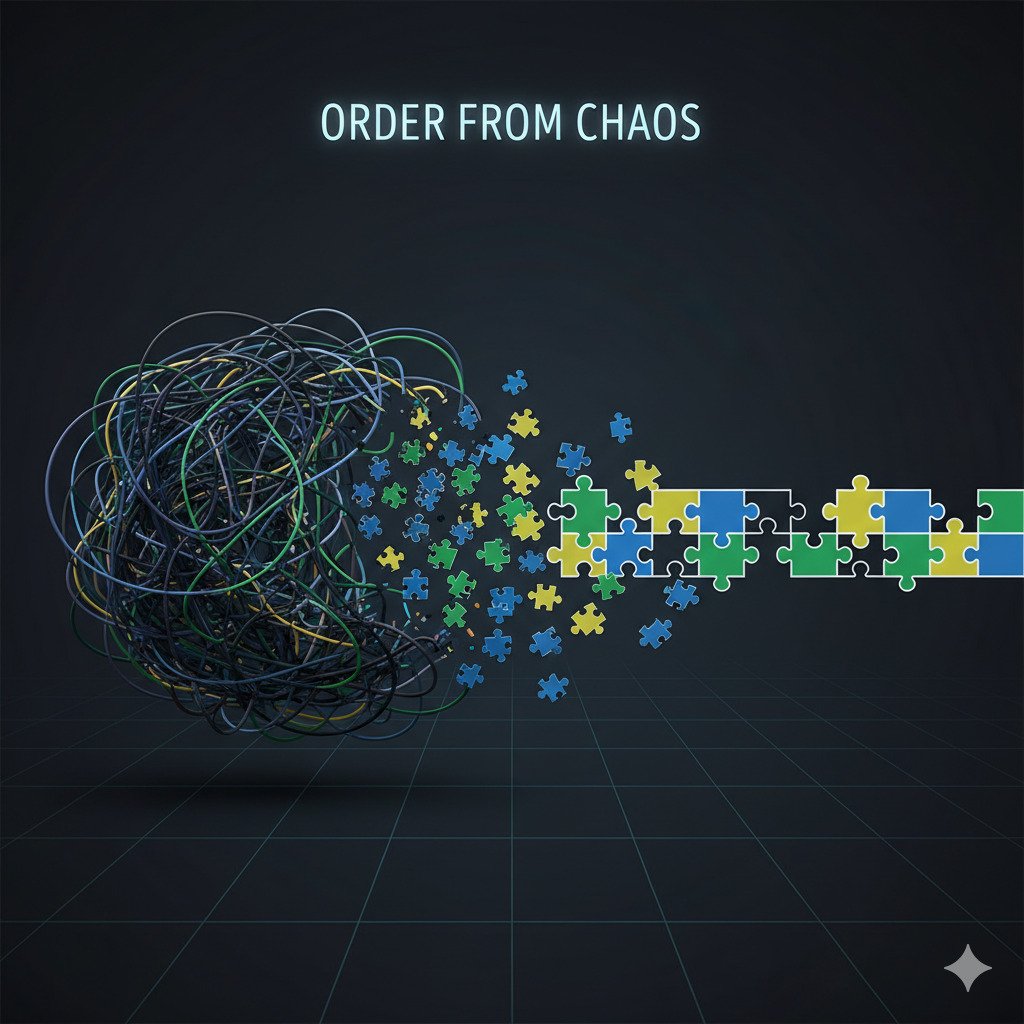
What do solving a tricky Sudoku, untangling a complex logic puzzle, and tackling a major project at work have in common? It might seem like a stretch, but they all rely on one fundamental, powerful skill: the ability to break down a large, intimidating problem into smaller, manageable parts.
This skill, often called “decomposition,” isn’t just a neat trick for puzzle enthusiasts. It’s one of the most critical cognitive tools we can develop, and puzzles are the perfect gym for strengthening this mental muscle.
Welcome back to Sequentia, where today we’re exploring the most valuable takeaway from our favorite hobby!
The Overwhelm of the Unsolved
Look at a brand new, empty logic grid or a complex number sequence. The initial feeling can be overwhelming. Where do you even begin? There are dozens of empty squares, countless possibilities, and no obvious starting point. Trying to solve the entire thing in one giant mental leap is impossible.
This is exactly how major real-world problems feel. Whether it’s planning a big event, learning a new software, or starting a business, the sheer scale of the task can lead to paralysis. Our brains aren’t wired to solve massive, undefined problems all at once.
The Puzzle-Solver’s Approach: Deconstruct and Conquer
So, what does a puzzle solver do? Instinctively, they start breaking it down.
- Isolate the Knowns: In a Sudoku, you don’t look at all 81 squares. You look for the one row, column, or 3×3 box that has the most numbers already filled in. You find your anchor point.
- Identify the Smallest Next Step: You ask, “What is the one thing I can solve right now?” Not the whole puzzle, just one square. “Given what I know, can I place the number 7 in this box?”
- Solve Incrementally: You solve that one small piece. This new piece of information (the ‘7’ you just placed) now becomes part of your “knowns,” slightly changing the landscape of the puzzle.
- Repeat the Process: You scan the puzzle again with this new information. What is the next smallest, solvable step? You repeat this loop—find a small problem, solve it, reassess, find the next small problem—until, piece by piece, the entire puzzle is complete.
This methodical deconstruction turns an overwhelming challenge into a series of simple, achievable wins. Each small victory provides a hit of dopamine and the momentum to tackle the next piece.
Applying This Skill Beyond the Puzzle Page
This exact same methodology is the secret to tackling complex tasks in our daily lives.
- Writing a research paper? Don’t think “write a 20-page paper.” Break it down: 1. Choose a topic. 2. Create an outline. 3. Research the first point. 4. Write the first paragraph. 5. Find supporting quotes…
- Cleaning a messy garage? Don’t think “clean the whole garage.” Break it down: 1. Clear out one corner. 2. Sort those items into “keep,” “donate,” and “trash” piles. 3. Put away the “keep” items. 4. Move to the next corner…
- Learning to code? Don’t think “learn Python.” Break it down: 1. Set up the environment. 2. Write a “Hello, World!” program. 3. Learn about variables. 4. Understand a for loop…
Every time you sit down with a puzzle, you are practicing this vital skill of deconstruction. You are training your brain to resist overwhelm, to search for a starting point, and to build a solution incrementally. The confidence and methodical approach you gain from solving puzzles directly translate into a more effective way of navigating the complexities of life.
So next time you feel stuck on a big challenge, channel your inner puzzle solver. Ignore the overwhelming whole, and simply ask yourself: “What’s the next small piece I can solve right now?”
What real-world problems have you solved by breaking them down? Let us know in the comments!
