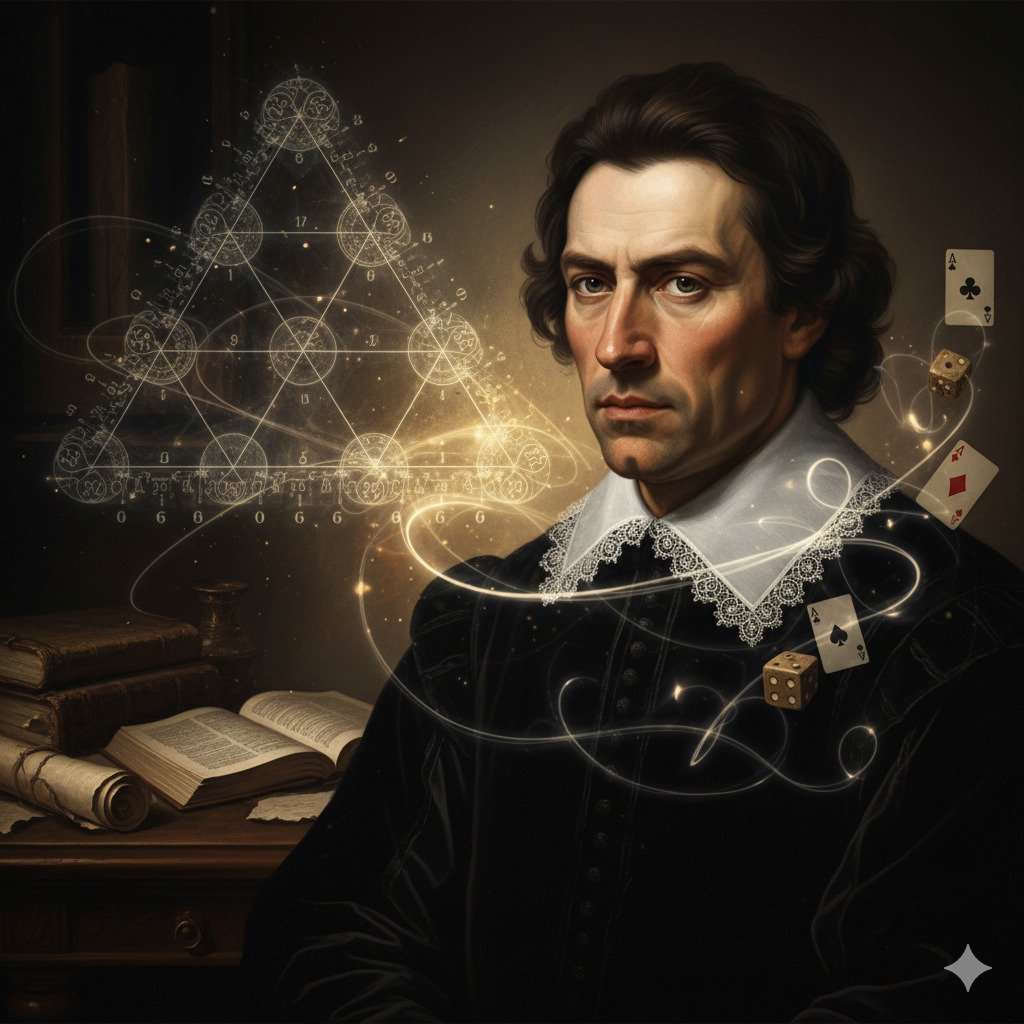
Some minds are so vast they can’t be contained by a single field. They see the world as a grand, interconnected puzzle, applying logic to everything from games of chance to the very nature of existence. One such mind belonged to the 17th-century French genius, Blaise Pascal.
Pascal was a mathematician, physicist, inventor, and philosopher whose work laid the foundation for concepts we use every day. Welcome back to Sequentia, where today we celebrate a polymath whose legacy is woven into a famous triangle, a revolutionary theory, and a profound philosophical wager.
The Elegance of Pascal’s Triangle
Even if you don’t know the name, you may have seen the beautiful pattern of Pascal’s Triangle. It’s an infinite triangular array of numbers constructed with a simple, elegant rule: each number is the sum of the two numbers directly above it. It starts with a single ‘1’ at the top.
11 11 2 11 3 3 11 4 6 4 11 5 10 10 5 1...and so on...
But this simple construction hides a universe of incredible patterns! The sums of the rows are powers of 2. The diagonals hold different number sequences, including—amazingly—the Fibonacci numbers we discussed in our last post! Most importantly, the triangle is a powerful tool in combinatorics for figuring out combinations, like the number of ways you can choose a committee of 2 people from a group of 5.
A Gambling Problem and the Birth of Probability Theory
Have you ever wondered if you could use math to predict the outcome of a coin flip or a roll of the dice? Pascal did, and in doing so, he co-founded modern probability theory.
The story goes that a nobleman asked Pascal for help solving a gambling problem: if a game of chance is interrupted before it’s finished, how should the prize money be divided fairly based on the players’ scores at that moment? This real-world puzzle prompted a series of letters between Pascal and another great mathematician, Pierre de Fermat. Together, they developed a systematic way to analyze uncertain events, proving that even chance follows mathematical laws. Every time we talk about the “odds” of something happening, we’re walking in Pascal’s footsteps.
The Philosopher’s Wager: A Logical Puzzle of Faith
Pascal’s brilliant mind wasn’t confined to numbers. He famously applied his logical and probabilistic thinking to one of humanity’s biggest questions: the existence of God. This resulted in what is now known as Pascal’s Wager.
He framed it not as a proof, but as a decision-theory problem—a logic puzzle. He argued that since reason cannot definitively prove or disprove God’s existence, a rational person should wager that God exists. Why?
- If you believe and God exists, you gain infinite reward (heaven).
- If you believe and God doesn’t exist, you lose very little (a life lived virtuously).
- If you don’t believe and God exists, you face infinite loss.
- If you don’t believe and God doesn’t exist, you gain very little.
From a purely logical standpoint of potential outcomes, Pascal argued the only rational “bet” was to live a life of faith. Whether you agree with the premise or not, it’s a fascinating example of a mathematical mind grappling with profound philosophical questions.
Blaise Pascal showed us that the same logical tools we use to solve a number sequence or a game of chance can be applied to the biggest questions we can ask. He was a true Sequentia spirit, always searching for the underlying pattern, the logical path, and the elegant solution.
