Sequentia Explores: The Mathematics of Crypto
Part VII: Advanced Concepts & The Frontier
Lecture 51: Lattice-Based Cryptography: A Leading Post-Quantum Candidate
In our last lecture, we faced the long-term threat of quantum computers, which could break our current public-key systems like RSA and ECC using Shor’s algorithm. We learned that the solution lies in Post-Quantum Cryptography (PQC)—a new generation of algorithms built on mathematical problems believed to be hard for both classical and quantum computers.
Today, we’re going to take a conceptual look at one of the front-runners in the race to secure our quantum future: Lattice-based cryptography. This family of algorithms is at the heart of several of the first standards selected by NIST and represents one of the most promising paths forward.
What is a Lattice? From Garden Fences to High Dimensions
When you hear the word “lattice,” you might picture a garden trellis or a fence with a regular, crisscrossing pattern. In mathematics, the concept is very similar, just extended into higher dimensions.
A lattice is a regular, repeating grid of points that extends infinitely in all directions. You can think of it as a coordinate system where you are only allowed to land on points with integer coordinates.
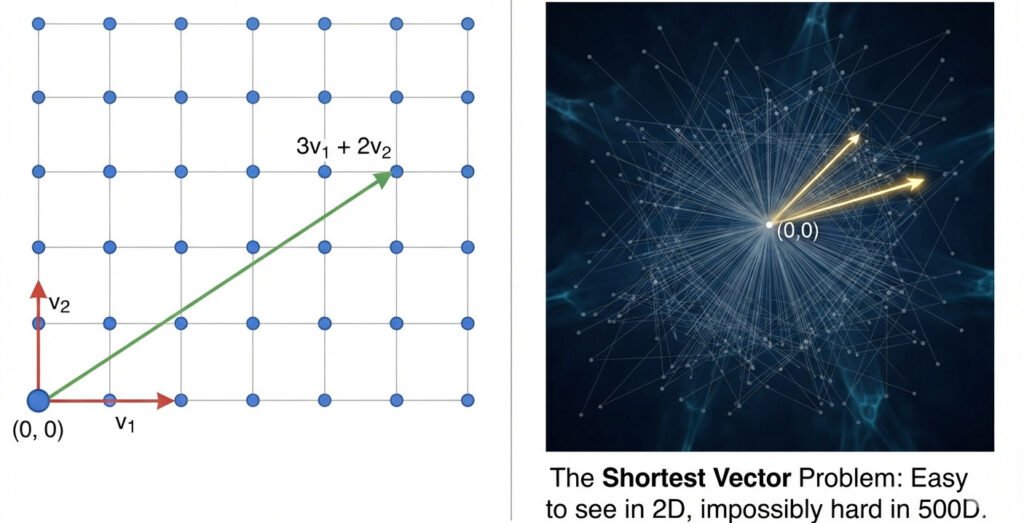
- In two dimensions, imagine a grid of dots on a piece of graph paper. You can describe any point on this lattice by starting at the origin (0,0) and adding together multiples of two basis vectors. For a simple square grid, the basis vectors might be v1 = (1, 0) and v2 = (0, 1). The point (3, 2) is simply 3*v1 + 2*v2.
- In three dimensions, it’s a crystal-like structure, like the corners of a vast set of stacked cubes.
- In cryptography, we work with lattices in hundreds or even thousands of dimensions. We can no longer visualize this, but the mathematical principles remain the same.
The beauty of a lattice is its perfect, regular structure. But it’s this very regularity that gives rise to some incredibly difficult mathematical problems.
The “Hard Problems” on a Lattice
The security of lattice-based cryptography is built on the presumed difficulty of solving certain problems within these high-dimensional grids. Unlike the “hard problems” of RSA and ECC, these lattice problems are not believed to be solvable by Shor’s algorithm.
Let’s look at one of the most famous examples: the Shortest Vector Problem (SVP).
The Shortest Vector Problem (SVP): Finding the Closest Point
- The Problem: Given a lattice, find the non-zero lattice point that is closest to the origin (0,0,0,…).
This sounds simple, and in two or three dimensions, you could likely find the shortest vector just by looking at the grid. But as the number of dimensions increases, the complexity of the lattice explodes.
Imagine a lattice in 500 dimensions. The grid is no longer a neat square pattern. The basis vectors that define it can be long, skewed, and point in all sorts of strange directions. The resulting grid of points is an incredibly complex, non-intuitive structure. Trying to find the “closest” point to the origin in this high-dimensional maze is like trying to find the single shortest twig in a gigantic, tangled beaver dam that spans a universe you can’t even see.
There is no known efficient algorithm (classical or quantum) to solve the SVP in high-dimensional lattices. This presumed difficulty provides the “one-way function” we need for cryptography.
Another related hard problem is the Closest Vector Problem (CVP), which asks to find the lattice point closest to a given point that is not on the lattice.
How Lattices Create a Cryptosystem (Conceptual)
So, how do we use this “hard problem” to build a system for encryption? Here is a very simplified, conceptual idea behind a lattice-based key exchange (like CRYSTALS-Kyber, one of the NIST standards).
- Public Lattice: Alice and Bob agree on a large, public lattice that is intentionally “messy” and complex.
- Alice’s Secret: Alice secretly chooses a very short, simple “vector” (a path) within this lattice. This is her private key. She then uses this secret vector to slightly “perturb” or “wobble” the public lattice in a specific way, creating a new set of points that looks random. This new set of points is her public key.
- Bob’s Encryption: Bob wants to send Alice a secret message. He uses her public key (the wobbly lattice) and adds a small amount of his own secret “noise.” He can do this in such a way that the resulting point ends up very close to one of the original, un-wobbled lattice points defined by Alice’s secret.
- Alice’s Decryption (The Trapdoor): For anyone else, the point Bob sent just looks like a random point in space. But Alice, because she knows her original secret short vector, has the “trapdoor.” She knows the secret structure of the lattice’s “wobble.” This allows her to easily “snap” the point Bob sent to the nearest true lattice point, which removes the noise and reveals the original message.
For an attacker, Eve, to break this, she would need to figure out Alice’s secret short vector. This is equivalent to solving the Shortest Vector Problem on the public lattice, which is computationally infeasible.
Why Lattices are a Leading Candidate
- Quantum Resistant: Believed to be secure against Shor’s algorithm.
- Versatile: They can be used to build a wide range of cryptographic tools, including public-key encryption, digital signatures, and even Fully Homomorphic Encryption.
- Efficiency: Many lattice-based schemes are relatively fast and efficient compared to other PQC candidates.
- Security Proofs: They often have strong security proofs that relate their security directly to the worst-case hardness of the underlying lattice problems.
Lattice-based cryptography is a fascinating and active area of research. By moving from the number theory of primes and curves to the geometric world of high-dimensional lattices, cryptographers are building a new and diverse set of mathematical fortresses designed to withstand the coming quantum age.
