Sequentia Explores: The Mathematics of Crypto
Part VII: Advanced Concepts & The Frontier
Lecture 50: Post-Quantum Cryptography: Preparing for the Quantum Threat
Throughout our entire journey into public-key cryptography, our confidence has been built upon a simple premise: the “hard problems” of integer factorization (for RSA) and the discrete logarithm (for Diffie-Hellman and ECC) are computationally infeasible for even the most powerful classical supercomputers. An attacker would need trillions of years to break them.
But what if a new kind of computer came along, one that doesn’t play by the classical rules?
This is the looming threat posed by quantum computers. Today, we’re going to explore why these futuristic machines represent an existential threat to our current cryptographic standards and what the world’s cryptographers are doing to prepare for a “post-quantum” world.
The Quantum Threat: Shor’s Algorithm
A classical computer, from your laptop to a supercomputer, works with bits that are either a 0 or a 1. A quantum computer, on the other hand, works with qubits. A qubit, thanks to the bizarre principles of quantum mechanics like superposition, can be a 0, a 1, or both at the same time. This, combined with another quantum phenomenon called entanglement, allows a quantum computer to explore a vast number of possibilities simultaneously.
For most problems, this doesn’t offer a significant speedup. But for a very specific set of mathematical problems, it’s a game-changer.
In 1994, a mathematician named Peter Shor developed a theoretical quantum algorithm, now known as Shor’s algorithm. This algorithm was designed to do one thing incredibly well: find the period of a function. It just so happens that this is mathematically related to the two “hard problems” that underpin all of our current public-key cryptography:
- Integer Factorization: Shor’s algorithm can be used to factor large numbers into their prime components exponentially faster than any known classical algorithm.
- The Discrete Logarithm Problem: Shor’s algorithm can also be used to solve the discrete logarithm problem (both the traditional and the elliptic curve versions) with similar efficiency.
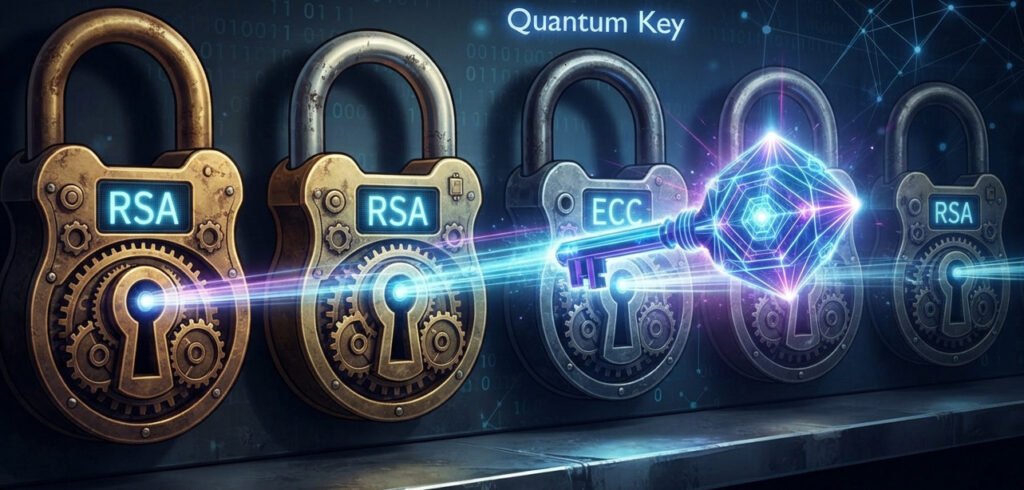
The Bottom Line: If a sufficiently large and stable quantum computer were to be built, it could theoretically break RSA and ECC encryption in a matter of hours or days, not trillions of years.
This would be a cryptographic apocalypse. The security of online banking, e-commerce, digital signatures, secure messaging, and cryptocurrencies—all of which rely on RSA or ECC—would crumble.
What is NOT Threatened?
It’s important to be precise about the threat. Shor’s algorithm is specifically tailored to the mathematical structures of RSA and ECC. It does not offer a significant speedup for breaking:
- Symmetric Cryptography (like AES): The best-known quantum attack against symmetric ciphers (Grover’s algorithm) does offer a speedup, but a less dramatic one. To counter it, we can simply double the key length. For example, AES-256 is considered secure against both classical and future quantum attacks.
- Cryptographic Hash Functions (like SHA-256): Hashing is also largely resistant to quantum attacks. The security is reduced, but not catastrophically broken in the same way as public-key crypto.
The primary, immediate threat is to asymmetric (public-key) cryptography, which is used for key exchange and digital signatures.
The Solution: Post-Quantum Cryptography (PQC)
The cryptographic community has been aware of this threat for decades and is actively working on the solution: a new generation of public-key algorithms collectively known as Post-Quantum Cryptography (PQC).
The goal of PQC is to develop new cryptographic systems that are secure against attacks from both classical and quantum computers. These new systems are not based on quantum physics themselves; they are classical algorithms that can run on our existing computers, but they are built upon different mathematical “hard problems” that are believed to be resistant to Shor’s algorithm and other quantum attacks.
Researchers are exploring several different families of mathematical problems for PQC:
- Lattice-based Cryptography: This approach is based on the difficulty of finding the shortest point in a high-dimensional grid of points (a “lattice”). It’s currently one of the most promising and well-studied areas.
- Code-based Cryptography: Based on the difficulty of decoding a message that has been scrambled with a general linear error-correcting code.
- Multivariate Cryptography: Based on the difficulty of solving systems of multivariate polynomial equations over a finite field.
- Hash-based Signatures: These systems build digital signatures using only the security of cryptographic hash functions, which are known to be largely quantum-resistant.
- Isogeny-based Cryptography: A more recent approach that uses complex maps between different elliptic curves.
The Race to Standardize
The U.S. National Institute of Standards and Technology (NIST) has been running a multi-year competition to solicit, evaluate, and standardize the first generation of PQC algorithms. In 2022, they announced the first set of winners, with CRYSTALS-Kyber (for key exchange) and CRYSTALS-Dilithium, FALCON, and SPHINCS+ (for digital signatures) being selected for standardization.
The transition will be long and complex. It will involve updating software, hardware, and protocols across the entire internet. But the work has begun, ensuring that by the time a cryptographically relevant quantum computer becomes a reality, we will have already upgraded our digital immune system to be resistant to it.
The quantum threat is real, but it is not a surprise. Thanks to the foresight of mathematicians and cryptographers, the tools are being built to ensure our digital world remains secure in the quantum era and beyond.
