Sequentia Explores: The Mathematics of Crypto
Part VII: Advanced Concepts & The Frontier
Lecture 49: Homomorphic Encryption: The Holy Grail of Computing on Encrypted Data
Throughout our entire series, we’ve operated under one fundamental assumption: to do anything useful with encrypted data, you must first decrypt it. If you want a cloud server to analyze your encrypted financial records, you have to provide it with the key, exposing your sensitive data to the server at the moment of computation. This creates a significant vulnerability.
But what if you didn’t have to? What if you could send your encrypted data to a server, have the server perform calculations directly on the encrypted data, and get an encrypted result back, all without the server ever learning a single thing about your original information?
This sounds like a cryptographic superpower, a logical impossibility. Yet, it is the goal of a revolutionary and powerful field of cryptography known as Homomorphic Encryption. It is often referred to as the “holy grail” of secure computation.
What is Homomorphic Encryption?
Homomorphic encryption is a form of encryption that allows a third party to perform specific types of computations on ciphertext and obtain an encrypted result which, when decrypted, matches the result of the same operations performed on the plaintext.
Let’s break that down with a simple analogy.
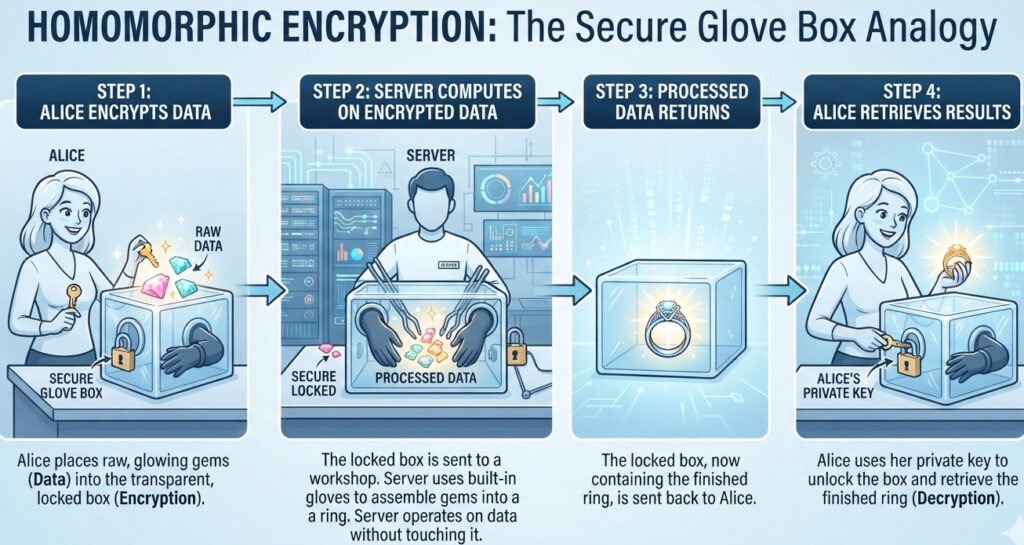
The “Glove Box” Analogy
Imagine you own a jewelry workshop, but you don’t have the tools to assemble your own jewelry. You hire a skilled artisan, Bob, to do the work for you, but you don’t fully trust him with your valuable, raw diamonds and gold.
So, you build a special, transparent glove box.
- Encryption: You place your raw materials (the plaintext) inside the glove box and lock it with a key that only you possess. This is your encrypted data.
- Delegated Computation: You send the locked box to Bob. Bob can’t open it. However, he can place his hands into the built-in, sealed gloves and work with the materials inside the box. He follows your instructions to assemble a ring, never once touching the raw materials directly.
- Encrypted Result: The result of his work is a finished, assembled ring, still securely locked inside the box. He sends the box back to you.
- Decryption: You use your private key to unlock the box and retrieve the finished ring (the decrypted result).
At no point did Bob, the worker (the server), ever have direct, unencrypted access to your valuable data. He performed the computation while the data remained completely protected. This is the promise of homomorphic encryption.
The Mathematics: Preserving Structure
The term “homomorphic” comes from algebra and means “structure-preserving.” A homomorphic encryption scheme is one where the mathematical structure of the plaintext is preserved in the ciphertext.
Let’s say Enc() is our encryption function.
A standard encryption scheme scrambles everything. Enc(2) + Enc(3) would just be a meaningless jumble of data.
With a homomorphic scheme, this is different. For example, a scheme that is homomorphic with respect to addition would have this property:
Enc(2) × Enc(3) = Enc(2 + 3) = Enc(5)
(Note: The operation on the encrypted data, here shown as ×, might be different from the plaintext operation +, but it is a well-defined operation.)
This means you can encrypt the numbers 2 and 3, send Enc(2) and Enc(3) to a server, ask the server to perform the special “homomorphic multiplication” on them, and it will get Enc(5). When you decrypt this result, you get 5, the correct sum, all without the server ever knowing the original numbers were 2 and 3.
Types of Homomorphic Encryption
Creating a scheme that works for all types of math has been a long and difficult road.
- Partially Homomorphic Encryption (PHE): These are schemes that work for one type of operation indefinitely.
- Additive Homomorphism: You can perform any number of additions on the ciphertext (e.g., the Paillier cryptosystem).
- Multiplicative Homomorphism: You can perform any number of multiplications on the ciphertext (e.g., standard RSA without padding).
- Somewhat Homomorphic Encryption (SHE): These schemes can perform both addition and multiplication, but only for a limited, pre-defined number of operations. Each operation adds “noise” to the ciphertext, and after too many operations, the noise becomes overwhelming and the data can no longer be decrypted correctly.
- Fully Homomorphic Encryption (FHE): This is the “holy grail.” An FHE scheme can handle an unlimited number of both additions and multiplications. The first plausible FHE scheme was developed by Craig Gentry in 2009. It involves a clever “recryption” or “bootstrapping” process that periodically “cleans the noise” from the ciphertext after each operation, allowing for computations of arbitrary depth.
Why is this the Future of Privacy?
The implications of practical Fully Homomorphic Encryption are staggering.
- Secure Cloud Computing: You could outsource sensitive computations (like medical data analysis, financial modeling, or machine learning model training) to powerful cloud servers with a mathematical guarantee that the cloud provider can learn absolutely nothing about your data.
- Private Database Queries: You could search a database without the database owner knowing what you searched for. You would send an encrypted query, the server would homomorphically scan its data, and return an encrypted result that only you can read.
- Enhanced Machine Learning: Train AI models on sensitive, encrypted datasets without ever decrypting them, preserving the privacy of the individuals in the dataset.
The Catch: The Price of Power
While FHE is a reality today, it is not yet widely deployed. The primary reason is performance.
The ciphertexts in FHE are much larger than the plaintexts, and the computations performed on them are thousands or even millions of times slower than the same operations on unencrypted data.
However, researchers are making incredible progress in developing more efficient schemes and hardware accelerators. As performance improves, homomorphic encryption is poised to move from a theoretical marvel to a practical, foundational technology for a more private and secure digital future. It represents the ultimate fulfillment of the cryptographic promise: the ability to use data without having to see it.
