Sequentia Explores: The Mathematics of Crypto
Part VI: Building a Blockchain – The Math of a Distributed Ledger
Lecture 44: The Math of Mining Difficulty Adjustment
In our exploration of the Bitcoin network, we’ve encountered two seemingly fixed numbers: a new block is found approximately every 10 minutes, and the block reward halves every 210,000 blocks (roughly every 4 years).
But a puzzle arises. The total computational power of the network (the hash rate) is constantly changing. In Bitcoin’s early days, a single laptop could mine blocks. Today, it’s a global industry with warehouses full of specialized hardware. If more and more miners join the network, shouldn’t they be solving the hash puzzle faster and faster, causing blocks to be found every minute, or even every second?
Conversely, if half the miners were to suddenly turn off their machines, shouldn’t the block time balloon to 20 minutes or more?
The fact that the block time remains remarkably stable, averaging around 10 minutes, is not an accident. It’s the result of an elegant, self-regulating feedback mechanism built directly into the Bitcoin protocol: the difficulty adjustment algorithm.
The Target: A 2-Week Check-up
The Bitcoin network is programmed to re-evaluate its mining difficulty every 2016 blocks.
Why 2016? Let’s do the math:
- Target time per block: 10 minutes
- Total minutes in 2 weeks: 14 days × 24 hours/day × 60 minutes/hour = 20,160 minutes
- Number of blocks in 2 weeks (at target time): 20,160 minutes / 10 minutes/block = 2016 blocks
So, every 2016 blocks (approximately every two weeks), every node on the network independently runs the same simple calculation to decide what the next difficulty should be.
The Difficulty Adjustment Formula
The calculation is straightforward. At the end of a 2016-block “difficulty epoch,” the node looks at how long it actually took to mine those blocks.
Actual Time = Timestamp of Block 2016 – Timestamp of Block 1
It then compares this Actual Time to the Expected Time (20,160 minutes).
The formula for the adjustment is:
New Difficulty = Old Difficulty × (Expected Time / Actual Time)
Let’s see how this plays out in two scenarios:
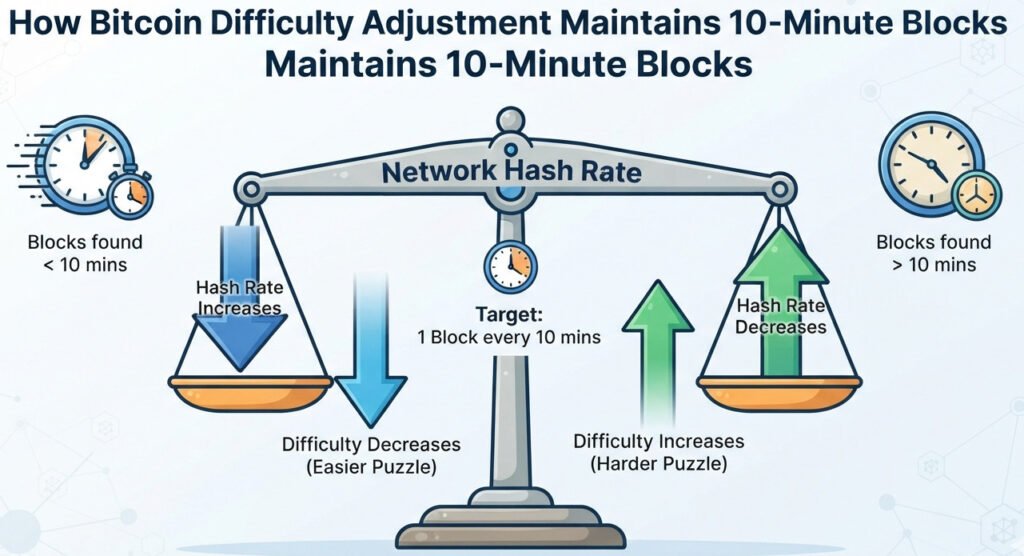
Scenario 1: Hash Rate Increases (Blocks are found too fast)
- Imagine a huge number of new, powerful miners join the network.
- They solve the hash puzzle much faster, and the 2016 blocks are found in, say, only 10,080 minutes (1 week instead of 2).
- At the end of the epoch, the network calculates:
Adjustment Factor = 20,160 / 10,080 = 2
New Difficulty = Old Difficulty × 2 - The difficulty doubles. This means the target hash that miners are looking for becomes a much smaller number, requiring (on average) twice as many leading zeroes. The puzzle is now twice as hard to solve, which will slow the rate of block discovery back down towards the 10-minute target for the next epoch.
Scenario 2: Hash Rate Decreases (Blocks are found too slow)
- Imagine a massive power outage forces 50% of miners to shut down.
- The remaining miners take much longer to find blocks. The 2016 blocks end up taking, say, 40,320 minutes (4 weeks instead of 2).
- At the end of the epoch, the network calculates:
Adjustment Factor = 20,160 / 40,320 = 0.5
New Difficulty = Old Difficulty × 0.5 - The difficulty is halved. The target hash becomes a larger number, requiring fewer leading zeroes. The puzzle is now twice as easy to solve, which will speed up the rate of block discovery, bringing it back towards the 10-minute target.
(Note: To prevent extreme volatility, the protocol caps the adjustment factor at a maximum of 4 and a minimum of 0.25 for any single epoch.)
The “Thermostat” of the Network
This simple, predictable algorithm acts like a thermostat for the entire Bitcoin ecosystem.
- It is completely decentralized. Every node runs the same calculation based on the public data in the blockchain. There is no central committee or authority deciding the difficulty.
- It is unbiased. The formula only cares about the time it took to find the last 2016 blocks. It doesn’t know or care about the price of Bitcoin, electricity costs, or global politics.
- It is self-correcting. It ensures that, over the long run, the block time remains consistent, regardless of Moore’s Law, booms and busts in mining operations, or the overall growth of the network’s hash rate.
This stability is crucial. It guarantees that the halving schedule—which is based on block count, not time—remains predictable (roughly every 4 years). It ensures a consistent and controlled issuance of new bitcoin into the system, which is the foundation of Bitcoin’s monetary policy.
The difficulty adjustment is a masterpiece of decentralized control theory. It’s a simple feedback loop that allows a global, chaotic system of competing miners to achieve a state of remarkable long-term equilibrium, ensuring the steady, rhythmic heartbeat of the blockchain.
