Sequentia Explores: The Mathematics of Crypto
Part VI: Building a Blockchain – The Math of a Distributed Ledger
Lecture 38: The Merkle Tree: Efficiently Hashing a Forest of Data
In our last lecture, we saw how the hash of the previous block is used to chain new blocks together, creating an immutable history. We mentioned that each block header contains a single hash that acts as a fingerprint for all the transactions within that block.
This raises a practical question: how do you efficiently create a single, reliable hash from potentially thousands of individual transactions?
One naive approach might be to concatenate all the transaction data together into one giant text file and then hash that file. This would work, but it’s incredibly inefficient. If you wanted to verify that a single transaction was included in the block, you would need to have all the other thousands of transactions on hand to reconstruct the giant file and re-calculate the final hash.
The creators of Bitcoin needed a more elegant and efficient solution. They found it in a data structure invented by Ralph Merkle in 1979: the Merkle Tree (also known as a hash tree).
What is a Merkle Tree?
A Merkle Tree is a mathematical structure that allows for the efficient and secure verification of the contents of a large set of data. It does this by repeatedly hashing data in pairs, building a tree-like structure that culminates in a single, final hash. This final hash is called the Merkle Root.
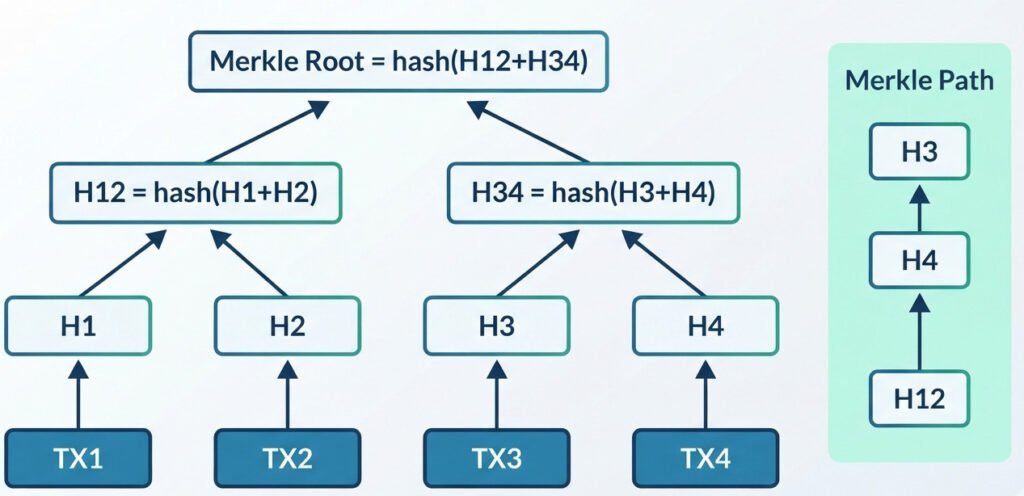
Let’s build a simple Merkle Tree from the bottom up. Imagine we have four transactions in our block: TX1, TX2, TX3, and TX4.
Step 1: Hash Each Individual Transaction (The “Leaves”)
First, we calculate the cryptographic hash (in Bitcoin, HASH256) of each individual transaction. These initial hashes form the “leaves” of our tree.
- H1 = hash(TX1)
- H2 = hash(TX2)
- H3 = hash(TX3)
- H4 = hash(TX4)
Step 2: Hash Pairs of Hashes (The “Branches”)
Next, we group the leaf hashes into pairs and hash each pair together.
- We concatenate H1 and H2, and then hash the result: H12 = hash(H1 + H2)
- We concatenate H3 and H4, and then hash the result: H34 = hash(H3 + H4)
These new hashes, H12 and H34, form the next level of the tree—the branches.
(Note: If there’s an odd number of hashes at any level, the last hash is simply duplicated and hashed with itself to create the next level.)
Step 3: Repeat Until a Single Root is Reached
We continue this process of pairing and hashing until we are left with only one hash.
- We now take our two branch hashes, H12 and H34, concatenate them, and hash the result:
Merkle Root = hash(H12 + H34)
This single, final hash—the Merkle Root—is the ultimate fingerprint for the entire set of transactions.
Why Merkle Trees are So Powerful
This tree structure provides two major benefits: data integrity and incredible efficiency.
1. Data Integrity:
The Merkle Root is dependent on every single bit of every single transaction in the set. If an attacker, Mallory, were to alter even a tiny part of TX3:
- Its hash, H3, would change completely.
- This would cause the branch hash H34 to change completely.
- This, in turn, would cause the final Merkle Root to change completely.
By placing just the compact Merkle Root into the block header, we create a secure fingerprint that guarantees the integrity of the entire set of thousands of transactions.
2. Efficiency of Verification (The “Light Client” Solution)
This is the true genius of the Merkle Tree. Imagine you are a “light client” (like a mobile wallet). You don’t have enough storage or bandwidth to download the entire multi-hundred-gigabyte blockchain. You just want to verify that your specific transaction, TX3, was included in a particular block.
Without a Merkle Tree, you’d need to download all the transactions in that block. But with a Merkle Tree, you only need a tiny fraction of the data.
To verify TX3, the network can provide you with:
- The hash of your transaction, H3.
- The “sibling” hash it was paired with: H4.
- The “uncle” hash from the next level up: H12.
With this small amount of information (called a Merkle proof or Merkle path), your wallet can perform the following calculations itself:
- It calculates H34 = hash(H3 + H4).
- It then calculates Root = hash(H12 + H34).
- Finally, it compares its calculated Root with the official Merkle Root published in that block’s header.
If the roots match, your wallet has mathematical proof that your transaction TX3 is part of the original, unaltered set of transactions in that block, all without ever needing to know or download TX1, TX2, or any of the other thousands of transactions.
This allows for secure and lightweight verification, a process known as Simple Payment Verification (SPV), which is essential for making blockchain technology usable on everyday devices.
The Merkle Tree is a perfect example of cryptographic elegance—a simple, recursive process that provides robust data integrity and a remarkably efficient method for verifying data in a massive dataset. It’s one of the crucial data structures that makes large-scale, decentralized systems like Bitcoin practical.
