Sequentia Explores: The Mathematics of Crypto
Part II: The Mathematician’s Toolkit
Lecture 16: Elliptic Curves: The Sinuous Shapes of Modern Security
In our journey so far, we’ve built a powerful toolkit based on familiar concepts: integers, primes, and clocks. We’ve seen how modular arithmetic creates a finite “universe” for our math, and how problems like prime factorization and discrete logarithms provide the one-way “trapdoors” needed for security.
Today, we’re going to introduce the foundation for the most efficient and powerful public-key cryptography in use today: Elliptic Curves.
When you first hear the term, you might picture an ellipse (an oval shape). Let me stop you right there—elliptic curves are not ellipses. The name is a historical quirk, coming from their relation to calculating the perimeters of ellipses. In reality, elliptic curves are strange, beautiful, and possess a mathematical structure so rich they provide a perfect “game board” for cryptographic operations.
This lecture is purely visual. We won’t be doing any heavy math yet. Our only goal is to build an intuition for what these curves look like and why they are so special.
The Equation of an Elliptic Curve
Most of the elliptic curves used in cryptography are defined by a deceptively simple-looking equation. Over the real numbers, it generally takes the form:
y^2 = x^3 + ax + b
Where a and b are just constant numbers that are chosen to give the curve specific properties. The graph of this equation on a standard (x, y) coordinate plane creates the characteristic shape of an elliptic curve.
What Do They Look Like?
Let’s look at a couple of examples.
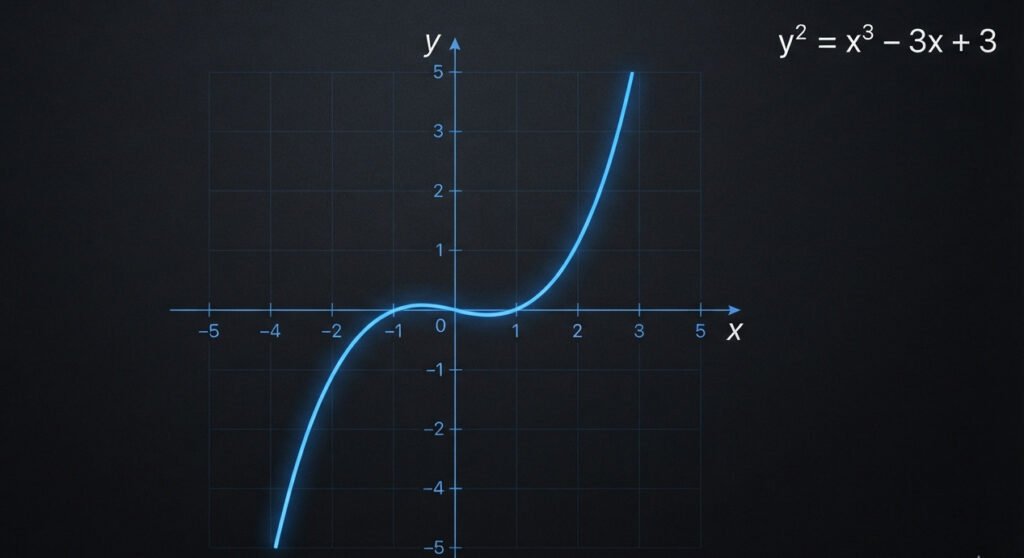
- Curve 1: y^2 = x^3 – 3x + 3
- This curve is a single, continuous line. Notice its unique symmetry: if a point (x, y) is on the curve, then the point (x, -y) is also on the curve. It’s perfectly symmetrical across the x-axis.
- Curve 2: y^2 = x^3 – 7x + 3
- This curve has two separate components: an enclosed oval on the right and an infinitely long curve on the left. It still maintains that perfect symmetry across the x-axis.
The specific values of a and b in the equation determine whether the curve is one connected piece or two. For cryptographic purposes, specific curves with well-understood properties are chosen.
The “Game Board” for Cryptography
So, what makes these sinuous shapes so special for cryptography? It’s not the curve itself, but a magical property that emerges when we start “playing a game” on it. The game is a special kind of addition, which we’ll call “point addition.”
The rule is simple:
If you draw a straight line through any two points on the curve, that line will intersect the curve at exactly one other point.
Let’s visualize this.
- Pick two points on the curve, let’s call them P and Q.
- Draw a straight line through P and Q.
- This line will hit a third point on the curve. Let’s call this intermediate point -R.
- Finally, reflect this point across the x-axis (due to the curve’s symmetry) to get our final point, R.
- In the world of elliptic curves, we define the “sum” of P and Q as this new point R. So, P + Q = R.
This “point addition” is our new operation. It’s the equivalent of modular addition or multiplication that we’ve seen before, but it’s happening on this strange, curvy game board.
What if we “add” a point to itself? (P + P)
If we want to calculate P + P (or 2P), we draw the tangent line to the curve at point P. This line will touch the curve at P and then intersect it at exactly one other point. We then reflect that point across the x-axis, and the result is 2P.
By repeatedly doing this, we can calculate 3P (as 2P + P), 4P (as 2P + 2P), and so on. This process of adding a point to itself n times is called point multiplication (nP).
The Connection to Cryptography: A New “Hard Problem”
Here is where it all comes together. The operations on an elliptic curve are just a visual representation of the mathematical structures we’ve already learned about. The set of points on an elliptic curve, along with this special “point addition” operation, forms a Group. This means it follows all our rules (closure, associativity, identity, and inverse) and is a predictable, reliable system.
And just like with modular exponentiation, it creates a powerful one-way function:
- Easy Task (Point Multiplication): Given a starting point P and an integer n, it is computationally easy to calculate the final point Q = nP by repeatedly applying the point addition rule.
- Hard Task (Elliptic Curve Discrete Logarithm Problem – ECDLP): Given the starting point P and the final point Q, it is computationally infeasible to find the original integer n.
This ECDLP is the elliptic curve version of the Discrete Logarithm Problem we discussed in the last lecture. The genius of elliptic curves is that this problem is believed to be much harder to solve than the traditional DLP for the same size numbers.
This means we can get the same level of security with much smaller numbers (and therefore smaller keys). A 256-bit elliptic curve key can provide a similar level of security to a 3072-bit RSA key. This incredible efficiency is why elliptic curves are now the standard for high-security applications, from securing mobile messaging apps to signing transactions on blockchains like Bitcoin and Ethereum.
For now, you don’t need to understand the deep math. Just hold on to this visual intuition: an elliptic curve is a special kind of “game board.” We have a set of points (our “numbers”) and a rule for “adding” them (our operation). This system is easy to play in the forward direction, but impossibly hard to reverse, providing the perfect foundation for modern, efficient cryptography.
In our next lecture, we’ll put this all together and see how these points on a curve are used in the Elliptic Curve Diffie-Hellman (ECDH) key exchange.
