Sequentia Explores: The Mathematics of Crypto
Part II: The Mathematician’s Toolkit
Lecture 10: What is a “Group”? A Gentle Introduction to Abstract Algebra
In our toolkit so far, we’ve gathered some powerful but seemingly separate concepts: modular arithmetic, prime numbers, and number systems like binary. Today, we’re going to introduce a high-level concept that acts as a unifying framework for many of these ideas. We are taking our first, gentle step into the world of abstract algebra by asking: what is a mathematical “Group”?
Don’t let the term “abstract algebra” intimidate you. At its core, it’s about studying the underlying structure and rules of mathematical systems. A “Group” is one of the most fundamental of these structures, and understanding it gives us a powerful language to describe why cryptographic operations behave so predictably and securely.
A Group: More Than Just a Collection
In everyday language, a “group” is just a collection of things. In mathematics, a Group is a much more specific and powerful concept. It consists of two things:
- A set of elements.
- A binary operation (like addition + or multiplication ×) that combines any two elements in the set.
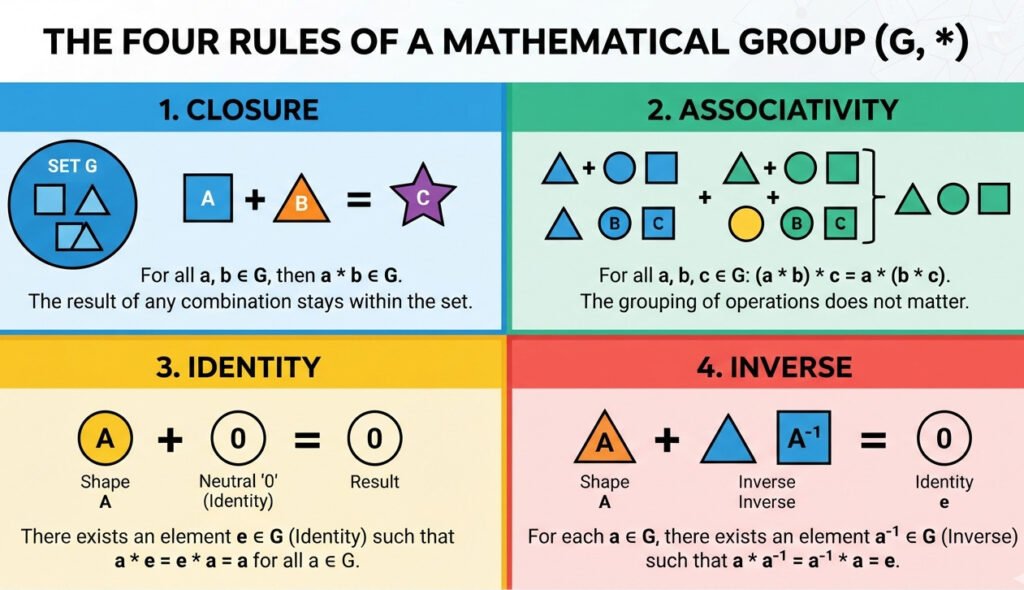
For this combination of a set and an operation to be officially called a Group, it must follow four simple, elegant rules. Let’s explore these rules using an example we’re already familiar with: the set of all integers (…, -3, -2, -1, 0, 1, 2, 3, …) with the operation of addition (+).
The Four Rules of a Group
Rule 1: Closure
- The Rule: If you take any two elements from the set and combine them with the operation, the result is also an element in the set.
- Our Example: If you add any two integers, is the result always an integer? Yes. 5 + (-3) = 2. 100 + 200 = 300. The set of integers is closed under addition. The operation never lets you “escape” the set.
- Why it Matters for Crypto: This rule guarantees predictability. If we’re working within a cryptographic system (like numbers mod n), we need to know that our operations will always produce a valid result within that same system, not some unexpected, out-of-bounds value.
Rule 2: Associativity
- The Rule: When you combine three or more elements, the order in which you group the operations doesn’t matter. (a + b) + c is the same as a + (b + c).
- Our Example: Is (2 + 3) + 4 the same as 2 + (3 + 4)?
- (5) + 4 = 9
- 2 + (7) = 9
- Yes, integer addition is associative.
- Why it Matters for Crypto: Associativity allows us to perform long chains of cryptographic operations without worrying about the order of evaluation. This is particularly important in processes like modular exponentiation, where we perform many multiplications in a row.
Rule 3: Identity Element
- The Rule: The set must contain a special “identity” element that, when combined with any other element, does nothing. It leaves the other element unchanged.
- Our Example: Is there an integer that, when you add it to any other integer a, the result is still a? Yes, the number 0.
- 7 + 0 = 7
- -5 + 0 = -5
- So, 0 is the identity element for the integers under addition.
- Why it Matters for Crypto: The identity element acts as a baseline or a starting point. In many cryptographic protocols, it represents a neutral, “un-transformed” state.
Rule 4: Inverse Element
- The Rule: For every element a in the set, there must exist an “inverse” element (let’s call it a^-1) in the set, such that when you combine a and a^-1, you get the identity element.
- Our Example: For any integer a, is there another integer we can add to it to get 0 (our identity element)? Yes, its negative counterpart.
- The inverse of 5 is -5, because 5 + (-5) = 0.
- The inverse of -3 is 3, because -3 + 3 = 0.
- Why it Matters for Crypto: This is perhaps the most critical rule for cryptography! The existence of an inverse is what makes decryption possible. If encryption is the act of combining our message with some element a, then decryption is the act of combining the result with the inverse of a to get back to the original message (our “identity” state). Without inverses, we could encrypt things but never get them back!
Another Example: Modular Arithmetic
Let’s test our new knowledge. Do the integers from 0 to 11 with the operation of addition mod 12 form a Group?
- Set: {0, 1, 2, 3, 4, 5, 6, 7, 8, 9, 10, 11}
- Operation: Addition mod 12
- Closure: If we add any two numbers in this set mod 12, will the result always be in the set? Yes, because the modulo operation always returns a number from 0 to 11. (8 + 5) mod 12 = 1. The set is closed.
- Associativity: Modular addition is associative. ((a+b) mod n + c) mod n is the same as (a + (b+c) mod n) mod n.
- Identity: Is there an identity element? Yes, 0. (7 + 0) mod 12 = 7.
- Inverse: Does every element have an inverse? Yes. The inverse of 3 is 9, because (3 + 9) mod 12 = 12 mod 12 = 0. The inverse of 1 is 11, because (1 + 11) mod 12 = 0. Every element has a unique partner that adds up to a multiple of 12.
So, yes! The integers under modular addition form a beautiful, finite Group. This predictable, rule-bound structure is exactly why modular arithmetic is so reliable for cryptography.
Why is This “Gentle Introduction” Important?
You don’t need to be an expert in abstract algebra to follow this series. However, understanding the concept of a Group gives you a formal language to appreciate the stability and predictability of the mathematical systems we use.
When cryptographers design new systems, they often build them upon mathematical structures that are proven to be Groups (or other related structures like Rings and Fields). This ensures that essential properties like the existence of inverses (allowing decryption) are guaranteed. It’s like building a skyscraper on a foundation of solid bedrock instead of sand.
From now on, when we look at a cryptographic system, we can ask: What is the set of elements? What is the operation? Do they form a Group? Answering these questions helps us understand the fundamental properties and guarantees of that system.
In our next lecture, we’ll dive into the Caesar Cipher, our first practical cryptosystem. As we do, you’ll clearly see the rules of a Group in action!
