Series: The Sequentia Lectures: Unlocking the Math of AI
Part 7: The Frontier – Open Problems & Research Directions
Lecture 64: The Mathematical Foundations of Deep Learning: Why Does it Really Work?
We have reached a fascinating point in our journey. We’ve explored the mathematical toolkits of linear algebra, calculus, and statistics. We’ve seen how they assemble into powerful architectures like CNNs, Transformers, and GANs. We’ve witnessed how optimization algorithms like Gradient Descent can train models with millions, or even billions, of parameters.
Deep learning works. Its empirical success is undeniable and has transformed our world. But this leads to one of the deepest, most humbling, and most exciting open questions in all of science: Why does it work so well?
Despite its incredible practical achievements, a complete, satisfying mathematical theory that fully explains the power of deep learning is still missing. We’ve built a revolutionary engine, but we don’t have the complete blueprints for why it’s so uniquely effective.
The Puzzles We Can’t Yet Solve
For decades, classical statistical learning theory suggested that models with a vast number of parameters (like modern deep networks) should be terrible at generalization. They should overfit catastrophically, memorizing their training data and failing on new examples. And yet, they don’t. They generalize incredibly well.
Here are some of the core theoretical puzzles that mathematicians and computer scientists are actively trying to solve:
1. The Puzzle of the Optimization Landscape:
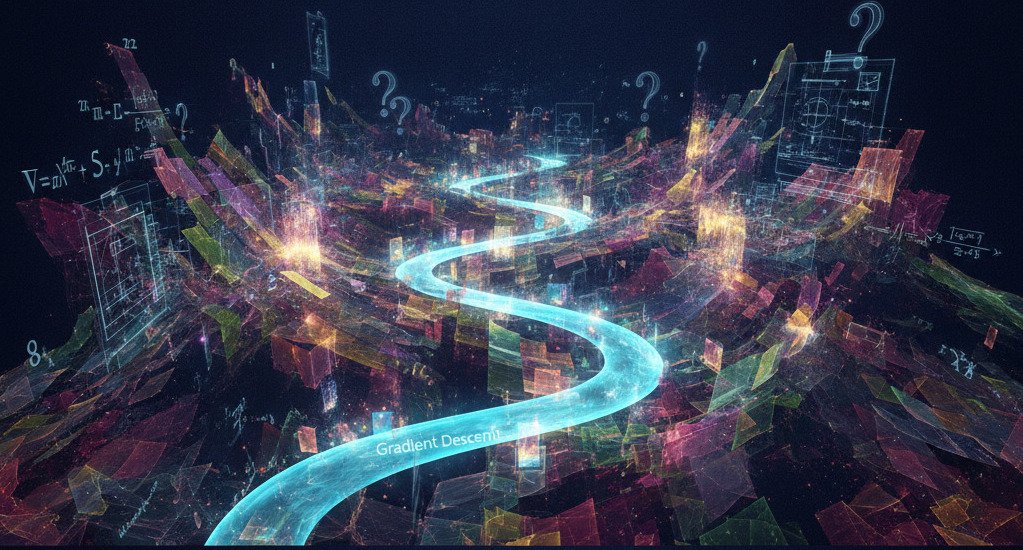
- The Problem: We’ve described training as finding the “global minimum” in a high-dimensional error landscape. A landscape with millions of dimensions should be unimaginably complex, filled with countless terrible local minima that should trap our Gradient Descent algorithm.
- The Mystery: Why does a simple algorithm like Stochastic Gradient Descent so consistently find solutions that are not just good, but often state-of-the-art? As we discussed in Lecture 24, it seems high-dimensional spaces are full of “saddle points” rather than traps, but a full explanation for why SGD navigates this terrain so effectively is still an area of active research.
2. The Puzzle of Generalization:
- The Problem: Classical theory links a model’s complexity (number of parameters) to its tendency to overfit. Modern models like GPT-3 have billions of parameters, sometimes more than the number of data points they are trained on! They should be the ultimate memorizers.
- The Mystery: Why do these massively “overparameterized” models generalize so well to new data? There’s a phenomenon called “double descent,” where performance first gets worse with increasing model size (as expected) but then, past a certain point, starts to get better again. The mathematical reasons for this are still being debated and explored.
3. The “Blessing” of Dimensionality:
- The Classical View: For a long time, high-dimensional data was seen as a “curse.” It’s sparse, computationally expensive, and hard to work with.
- The Modern View: In deep learning, high dimensionality often seems to be a “blessing.” It appears that in a very high-dimensional space, it’s easier to find a simple separating boundary (like an SVM’s hyperplane) between data clusters. The extra “room to maneuver” seems to make complex problems simpler, a deeply counter-intuitive idea that researchers are still trying to formalize.
The Quest for a Unified Theory
The search for the mathematical foundations of deep learning is a vibrant and exciting frontier. Researchers are drawing on tools from statistical physics, random matrix theory, information theory, and advanced geometry to try and build a solid theoretical framework.
- Why do certain architectures (like Transformers) work better than others?
- What is the true “geometry” of the data and the model that allows for such effective learning?
- Can we predict, before training, how well a certain model will perform?
Finding these answers is not just an academic exercise. A robust theory of deep learning would allow us to design new, more efficient, and more reliable architectures in a principled way, rather than relying on the current process of large-scale experimentation and intuition. It would help us understand the limits of our models and build AI that is not only powerful but also provably safe and robust.
So, as we stand in awe of the incredible capabilities of modern AI, it’s worth remembering that we are still in the early days of a great scientific adventure. We have discovered a new continent of possibilities, and now the mathematicians and theorists are hard at work drawing the maps to explain the strange and wonderful new world we’ve found.
